
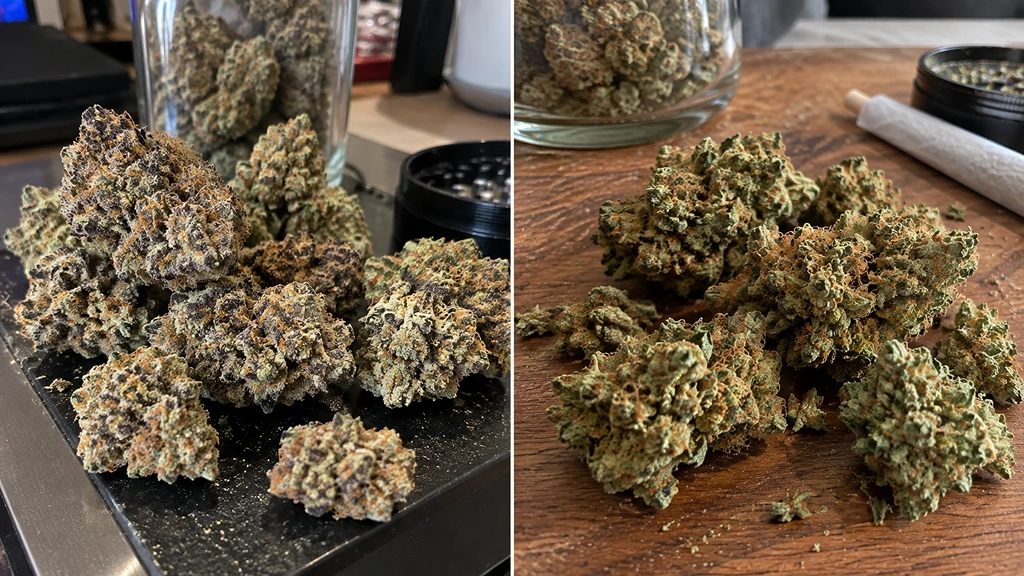
THCa vs. Delta-9 THC isn’t just a chemistry question. For wholesale buyers, it’s a compliance question.
THCa is the raw, non-intoxicating compound in fresh cannabis flower. Delta-9 THC is the psychoactive form that it becomes once heated. That one difference built the entire legal THCa flower market – and it’s the same difference putting that market at risk.
Federal rules are shifting toward a total THC standard in late 2026. Before you place another wholesale order, here’s what you need to know about THCa vs. Delta-9 THC potency and legality.
What Is THCa?
THCa (tetrahydrocannabinolic acid) is the non-psychoactive cannabinoid found naturally in raw, unheated cannabis flower. It won’t get anyone high on its own.
Why not? Its molecular structure doesn’t bind efficiently to the body’s CB1 receptors – the receptors responsible for the “high” feeling.
Quick facts about THCa:
These are the numbers every bulk buyer should know before treating THCa percentage as the full potency picture:
- Found in high concentrations in fresh-cured cannabis flower
- Often tests between 20% and 35% by weight
- This is usually the number marketed as “potency” on bulk flower listings
- Does not produce a high until it’s smoked, vaped, or otherwise heated
Understanding THCa is step one in any accurate THCa vs. Delta-9 THC comparison – and it shapes how a bulk flower listing like 5G Blue Dream should be labeled and priced.
What Is Delta-9 THC?
Delta-9 THC is the primary psychoactive cannabinoid in cannabis – the compound behind the traditional marijuana high.
Unlike THCa, Delta-9 THC binds directly to CB1 receptors in the brain. That’s exactly why regulators use it as the legal benchmark for separating federally compliant cannabis from marijuana.
Why Delta-9 THC matters legally:
Regulators built the entire legal classification system around this one compound:
- The 2018 Farm Bill sets the federal legal threshold at no more than 0.3% Delta-9 THC by dry weight for cannabis to remain federally compliant
- This is measured at the time of lab testing
- Raw THCa flower can test far below that 0.3% line – even with high THCa content
- That’s because THCa isn’t counted the same way under the older, Delta-9-only standard
For bulk buyers, this single number has historically decided whether a shipment – like a batch of Mole – counts as federally compliant cannabis or falls into a stricter regulatory category.
THCa vs. Delta-9 THC: Direct Comparison
Every wholesale decision comes back to one question: Does this batch behave like THCa on paper, or like Delta-9 THC in practice? The table below breaks down exactly where these two compounds line up and where they part ways.
Here’s a side-by-side look at how the two compounds actually differ:
| Factor | THCa | Delta-9 THC |
| Psychoactive? | No | Yes |
| Found in | Raw, unheated flower | Heated/decarboxylated flower |
| Typical flower content | 20%-35% | Near 0% before heating |
| Activation method | Requires heat (smoking, vaping, baking) | Already active |
| Federal legal threshold | Not directly capped (currently) | 0.3% by dry weight |
| Regulatory role | Historically overlooked in testing | The traditional compliance benchmark |
| Conversion factor | Multiply by 0.877 to estimate Delta-9 yield | N/A – already converted |
| Buyer risk | High THCa can mean high potential Delta-9 | Directly reflects the actual psychoactive strength |
The takeaway: THCa tells you potential, Delta-9 THC tells you actual effect. A wholesale buyer who only looks at THCa percentage is only seeing half the compliance picture.
Buyers researching Delta-8 vs. Delta-9 vs. THCa should keep the three straight: Delta-8 THC is a separate, milder cannabinoid, not a converted form of THCa, the way Delta-9 THC is. For a strain-level look at how potency claims hold up in practice, see our Snow Caps guide.
How Does THCa Convert Into Delta-9 THC?
THCa becomes Delta-9 THC through a process called decarboxylation – a reaction triggered by heat, prolonged light exposure, or extended storage time.
The conversion formula
Total possible Delta-9 THC yield = THCa % × 0.877
That 0.877 factor accounts for mass lost as carbon dioxide during the reaction.
What this means in practice:
In real-world terms, that conversion plays out like this:
- Smoking, vaping, or baking triggers near-instant conversion
- A flower testing 30% THCa converts to roughly 26% Delta-9 THC
- Raw THCa flower can also convert slowly during storage and transit – no direct heat needed
- Potency and compliance are not static from harvest to delivery
Because of this, climate-controlled storage, humidity control, and fast inventory turnover all directly protect the accuracy of the THCa percentage printed on a certificate of analysis (COA) – something we track closely on strains like Pink Slurpe.
Is THCa Legal for Bulk and Wholesale Buyers?
Right now, THCa flower is legal for interstate commerce under the 2018 Farm Bill – but that status is actively changing.
The old rule vs. the new rule
Here’s how the compliance goalposts are shifting:
- Old standard: Delta-9-only threshold (0.3% by dry weight)
- New standard: Total THC formula – Delta-9 THC + (THCa × 0.877)
- New cap: 0.3% by dry weight for raw flower, or 0.4 mg per container for finished products
- Enforcement date: Pushed back from November 12 to December 11, 2026
Several states have already adopted total THC testing or restricted THCa flower sales entirely, ahead of the federal deadline.
Bottom line for multi-state buyers: a batch that’s compliant today may not be compliant in every state by year’s end. Track both the federal timeline and each destination state’s rules before committing to large orders from our bulk flower category.
Why Does Potency Testing Matter for Bulk Buyers?
This is where THCa vs. Delta-9 THC stops being a marketing detail and becomes a real compliance issue.
A reliable COA should report three separate numbers:
Without all three, you’re not getting the full compliance picture:
- Delta-9 THC percentage
- THCa percentage
- Calculated total THC (the combined figure regulators increasingly rely on)
Buyers who look only at advertised THCa percentage risk buying a product that fails a total THC threshold in stricter states – even if it passed Delta-9-only testing at harvest.
What to confirm before finalizing a large order
Run through this short list with any supplier before you sign off on a shipment:
- The lab is accredited and independent
- The COA matches the exact batch being shipped, not an older report
- Total THC calculations match your destination state’s current limits
- Testing methodology is current, not outdated
This diligence protects your margins, your licensing standing, and your long-term supplier relationships, whether you’re ordering Gelato or any other strain in bulk.
How Do THCa and Delta-9 THC Affect Wholesale Pricing?
THCa percentage still drives most wholesale pricing today – it’s the number printed on flower listings and used to compare strains at scale.
But pricing built purely on THCa is getting risky, because:
The same THCa number can hide very different compliance exposure from batch to batch:
- Two products with identical THCa numbers can carry different Delta-9 THC readings
- Different Delta-9 readings mean different compliance risk
- THCa-heavy inventory may need repositioning once total THC enforcement begins
Smart bulk buyers are starting to price in a “compliance margin” – not just potency. That means factoring in testing costs, destination-state restrictions, and the real risk that current inventory could need repricing or repositioning.
Suppliers who share transparent, batch-level Delta-9 THC and total THC data – not just THCa percentage – give buyers a far more defensible basis for pricing decisions in a fast-changing wholesale market. See how this plays out in real numbers in our half-pound breakdown.
What Should Bulk Buyers Look for on a THCa Certificate of Analysis?
Use this as a working checklist before you sign off on any bulk order:
- Separate values for THCa, Delta-9 THC, and calculated total THC
- Testing date and batch/lot number clearly listed
- Accredited, independent lab – not an in-house test
- Full safety panel: residual solvents, pesticides, heavy metals, microbials
- Batch match – the COA matches the exact shipment, not an earlier harvest
THCa and Delta-9 THC levels shift between batches and over time. A fresh COA for every large or recurring order protects you from receiving flowers that have drifted out of compliance since it was first tested – a standard we apply to every batch of Duh Lemma we ship.
Which States Restrict THCa or Delta-9 THC Products?
State rules on THCa and Delta-9 THC vary widely – and change often. Federal legality alone isn’t enough to go on.
Here’s what the current patchwork looks like:
No two states treat THCa the same way, and the differences matter for anyone shipping across state lines:
- Some states have banned THCa flower outright
- Some restrict sales to licensed dispensaries only
- Some allow it, but only under total THC testing – a stricter rule than the current federal Delta-9-only standard
- A handful of states restrict THCa shipping and delivery entirely, regardless of potency
Because state rules move faster than federal law, multi-state distributors need a current view before every shipment – not a check performed months ago. A supplier who actively tracks these changes reduces your risk of shipping non-compliant product into a restricted market, whether you’re moving Butcher or another strain.
How Does THCa vs. Delta-9 THC Impact Shelf Life and Storage?
THCa is less stable than Delta-9 THC over time. It keeps converting slowly, even in storage – no smoking required.
What accelerates conversion:
Several everyday storage conditions speed this process up:
- Heat
- Light
- Humidity
- Oxygen exposure
A batch that tested compliant at harvest could carry a different THCa-to-Delta-9 THC ratio by the time it reaches a buyer months later, which matters if that shift pushes total THC over the legal limit.
How to protect potency and compliance:
A few simple storage practices go a long way toward keeping potency and compliance intact:
- Use climate-controlled, light-restricted storage
- Move inventory quickly – avoid long-term holding
- Consider vacuum-sealed or nitrogen-flushed packaging to slow conversion
- Keep testing dates recent
Curious what happens when storage goes wrong? Our Blueberry Muffin guide shows exactly how fast potency and aroma can slip.
What Happens to Non-Compliant THCa Inventory After December 2026?
Once the total THC standard takes effect on December 11, 2026, anything exceeding 0.3% total THC (raw flower) or 0.4 mg per container (finished goods) no longer qualifies as federally compliant cannabis.
Risks for buyers holding non-compliant inventory:
Buyers caught holding inventory that fails the new standard face real consequences:
- Reclassification risk
- Loss of resale value
- Exposure to state-level enforcement, depending on where the inventory is held or shipped
What to do now, not later:
Getting ahead of the deadline comes down to a few concrete steps:
- Audit current stock against the total THC formula
- Identify which batches are genuinely at risk
- Look for suppliers offering reformulated, lower-THCa genetics already tested against total THC limits
Acting before the deadline beats scrambling to offload non-compliant stock after the rules change, especially for high-volume strains like Berryjuana.
Why Buy Bulk THCa Flower From Passion Farms?
Passion Farms removes the guesswork from THCa vs. Delta-9 THC compliance. Cultivation, processing, and distribution all happen in-house across Texas, California, and Oklahoma.
What vertical integration gets you:
In practice, that means:
- No middlemen marking up prices or diluting accountability
- Every batch is lab-tested for THCa, Delta-9 THC, and total THC
- Real answers on potency and legality – not a generic spec sheet
- Flexible order sizes: quarter-pounds and half-pounds to full bulk-tier pricing
With state restrictions and federal total THC rules both tightening through 2026, a transparent, vertically integrated supplier isn’t a nice-to-have anymore. It’s the safer way to buy – see it for yourself with a strain like LCG V.
How Do I Get Wholesale Pricing, Samples, or a COA?
Getting started only takes a few steps:
- Submit a wholesale inquiry through the website, or contact the sales team directly by phone or email
- Get vetted – pricing tiers, MOQs, and product mix are matched to your actual business, not a one-size-fits-all deal
- Receive your catalog – full product list, current COAs, and sample options for your target market
- Ask about white-label – custom packaging and branding options are available for partners ready to build on top of an existing compliance infrastructure
Because the supply chain is controlled in-house, you also get faster answers on batch-specific THCa and Delta-9 THC data than you would from a broker or third-party grower – ask about current availability on Blueberry Muffin when you reach out.
Ready to Place a Bulk THCa Order With Passion Farms?
Total THC enforcement arrives December 11, 2026. Buyers who wait until the deadline to review their supply chain will have far fewer options than buyers who act now.
Passion Farms offers:
- Lab-tested batches with transparent THCa and Delta-9 THC data
- Flexible order sizes, from quarter-pounds to bulk pounds
- A vertically integrated supply chain across Texas, California, and Oklahoma
Whether you’re stocking a dispensary, supplying a distribution network, or launching a white-label line, the Passion Farms sales team can walk you through pricing, MOQs, and compliant shipping for your market.
Contact Passion Farms today to request current pricing, sample availability, and batch-specific COAs – and lock in a reliable, compliant bulk supply, starting with strains like KeyLime OG, before the rules tighten further.
The Bottom Line for Bulk Buyers
THCa vs. Delta-9 THC comes down to one core relationship: THCa is the raw, non-intoxicating precursor, and Delta-9 THC is the psychoactive compound it becomes under heat.
For bulk buyers, that distinction has driven pricing and legal classification for years. But the ground is shifting fast as regulators move toward total THC standards – and advertised THCa percentage alone no longer tells the full compliance story.
This is where a vertically integrated supplier like Passion Farms makes the difference. Controlling cultivation, processing, and distribution in-house across Texas, California, and Oklahoma means every batch ships with transparent, lab-tested THCa and Delta-9 THC data instead of recycled paperwork. Buyers working with Passion Farms get accurate potency figures and consistent, compliant bulk supply as enforcement tightens through 2026 and beyond.
Passion Farms is built to be that supplier – reach out today to lock in pricing and supply before the rules change.
Frequently Asked Questions
1. What is THCa vs. Delta-9?
THCa is the raw, non-intoxicating compound found in unheated cannabis, while Delta-9 THC is the psychoactive compound that THCa becomes once heated through smoking, vaping, or cooking. THCa dominates fresh flower’s potency numbers, but only Delta-9 THC produces a high. For bulk buyers, this difference determines both product effect and regulatory classification.
2. What is Delta-9 THC vs. THCa in terms of potency?
Delta-9 THC is the active compound that delivers psychoactive effects, while THCa is inactive until decarboxylated. A flower testing 30 percent THCa converts to roughly 26 percent Delta-9 THC after heating, since about 12 to 13 percent of the mass is lost as carbon dioxide during conversion.
3. What is Delta-9 THCa vs. THC from a lab-testing standpoint?
Lab reports separate THCa and Delta-9 THC into distinct line items, since they are chemically different compounds measured independently. A compliant certificate of analysis should also show calculated total THC, combining both figures, because that combined number increasingly determines federal compliance status under current and incoming regulations.
4. What is Delta-9 vs. THCa under federal cannabis law?
Federal cannabis law has historically capped Delta-9 THC at 0.3 percent by dry weight without limiting THCa separately, creating the so-called THCa loophole. New legislation shifts enforcement to a total THC standard, combining Delta-9 THC and THCa, with enforcement pushed to December 11, 2026.
5. THCa vs. Delta-9, which is stronger?
Delta-9 THC is the stronger compound in terms of psychoactive effect, since THCa produces no high in its raw form. However, THCa flower often carries a higher percentage on paper because it has not yet converted, which can make raw potency numbers misleading for wholesale buyers.
6. Is THCa legal for wholesale and bulk purchase?
THCa remains legal for interstate commerce under the 2018 Farm Bill for now, but that status is changing. A total THC standard takes effect December 11, 2026, and several states already restrict or ban THCa flower sales ahead of that federal deadline.
7. How is total THC calculated for bulk cannabis orders?
Total THC is calculated using the formula Delta-9 THC plus THCa multiplied by 0.877, accounting for mass lost as carbon dioxide during conversion. Regulators increasingly use this combined figure, rather than Delta-9 THC alone, to determine whether a shipment legally qualifies as federally compliant cannabis.
8. Does THCa show up as Delta-9 THC on a lab test?
No, standard testing reports THCa and Delta-9 THC as separate cannabinoids, since THCa has not yet been converted at the time of harvest testing. Only a calculated total THC figure, which combines both values, reflects the psychoactive potential a batch would reach after full decarboxylation.
9. Does storage affect THCa potency before it reaches buyers?
Yes, THCa slowly converts to Delta-9 THC over time from heat, light, and humidity exposure, even without smoking or vaping. Improperly stored bulk flower can shift its THCa-to-Delta-9 ratio before it reaches buyers, which is why climate-controlled storage and fast turnover matter for compliance.

