

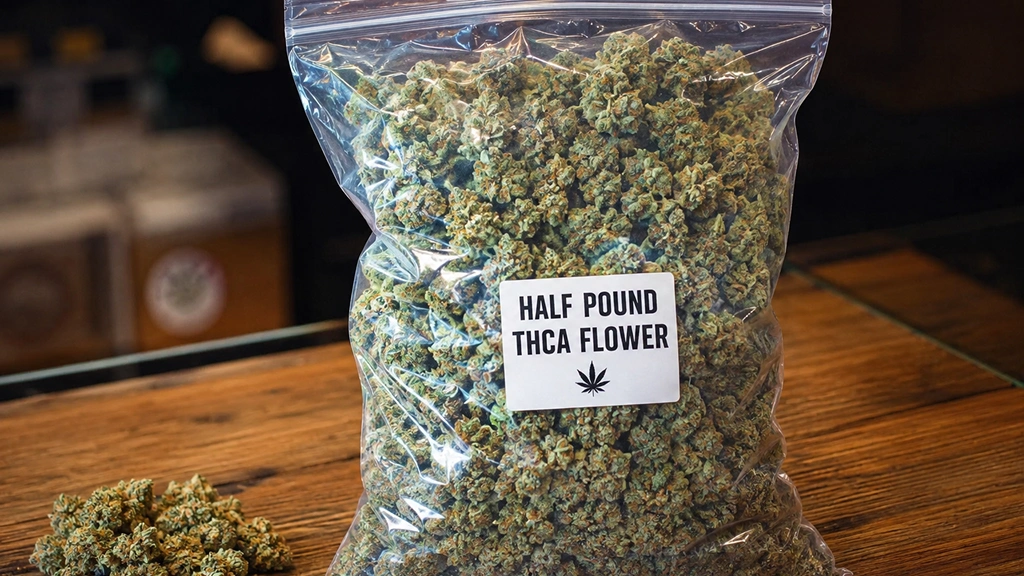
Same jar. Same grow. Same lab report. One buyer pays $62.50 an ounce and the other pays $46.88, and the only thing separating them is which line they clicked on the dropdown.
- Bulk Flowers
Illemonati THCa Flower
Price range: $300.00 through $9,000.00 Select options This product has multiple variants. The options may be chosen on the product page - Bulk Flowers
Tangie Candy THCa Flower
Price range: $275.00 through $8,500.00 Select options This product has multiple variants. The options may be chosen on the product page - Bulk Flowers
Schmega LCG THCa Flower
Price range: $300.00 through $9,250.00 Select options This product has multiple variants. The options may be chosen on the product page - Bulk Flowers
Blue Runtz THCA Flower
Price range: $400.00 through $12,000.00 Select options This product has multiple variants. The options may be chosen on the product page - Bulk Flowers
Blueberry Belts THCa Flower
Price range: $400.00 through $12,500.00 Select options This product has multiple variants. The options may be chosen on the product page - Bulk Flowers
MOB 342 THCa Flower
Price range: $375.00 through $11,500.00 Select options This product has multiple variants. The options may be chosen on the product page

That gap is what a pricing tier is. Nobody in this business explains it, everybody charges you for not knowing it, and the half pound sits right in the middle of it, which is why it’s the most misunderstood size on any bulk menu.
A half pound of THCA flower is eight ounces. It’s the step between the quarter pound and the full pound, and whether it’s the smart buy or the expensive middle depends entirely on math that takes about ninety seconds to run. Below is that math, using real prices off our own bulk shelf, plus the part that surprised us when we ran it: the cheaper the flower, the more the small buy costs you.
The Short Answer
A half pound is eight ounces, roughly 226 grams. On our shelf every bulk strain carries the same unit ladder: quarter pound, half pound, then 1 through 10 pounds. Above that, pound pricing itself splits into three published tiers, singles, multiples, and wholesale, and those three tiers are where most of your money is actually decided.
The half pound is the right buy in one specific situation: you’ve already tested a strain at the quarter pound, you know it moves, and you’re not ready to hold sixteen ounces of it. That’s it. That’s the job.
If you haven’t tested it, buy the quarter. If you know it sells and you’ll clear a pound inside a month, buy the pound and take the tier discount. The half is a bridge, and bridges are for crossing, not living on.
The Three-Price Ladder Nobody Explains
Look at any bulk listing on our site and you’ll see a pricing block with three numbers. Here’s what they actually mean, because no menu in this industry bothers to say.
Singles is what you pay for one pound. One strain, one pound, done. Pink Runtz sits at $850 there.
Multiples is what you pay per pound when you take several pounds of the same strain. Pink Runtz drops to $800.
Wholesale is the floor, the rate for real volume. Pink Runtz lands at $750.
Three tiers, $100 of spread per pound, and every one of them is printed on the listing before you buy anything. That transparency is deliberate. Most suppliers make you ask, which means the number you get depends on how you sound on the phone.
Now the part that matters for the half pound: those three tiers are all pound pricing. The QP and HP sit below the ladder entirely, priced as their own units. So when you buy a half pound you are not on the ladder yet. You’re paying for the convenience of not committing, and that convenience has a number attached.
What Every Tier Actually Costs Per Ounce
This is the table nobody publishes. Same strains, every tier, converted to a per-ounce number so you can compare them honestly. QP and 10-pound figures come straight off the live listings; the per-ounce column is just division.
| Strain | QP (per oz) | 1 lb singles | 1 lb multiples | 1 lb wholesale | 10 lb rate |
| Seeded Deps | $31.25 | n/a | n/a | n/a | $19.69 |
| Pink Runtz | $62.50 | $53.12 | $50.00 | $46.88 | $46.88 |
| Grease Monkey | $62.50 | $53.12 | $50.00 | $46.88 | $46.88 |
| Gumbo | $100.00 | $84.38 | $81.25 | $78.12 | $78.12 |
Two things worth noticing.
First, the wholesale rate and the 10-pound rate are identical on every strain. Pink Runtz at $750 wholesale works out to exactly the $7,500 you’d pay for ten pounds. That means the ladder tops out at wholesale and stays flat, so there’s no secret twelfth tier you’re missing by not asking. What’s printed is what exists.
Second, look at the spread from quarter pound to wholesale. Pink Runtz goes from $62.50 an ounce to $46.88, a 25 percent drop for the same flower out of the same room. That’s the number in the headline, and it’s the entire reason to understand where you sit on this ladder.
The half pound lands between the QP figure and the singles figure. Select the half-pound unit on any listing and the price shows up before checkout, which is the honest way to find it, because these numbers move as drops rotate and any figure I print here has a shelf life.
The Cheap-Strain Paradox
Here’s what surprised us when we ran the whole shelf, and it’s backwards from what most buyers assume.
The cheaper the flower, the more the small buy punishes you.
Run the percentages. Buying Gumbo by the quarter pound instead of at wholesale costs you about 22 percent extra per ounce. Pink Runtz, 25 percent. Seeded Deps, the value tier, costs 37 percent extra at the quarter compared to its bulk rate.
Most people expect the opposite. They figure the premium stuff carries the fat margins and the cheap stuff is already at the floor. But the fixed costs of breaking down, packing, and shipping a small unit don’t shrink just because the flower is cheaper, so on a $315 pound those fixed costs eat a much bigger slice than they do on a $1,250 pound.
The practical takeaway is specific. If you’re buying value flower, the tier you choose matters enormously, and getting to a pound or beyond is where the real savings live. If you’re buying top shelf, the penalty for staying small is real but modest, so paying 22 percent to avoid holding sixteen ounces of a $1,350 strain you haven’t proven is often the correct call.
Cheap flower rewards commitment. Expensive flower rewards caution. Nobody tells you that.
There’s a second-order effect worth catching too. Because the penalty is steepest at the bottom, the value tier is where the gap between a disciplined buyer and a casual one gets widest. Two people can run the same Seeded Deps all year, sell it at the same price, and end the year with noticeably different money purely on which rung they bought from. On a $1,350 strain that same discipline gap is worth a fraction as much. So if your business lives on volume flower, the tier ladder is not a detail you optimize later. It is the business.
When the Half Pound Is the Right Buy
Four situations where eight ounces is genuinely the correct answer, not the indecisive one.
You tested it at the QP and it moved. This is the main one. You bought four ounces, it sold through faster than you expected, and now you want more without jumping to a full pound of a strain you’ve known for three weeks. The half is exactly this step.
Your turnover is four to six weeks. Flower degrades whether or not it sells. If you’ll clear eight ounces inside about a month, the half pound keeps everything fresh through its whole life. If you’d take three months to move a pound, that pound’s last quarter smokes like a different product than its first, and you paid pound prices for it.
Cash flow is the constraint, not demand. Plenty of buyers can sell a pound and can’t float a pound. Two half pounds a month beats one pound every two months if the tighter cycle keeps you liquid, even though the per-ounce number is worse. Margin you can’t finance isn’t margin.
You want two proven strains instead of one. Two halves of strains you’ve already tested equals one pound of total weight, split across two things that both work. That’s a different move from the untested variety play, and it’s usually the right one once you know your shelf.
When to Skip It
Equal time, because the half pound is oversold as the safe middle and safe middles are where money goes quietly missing.
Skip it if you haven’t tested the strain.
Eight ounces of an unknown is just a smaller version of the same bad bet. Test at the quarter, where being wrong costs half as much. We wrote the case for that approach in detail, and it holds: prove it small first.
Skip it if you’ll clear a pound in a month.
You’re leaving the tier discount on the table for no reason. At Pink Runtz numbers that’s real money per ounce, every ounce, every reorder.
Skip it if you’re buying value flower for volume.
The 37 percent penalty on the cheap tier is brutal. If Seeded Deps is your workhorse and you move weight, get to the pound tier and stay there. That’s where that particular strain makes sense at all.
Skip it if storage is a problem.
Eight ounces held badly for two months is worse flower than four ounces held right for one. If you don’t have cool, dark, airtight space, buy smaller and buy more often. Our flower care guide covers what that setup actually looks like, and it’s cheaper than the flower you’d ruin without it.
Reading the Ladder on a Live Listing
Practical walkthrough, because the numbers are all there and most people never look.
Open any strain on the bulk shelf. You’ll see a price range at the top, something like $250 through $7,500. That range is not a mystery: the low number is the quarter pound and the high number is ten pounds. Everything else lives in the dropdown.
Under it sits the pricing block with singles, multiples, and wholesale. Those are your pound rates. Divide any of them by sixteen and you have a per-ounce number you can compare against anything else on the market, including the competitors selling “cheap pounds” without telling you what tier that price assumes.
Then select the unit you actually want. Quarter, half, or a pound count. The price updates before you add to cart, which is the only figure that’s guaranteed current.
One more listing detail worth using while you’re there: every bulk strain publishes a nose score and a grow tag. Pink Runtz and Grease Monkey both read Gassy (8/10) under the Cali Deps tag, and Gumbo reads Gas/Candy (9/10) under Licensed Cali Candies. That’s why Gumbo costs what it costs, and it’s how you predict pricing across the shelf without opening twenty tabs. If you’re weighing potency alongside price, the strongest-strain rundown covers that end of the menu.
Turnover Math: The Number That Beats Price
The tier ladder gets all the attention. Turnover quietly decides more of your outcome.
Run it honestly. Take what you actually sold last month, not what you hoped to. Divide the size you’re considering by that number and you get weeks of inventory. Eight ounces against two ounces a week is a month of stock, which is fine. Eight ounces against half an ounce a week is four months, which means the back half of that bag is going stale before it ever gets smoked.
Now price the loss. Flower that sits past its window doesn’t become worthless, it becomes discountable, and the discount you take at the end usually exceeds the tier savings you captured at the start. A buyer who saved 12 percent stepping up a tier and then marked down 30 percent on stale weight lost the trade.
This is why the half pound survives as a category despite worse per-ounce pricing than a pound. For a lot of operations, eight ounces is simply the largest amount that stays fresh through its whole life. That’s not a compromise, that’s matching the buy to the business.
The bulk buying guide goes deeper on the margin and storage side if you want the full model.
Smalls: The Other Way Down the Ladder
There’s a second lever besides quantity, and it gets ignored because it isn’t as obvious as a bigger bag.
Smalls are the smaller nugs off the same plants as the premium buds, same genetics, same lab numbers, lower price per gram. The trade is cosmetic. Once flower is ground for a joint or packed in a bowl, nug size is irrelevant to the experience, which is why smalls quietly became the smart tier for anybody rolling rather than displaying. The small buds guide has the full grading breakdown.
For tier strategy specifically, smalls let you buy a bigger unit at the same total spend. A half pound of smalls can cost less than a quarter of the same-tier premium, which means you get the better per-ounce rate and the freshness of a size you’ll actually clear. If your customers grind it, you’re paying for looks they never see.
Scaling Up Without Getting Stuck
The path most successful bulk buyers walk looks the same every time.
Start at the quarter, testing several strains. Move your proven winners to the half while you confirm they hold up over a longer sell cycle. Take the ones that survive both to the pound, where singles pricing kicks in. Then, once a strain is a genuine staple and your turnover supports it, buy multiples and drop to the multiples rate, and eventually wholesale.
The mistake is jumping tiers on enthusiasm. One great week does not prove a strain, it proves a week. The second mistake is never jumping at all, sitting at the quarter forever on strains you’ve sold out of four times, donating 25 percent per ounce to caution you no longer need.
Everything currently live is on the menu, and stock rotates hard, so a strain you’re scaling can disappear. That’s the real argument for moving up a tier on something proven: the shelf doesn’t wait.
Logistics, briefly. Orders leave from California, Oklahoma, or Texas, five states are excluded under their own rules, and the rest of the lower 48 arrives tracked and discreet. On the legal side, THCA flower sells under the federal hemp framework measured by delta 9 content, and Texas keeps arguing about it in court, which we track in the Texas situation. Hold weight, keep paperwork.
One habit worth building as you climb the ladder: log every buy. Strain, tier, price per ounce, date it landed, date it sold out. Four entries deep and you stop guessing about turnover, because you’re reading your own history instead of your optimism. Six entries deep and you’ll spot the strain you keep reordering at singles pricing that should have moved to multiples two orders ago. A notes app is fine. The buyers who scale cleanly are almost always the ones who wrote it down, and the ones who stall are usually running the whole operation on memory and vibes.
For Licensed Shops and Wholesale Accounts
Retail accounts, this section is yours alone. The half pound has a specific role in a licensed operation: it’s the size that answers whether a strain earns permanent case space. A quarter tells you if anybody bites. A half tells you if they come back, which is a different and more valuable question.
The tier ladder is also where your buying gets sloppy if nobody owns it. Shops routinely pay singles pricing on strains they reorder monthly, purely because nobody sat down and counted. Reordering the same strain four times a year at singles when multiples was available is a self-inflicted line item.
Our wholesale bulk buyer’s guide lays out how licensed accounts get structured, what rides along with case orders, and where the tier breaks land as volume climbs. To map your actual reorder pattern against the right tier, reach us through the contact page and a real person will run it with you.
Half Pound Questions, Answered Straight
The ones that come in. More on the FAQ page.
How many ounces are in a half pound?
Eight ounces, about 226 grams. Double a quarter pound, half of a full pound.
How much does a half pound of THCA flower cost?
It depends on the strain’s tier, and the live listing is the only current answer. For scale, quarter pounds on our shelf run $125 to $400 and pounds run from around $315 up to $1,350 depending on the grow tier, with the half sitting between the two on a per-ounce basis.
Is a half pound cheaper per ounce than a quarter pound?
Yes. Every step up the size ladder lowers your per-ounce cost. The question is never whether it’s cheaper, it’s whether you’ll clear it while it’s still fresh.
What’s the difference between singles, multiples, and wholesale?
They’re the three pound-pricing tiers on every listing. Singles is one pound, multiples is several pounds of the same strain, wholesale is the volume floor. On Pink Runtz that’s $850, $800, and $750 respectively.
Does the price keep dropping above ten pounds?
No. The wholesale rate is the floor and it holds. Ten pounds of Pink Runtz at $7,500 works out to exactly the $750 wholesale rate, so the ladder flattens rather than continuing down.
Why is the small-size penalty bigger on cheap flower?
Because breaking down, packing, and shipping a small unit costs about the same regardless of what’s inside it. Those fixed costs are a much larger share of a $315 pound than a $1,250 pound. Value strains punish small buys hardest, around 37 percent versus about 22 percent on top shelf.
Should I buy one pound or two half pounds?
If it’s one proven strain you’ll clear in a month, buy the pound and take the tier price. If it’s two proven strains, or if a pound would sit past six weeks, two halves is the better trade even at the worse rate.
How long will a half pound stay fresh?
Stored properly in airtight glass, cool and dark, you have a comfortable couple of months before quality noticeably slides. Stored in a warm room or a plastic bag, that window shrinks fast.
Do half pounds come with lab results?
Yes. Every bulk order ships with a COA covering cannabinoid content and the safety panel, regardless of size.
Can I mix strains to reach a half pound?
No. Each unit is priced per strain, so a half pound is eight ounces of one strain. If you want multiple strains, you’re buying multiple units, each at its own listed price.
What’s a smalls half pound?
Eight ounces of the smaller nugs off the same plants as the premium buds. Same genetics and lab numbers, lower price, less photogenic. For grinding and rolling there’s no practical difference.
Where do you ship bulk orders?
Five states are off the list under their own guidelines on THCA products: Arkansas, Idaho, Minnesota, Oregon, and Rhode Island. The rest of the lower 48 is fair game, shipped tracked and discreet out of our three operations.
Do the Division
The dropdown looks like a convenience menu. It’s a pricing instrument, and most buyers use it without ever running the one calculation that tells them what they’re paying.
So run it. Take the tier price, divide by sixteen for pounds or four for a quarter, and put every option on the same per-ounce footing. Then check that number against how fast you actually move product, because the cheapest ounce you can’t sell before it goes flat isn’t cheap.
A half pound of THCA flower earns its place when you’ve proven the strain and a pound would outlive its freshness. Outside those two conditions, the ladder has a better rung for you in one direction or the other. Now you can tell which.
