
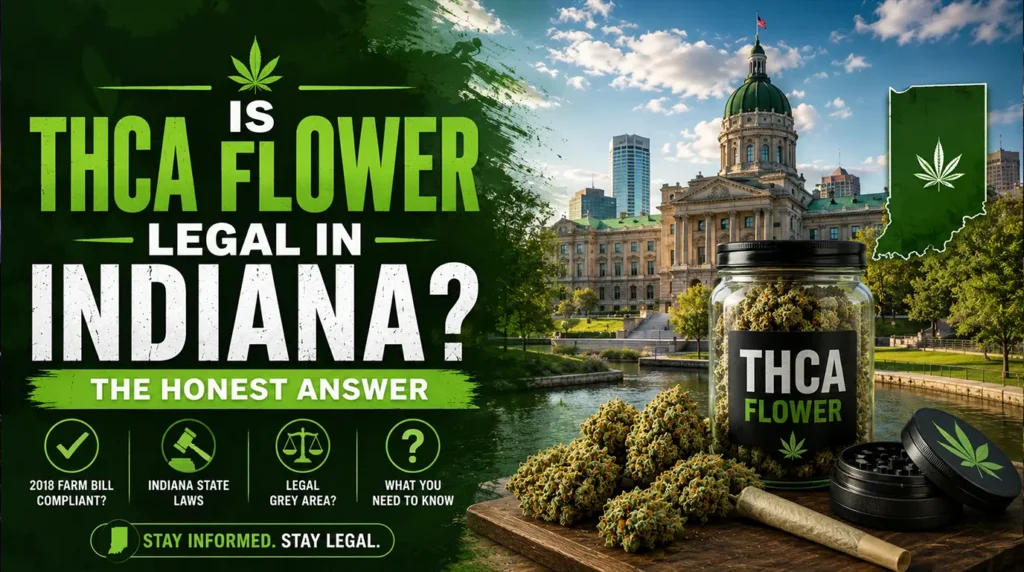
Federal law (the 2018 Farm Bill) treats hemp-derived THCA flower as legal hemp when the source material tests under 0.3% Delta-9 THC by dry weight at harvest. This federal protection applies to interstate shipping and commerce in hemp products.
Indiana state law has a state hemp program. Indiana Code 15-15-13 defines hemp consistent with the federal definition. So far the federal and state positions align.
The complication is in interpretation. The Indiana Prosecuting Attorneys Council (IPAC) has issued guidance suggesting that the relevant threshold for “hemp” status should be Total THC (calculated as THCA × 0.877 + Delta-9 THC) rather than the federal Delta-9-only measurement. Under the Total THC interpretation, a 25% THCA flower calculates to approximately 22% Total THC, which is far above the 0.3% threshold. Indiana courts have not produced a controlling decision settling the question.
Practical reality on the ground: some Indiana retailers operate openly with THCA flower products. Some have been targeted by enforcement actions. Consumers face an uncertain enforcement landscape where the answer depends on county, prosecutor, and the specific facts.
We can’t say “THCA flower is legal in Indiana.” We can’t say “THCA flower is illegal in Indiana.” Both overstatements would misrepresent the legal record.
What we can say honestly: federal law allows it. Indiana state interpretation is contested. Buyers and businesses face real risk that varies by location and circumstance. Recommended path: due diligence, documentation, and for any commercial activity, consultation with Indiana-licensed legal counsel.
Indiana’s Hemp Statute and the Marijuana Statute
Two statutes interact to create the legal question.
Indiana Code 15-15-13 (Industrial Hemp Act)
Indiana’s Industrial Hemp Act, codified at Indiana Code 15-15-13, was enacted to align Indiana with the federal 2018 Farm Bill. The statute establishes:
- A state hemp program administered by the Indiana State Department of Agriculture
- A licensing scheme for hemp cultivators
- A definition of hemp that mirrors the federal Farm Bill (Cannabis sativa with under 0.3% Delta-9 THC on a dry weight basis)
- Provisions for hemp processing and sale
Under this statute, hemp-derived products that meet the federal definition are legal in Indiana.
Indiana Code 35-48 (Controlled Substances)
Indiana Code 35-48 defines controlled substances under Indiana law. Marijuana is listed as a Schedule I controlled substance. The statute defines marijuana broadly to include “any part of the plant” Cannabis sativa, with exceptions for stalks, fiber, and other industrial-hemp components.
The statute doesn’t explicitly differentiate hemp-derived THCA flower from marijuana-derived flower beyond the federal Farm Bill hemp exception. This is where the interpretation question arises.
How the Two Statutes Interact (And Where They Conflict)
Take 15-15-13 as written: hemp under 0.3% Delta-9 at harvest is legal, and a THCA flower meeting that harvest-time test is hemp.
Take 35-48 broadly and apply the IPAC’s Total THC interpretation: any flower with significant THCA exceeds the 0.3% Total THC threshold once decarboxylation is considered, and the flower could be classified as marijuana under the controlled substances statute.
This interpretive gap is the heart of the Indiana legal question. Federal preemption arguments support the hemp interpretation. State-law sovereignty arguments support the IPAC interpretation. Indiana courts have not definitively resolved the conflict.
The “Total THC” Interpretation Question
The math determines the interpretation outcome.
The Federal Delta-9-Only Interpretation
The 2018 Farm Bill text uses Delta-9 THC at harvest as the threshold test. The USDA Final Rule on Hemp Production codifies this interpretation. Under the federal frame, a flower at 25% THCA and 0.21% Delta-9 THC tests at 0.21% Delta-9, which is below 0.3%. That flower is hemp.
The DEA has not formally adopted a Total THC interpretation at the federal level. Most federal-level enforcement on hemp products focuses on the Delta-9 measurement.
The Indiana Total-THC Interpretation
The Indiana Prosecuting Attorneys Council has, in published guidance and in coordination communications with Indiana law enforcement, articulated a position that the relevant threshold for “hemp” determination should be the calculated Total THC after decarboxylation.
The math: Total THC = (THCA × 0.877) + Delta-9 THC. For a 25% THCA flower with 0.21% Delta-9, that’s (25 × 0.877) + 0.21 = 21.93% Total THC. Far above the 0.3% threshold.
We cover this math in detail in our Total THC Formula piece, including the 0.877 multiplier’s derivation from molecular weight.
Under the IPAC interpretation, virtually all THCA flower sold in the hemp market would test above the 0.3% threshold and would be classified as marijuana under Indiana state law.
Why Reasonable Legal Minds Disagree
Both interpretations have legal support.
The Delta-9-only interpretation rests on:
- The plain text of the 2018 Farm Bill
- USDA Final Rule guidance
- The fact that the harvest-time measurement is explicitly Delta-9 THC
The Total THC interpretation rests on:
- A reading of the underlying intent of the threshold (to control “psychoactive cannabis”)
- State sovereignty over controlled-substance classification
- The argument that THCA’s eventual decarboxylation to Delta-9 makes the harvest-time test incomplete
Federal versus state law usually resolves through federal preemption (federal law wins) when there’s a direct conflict. Whether the Indiana interpretation is a direct conflict with the Farm Bill or an exercise of state-law sovereignty over controlled substances is itself a legal question. Indiana courts have not produced a controlling opinion.
Federal vs Indiana Legal Interpretation Table
| Aspect | Federal (2018 Farm Bill) | Indiana State (IPAC Interpretation) |
| Definition test | 0.3% Delta-9 THC at harvest | 0.3% Total THC (THCA × 0.877 + Delta-9) per IPAC guidance |
| 25% THCA flower under federal rule | Legal hemp | N/A (federal allows) |
| 25% THCA flower under IPAC interpretation | N/A (state question) | ~22% Total THC, exceeds threshold |
| Interstate shipping | Federally protected | State enforcement on receipt variable |
| Enforcement authority | DEA (limited under Farm Bill) | Indiana State Police, county prosecutors |
Delta-8, Delta-9, HHC, and Other Cannabinoids in Indiana
Related cannabinoids face their own state-level questions.
Delta-8 THC. Delta-8 is a hemp-derived cannabinoid typically produced through chemical conversion from CBD. Indiana has considered specific legislation addressing Delta-8 in multiple sessions. As of May 2026, Delta-8 occupies a similar contested zone to THCA flower. Verify current Delta-8 status with Indiana legal counsel before any commercial decision.
Delta-9 THC. Marijuana-derived Delta-9 (the cannabinoid in dispensary-grade marijuana) is plainly illegal at the Indiana state level for recreational use. Indiana doesn’t have a medical marijuana program (one of the few remaining states without one). Hemp-derived products containing under 0.3% Delta-9 THC are the only legal Delta-9 pathway in Indiana.
HHC (hexahydrocannabinol). HHC is produced by hydrogenating CBD or THC. Legal status in Indiana follows a similar contested pattern to Delta-8 and THCA flower. State-level interpretation rules apply.
Each cannabinoid faces its own state legislative attention. Indiana legislative sessions have considered separate bills addressing Delta-8, THCA, and broader hemp cannabinoid regulation. The legal landscape continues to shift.
Documented Indiana Enforcement Patterns
What’s been publicly documented in Indiana enforcement.
Indiana State Excise Police and Indiana State Police have engaged in enforcement actions against retailers selling high-THCA hemp products in some Indiana counties. Indianapolis Star and IndyStar have reported on multiple enforcement actions across the state. WRTV and other Indiana media outlets have covered similar matters.
Enforcement varies by county and prosecutor’s office. In some Indianapolis-area counties, retailers have operated openly. In other counties, enforcement has been more aggressive. County-level discretion under Indiana’s prosecutor structure produces this variance.
Indiana Counties Enforcement Variance (Generalized)
| Region | Enforcement Pattern (Generalized) | Notes |
| Metro Indianapolis (Marion County) | Variable; some enforcement reported | Multiple retailers operate; some actions documented |
| Smaller cities (Fort Wayne, South Bend, Evansville) | Variable; depends on prosecutor | County-level discretion significant |
| Rural counties | Variable; less documented activity | Lower retail density |
This table represents generalized published patterns. Specific enforcement realities change month-to-month and county-to-county. Verify the current state before relying on this table.
We don’t name specific persons, specific retailers in ongoing matters, or specific enforcement events here. The goal is awareness of the pattern, not commentary on any individual case.
What This Means for Indiana Buyers (Due Diligence)
Practical consumer and business guidance for navigating the Indiana legal landscape.
For Personal Use (Consumer Due Diligence)
You an Indiana resident considering personal-use THCA flower purchase? The framework:
- Buy only from reputable brands with published COAs. Federal Farm Bill compliance starts with COA documentation showing under 0.3% Delta-9 THC at harvest. Brand can’t show you the COA? Walk away.
- Know what cannabinoid you’re buying. THCA flower, Delta-8 disposables, HHC products, and Delta-10 products each have different legal nuances in Indiana. Don’t conflate them.
- Keep records of your purchase. Order confirmations, COA copies, brand authentication. Ever face questions about legality? Documentation of federal Farm Bill compliance is the strongest position.
- Be aware of county-level variance. A retailer operating openly in one Indiana county may face different enforcement realities in a neighboring county.
- Follow Indiana legislative developments. Laws change. The 2025 Indiana legislative session considered hemp-related bills. The 2026 session likely will too. Stay current.
For Business Operations (Stronger Due Diligence Required)
You considering retail operations, wholesale, or other commercial activity involving THCA flower in Indiana? Due diligence bar is higher:
- Consult licensed Indiana legal counsel before any commercial commitment. This is non-negotiable for businesses.
- Understand your specific county’s prosecutor history on hemp-derived THCA enforcement.
- Maintain rigorous COA documentation for every batch.
- Consider state hemp program registration through the Indiana State Department of Agriculture for any cultivation or processing activity.
- Monitor legislative developments closely and budget for compliance pivots if state law changes.
County-Level Variance (Why Indianapolis Differs from Smaller Cities)
Marion County (Indianapolis metro) has a higher density of hemp retail and more documented enforcement activity than rural counties. Tippecanoe County (Lafayette area), Allen County (Fort Wayne), and St. Joseph County (South Bend) each have their own patterns. Indiana prosecutorial structure gives each county prosecutor significant discretion on charging decisions, which produces real variance.
This isn’t legal advice on which county to operate in. It’s awareness that “Indiana” is not a single enforcement regime.
Where to Buy THCA Flower in Indiana (With Caveats)
Three buying paths exist for Indiana buyers, each with appropriate caveats.
Path 1: Ship-to-home from federally-compliant brands. Federal Farm Bill protection applies to interstate shipping of legal hemp. The brand ships from a federally-compliant facility. Carrier delivers. Indiana state enforcement realities apply on receipt. This is the most common path for Indiana buyers.
Path 2: Indiana smoke shops and hemp retailers. Some Indiana retailers carry THCA flower openly. Variable across Indianapolis, Fort Wayne, South Bend, Evansville, Lafayette, and smaller cities. Coverage uneven. County-level enforcement variance applies. We don’t publish a specific shop list because retailers come and go and we don’t want to direct buyers to a shop that might face enforcement action.
Path 3: Do not buy. This is the lowest-risk path and the honest one to name. Some Indiana residents wait for state law to clarify before purchasing. Some travel to neighboring states with clearer legal frameworks (Michigan and Illinois both have legal recreational programs).
For Passion Farms specifically: [VERIFY: confirm our shipping policy to Indiana addresses before publish. If we ship to Indiana, the section can include that path honestly. If we don’t ship to Indiana, the section should disclose that we don’t.]
Where Passion Farms Stands (Brand Honesty)
Passion Farms is a Houston-pack hemp brand. We grow flower in California, finish the cure in Oklahoma, pack in Houston. Federal Farm Bill compliance throughout the chain. COA from ISO-accredited labs on every batch.
For Indiana: [VERIFY our current Indiana shipping policy].
Our position on the Indiana legal question:
- We operate under federal Farm Bill compliance and federally-protected interstate commerce
- State-level enforcement risk on receipt is the buyer’s awareness to navigate
- We don’t promise enforcement protection in Indiana because we can’t deliver that promise
- We do promise transparency about our supply chain, our COAs, and our compliance posture
For consumers proceeding with informed risk awareness, our flower category is here. For supply chain detail, our about page covers the full California-Oklahoma-Houston path.
For any commercial decision (retail, wholesale, distribution), consult Indiana-licensed legal counsel before relying on anything in this article.
Federal law allows. Indiana state interpretation contested. Both facts are real. Navigate accordingly.
FAQ
Is THCA flower legal in Indiana?
Federally yes, under the 2018 Farm Bill. Indiana state interpretation is contested. The Indiana Prosecuting Attorneys Council has issued guidance suggesting a Total THC interpretation that would put high-THCA flower outside the legal hemp definition. Indiana courts have not produced a controlling decision. Consult Indiana legal counsel before commercial decisions.
Can I buy THCA flower online and ship to Indiana?
Federal hemp shipping is protected under the Farm Bill. State-level enforcement on receipt is variable. Indiana residents face uncertain enforcement risk that depends on county and circumstance. Documentation of federal Farm Bill compliance (COA) is the strongest position.
Will I get arrested for THCA flower in Indiana?
We cannot guarantee against arrest. Enforcement varies by county and by specific facts. Personal-use possession risk is generally lower than retail or commercial activity risk. Consult Indiana legal counsel for any commercial activity.
What’s the Indiana Prosecuting Attorneys Council position?
IPAC has interpreted the relevant hemp threshold as “Total THC” (THCA × 0.877 + Delta-9), rather than the federal Delta-9-only interpretation. Under that calculation, virtually all THCA flower exceeds the 0.3% legal hemp threshold and would be classified as marijuana under Indiana state law.
Is Delta-8 legal in Indiana?
Delta-8 occupies a similar contested zone to THCA flower in Indiana. Specific Indiana legislation has addressed Delta-8 in recent sessions. Verify current Delta-8 status with Indiana legal counsel before any purchase or commercial decision.
Does Indiana have medical marijuana?
No. Indiana is one of the few remaining states without a medical marijuana program. Hemp-derived products (under federal Farm Bill thresholds) are the only legal cannabis pathway in Indiana.
Where can I buy THCA flower in Indianapolis?
Some Indianapolis retailers carry THCA flower products. Coverage and currency vary. We don’t publish a specific shop list because retailers come and go and enforcement varies. Personal due diligence on any retailer is recommended.
What’s the difference between federal and Indiana state law on THCA?
Federal law (2018 Farm Bill) uses Delta-9 THC at harvest as the threshold test, with 0.3% as the legal limit. Indiana state law, per Indiana Prosecuting Attorneys Council guidance, uses Total THC (THCA + Delta-9) as the relevant calculation, which would put most THCA flower above the 0.3% threshold.
If I have a COA showing under 0.3% Delta-9, am I protected?
The COA documents federal Farm Bill compliance, which is your strongest legal position. State-level interpretation may still differ. Indiana enforcement realities are not directly controlled by COA documentation; courts may consider the COA as evidence but the legal question depends on which interpretation prevails.
Has Indiana law changed in 2025-2026?
Indiana legislature has considered hemp-related bills in multiple sessions. As of May 2026, the law remains in the contested zone described above. Verify current statute and any pending legislative action before commercial decisions. Indiana legislative sessions meet annually.
Can Indiana retailers sell THCA flower?
Some do. Some have been targeted by enforcement actions. Indiana retailers operating in this space typically have legal counsel and risk-tolerance for the contested enforcement landscape. Retail in Indiana on THCA flower isn’t low-risk activity.
What should I do before buying THCA in Indiana?
For personal use: verify the brand’s COA, document your purchase, be aware of county-level variance, follow Indiana legislative developments. For business operations: consult Indiana-licensed legal counsel before any commercial activity. The legal landscape is real and the enforcement variance is real.

