
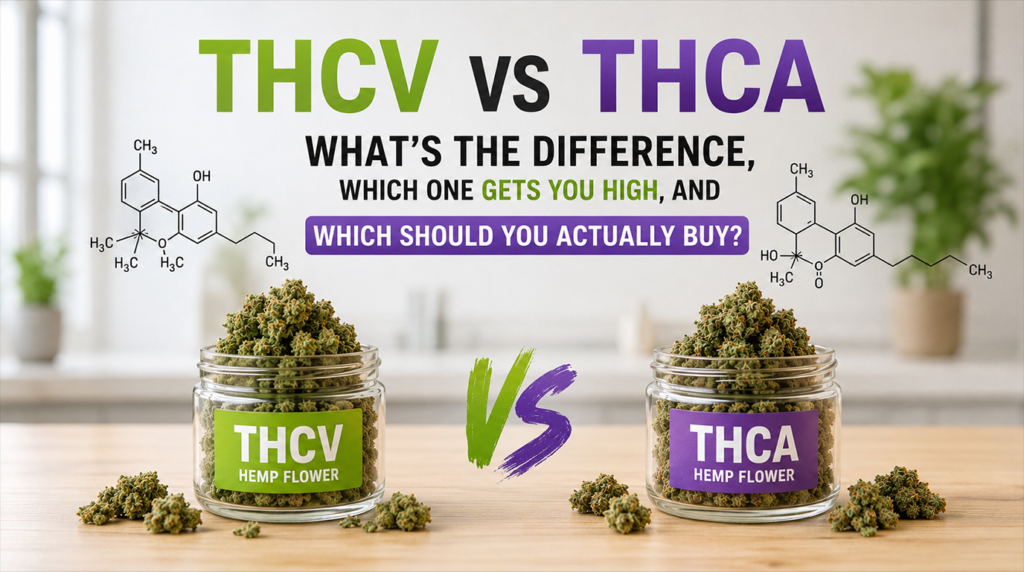
Two cannabinoids, two completely different jobs. THCA is the precursor to Delta-9 THC. Heat it and you get the traditional cannabis high. THCV is a totally separate compound that suppresses appetite, gives clear-headed energy at low doses, and gets you mildly high at higher doses. They share three letters. They share almost nothing else.
The 60-second answer for skimmers. Want the classic weed experience? THCA. Want lighter daytime effects, no munchies, more focus? THCV. They don’t substitute for each other. Picking between them is like picking between coffee and a glass of wine. Same category of plant-derived psychoactive. Different result.
This piece breaks down what each one does, how they compare on potency / legality / cost / effects, which one matches which use case, and what we actually stock at Passion Farms (spoiler: it’s THCA, not THCV, and there’s a reason for that). Internal-link map for the rest of the cannabinoid family: THCA vs Delta-9,THCP vs THCA, THCA vs CBD, THC vs THCA.
THCV vs THCA: The 60-Second Side-by-Side
THCA is what almost all the cannabis you’ve ever smoked actually was on the molecular level before you lit it. Hemp flower runs 20% to 30% THCA by weight. Heat strips a carbon-and-oxygen group off the molecule (decarboxylation, around 220°F) and turns it into active Delta-9 THC. That’s the high you know.
THCV (tetrahydrocannabivarin) is a different molecule entirely. Same plant, different biosynthesis path. It binds to the same receptors in your brain (CB1 and CB2) but in a weird inverse way: at low doses, it blocks them and you feel clear and a little energetic. At high doses, it activates them and you feel a mild, short, head-focused high. No munchies. Half the duration of a THC session.
You don’t pick one over the other to get the same result. You pick the one that matches what you actually want to feel.
For the wider context on the cannabinoid family, our THCA flower guide covers the THC side and our concentrates guide covers the extract side.
What Is THCV (And Why It Got the “Diet Weed” Nickname)
THCV stands for tetrahydrocannabivarin. Discovered in 1973. Found naturally in cannabis at very low concentrations, most strains test under 0.5% THCV, and even “THCV-dominant” strains rarely break 3% to 6%. Compare that to flower running 25%+ THCA. There’s a reason THCV products are mostly extracted concentrates and not flower: there isn’t enough of the stuff in the plant to smoke it conventionally and get a meaningful dose.
The “diet weed” nickname comes from one well-documented effect: at low doses (about 5 to 10mg), THCV suppresses appetite. It blocks the CB1 receptor activity that THC triggers. THC opens the munchies door. THCV closes it. That’s not marketing copy. That’s the receptor science doing what it does, validated across multiple published studies.
Other documented effects at the low-dose range. Mental clarity. Energy without anxiety. Reduced couch-lock. Some early research on diabetes-related insulin response, though that’s clinical-trial territory, not consumer-grade claim land. We’re not making medical claims here, that’s between you and a doctor.
The catch with THCV is the dose curve. At low doses (5 to 10mg), it’s appetite-suppressant and clear-headed. At higher doses (15mg+), the receptor relationship inverts and you start feeling a mild psychoactive effect. Not the heavy THC high. More like a head-focused buzz that fades in 30 to 60 minutes. Twice as fast as a THC session, less than half the body weight.
Strains with naturally elevated THCV include Doug’s Varin, Pineapple Purps, Durban Poison crosses, and a couple of African-genetic sativas. None of these are common on the open hemp market. Most THCV consumer products are isolated THCV gummies, vapes, or tinctures, not flower.
What Is THCA (And Why It’s Everywhere)
THCA is tetrahydrocannabinolic acid. The precursor to Delta-9 THC. The actual psychoactive ingredient in cannabis exists almost entirely as THCA inside the raw, living plant. Until heat hits it, THCA does nothing psychoactive. You could chew a raw cannabis bud and not get high.
Heat changes everything. Around 220°F (well below combustion temperature), THCA loses a carboxyl group, becomes Delta-9 THC, and the high you know shows up within seconds of inhalation. Smoking, vaping, dabbing, baking, they all clear that conversion threshold easily.
The federal legality of THCA hinges on this conversion. The 2018 Farm Bill measures hemp by Delta-9 THC content in the raw plant. THCA in raw flower form is not Delta-9, so flower can be packed with THCA and still test under 0.3% Delta-9 in its uncombusted state. That’s the legal loophole the entire national THCA market runs through. We covered the state-by-state side in THCA legality across the US and is THCA legal in Texas.
How much THCA is in real cannabis? Indoor flower runs 25% to 30%. Premium exotic strains push 32%+. Concentrates like drip diamonds hit 95% to 99% pure THCA on the COA. Compared to THCV at sub-6% even in dominant strains, THCA is roughly five to ten times more abundant in the plant and roughly five times more potent per equivalent dose.
That’s why almost every cannabis product on every shelf is THCA-dominant, not THCV. The supply chain math favors the abundant cannabinoid.
THCV vs THCA: The Side-by-Side Comparison
The table answers the question fast. Use this when someone hands you a menu at a shop.
| Variable | THCV | THCA |
| Full name | Tetrahydrocannabivarin | Tetrahydrocannabinolic acid |
| Psychoactive at room temp? | No | No |
| Psychoactive when heated? | Yes (mild) | Yes (full Delta-9 THC) |
| Concentration in flower | Under 6% even in THCV-dominant strains | 20% to 30%+ in standard indoor |
| Onset (inhaled) | 30 to 60 seconds | 30 to 60 seconds |
| Peak intensity | Mild head-focused | Full traditional cannabis high |
| Duration | 30 to 90 minutes | 1 to 3 hours |
| Appetite effect | Suppresses (at low dose) | Increases (the munchies) |
| Body weight on the high | Minimal | Heavy on indica, lighter on sativa |
| Federal legal status | Legal hemp-derived (Farm Bill) | Legal hemp-derived (Farm Bill) |
| State legal status | Varies by state, generally less restricted than THC | Varies, more restricted in some states (NC S328, etc.) |
| Drug test outcome | Likely positive (metabolites cross-react) | Positive (THC metabolites) |
| Available as flower | Rare (limited genetics) | Everywhere |
| Available as vape | Yes (mostly distillate) | Yes (live resin, distillate, sauce) |
| Available as gummies/edibles | Yes (3,100 monthly searches for “thcv gummies” alone) | Yes |
| Cost (retail vape) | $35 to $70 per 1g | $25 to $60 per 2g |
| Cost (retail edibles) | $25 to $50 per 10-pack | $20 to $40 per 10-pack |
| Best use case | Daytime focus, appetite control, energy | Traditional weed session, body relaxation, sleep |
A note on the price difference. THCV products cost more per milligram of active cannabinoid because the source material is scarce. Most “THCV” disposables are actually THC-dominant with THCV added in single-digit percentages. Read the COA. If the THCV percentage is under 5%, you’re paying premium for what’s functionally a regular THC product with marketing.
Effects: What Each Cannabinoid Actually Does to Your Body
This is where the comparison stops being abstract and starts mattering.
THCV at low doses (5 to 10mg). Mental clarity within 15 minutes of an edible, faster with vape. Slight energy boost similar to coffee but cleaner. Appetite suppression real and measurable. No high. No body weight. Some users report mild mood lift. Fades in 30 to 60 minutes. Good for: morning routine, pre-workout, working through a long task, social settings where you don’t want the cognitive fog of THC.
THCV at higher doses (15mg+). Mild psychoactive effect kicks in. Head-focused, not body-heavy. Some users report racing thoughts at high doses. Anxiety risk is higher than with THC for sensitive users. Duration shortens (paradoxically) as dose increases past a certain point because the receptor activity is unusual. Good for: experienced cannabis users wanting a lighter, faster session.
THCA (post-conversion to Delta-9 THC). Full classic cannabis experience. Body relaxation depending on strain (indica leans heavy, sativa leans head). Munchies. Time perception shifts. Couch potential. Onset 30 to 60 seconds inhaled, 30 to 90 minutes for edibles. Duration 1 to 3 hours inhaled, 4 to 8 hours edibles. Good for: evening sessions, sleep, social hangouts, pain management discussion with a doctor, the experience you came to cannabis for in the first place.
The receptor-level explanation. CB1 receptor (the one that makes you feel high) gets activated by THC. THCV at low doses blocks CB1, that’s the appetite suppression and clarity. THCV at high doses partially activates CB1, that’s the mild high. THCA itself doesn’t activate CB1 at all (which is why raw cannabis doesn’t get you high). Heat converts THCA to THC, then THC activates CB1 strongly. Three molecules, three receptor behaviors. Same plant.
For the chemistry context, THC vs THCA and THCA vs Delta-9 cover the heat-conversion side. THCA vs CBD handles the non-psychoactive comparison if CBD is the other cannabinoid you’re considering.
Legal Status: Are THCV and THCA Both Federally Legal?
Yes. Both. Same federal pathway, slightly different state heat.
The 2018 Farm Bill legalized all hemp-derived cannabinoids when the source plant tests at or under 0.3% Delta-9 THC by dry weight. THCV is naturally low in cannabis, so hemp-derived THCV (extracted from compliant hemp plants) sits comfortably inside the federal hemp framework with very little controversy. THCA is the cannabinoid that’s been creating the state-level fights because of the Delta-9-on-heat conversion math. THCV doesn’t have that math problem.
State-by-state, THCV is generally less restricted than THCA. The states moving to ban “THCA flower” (North Carolina’s S328 effective November 12, 2026, similar bills moving in other states) are targeting smokable cannabis flower specifically, not THCV vapes or edibles. THCV products in those states typically remain legal even after THCA flower bans, because the bill language targets visual-flower-resemblance and total-THC math, both of which leave THCV gummies and disposables outside the ban.
Drug tests are a different question. Both THCV and THCA metabolites can register on standard urine, blood, and hair tests. The metabolite cross-reactivity is real. If you’re subject to drug testing for work or probation, don’t use either, regardless of legality.
The federal Schedule III rescheduling delay covered in our Schedule III timeline post doesn’t directly change either cannabinoid’s federal hemp status. The state-level fights are where the action is.
Which One Should You Actually Buy? (Decision Framework)
Five questions. Two minutes. Ranked from most-decisive to least.
- What time of day are you using? Morning or early afternoon → THCV. Evening or night → THCA.
- Do you want to feel high or stay clear-headed? Clear → THCV at low dose. High → THCA.
- Are you trying to manage appetite? Suppress hunger → THCV. Open the door → THCA.
- Tolerance level. Seasoned daily smoker → THCA delivers what you expect, THCV may feel underwhelming. New or sensitive user → THCV is the gentler entry, with the caveat that high-dose THCV can spike anxiety in some users.
- Budget. Per milligram of active effect, THCA is cheaper. THCV products carry a premium because the source material is scarce.
If you’re choosing between buying a THCA disposable and a THCV disposable for the same price, you’re getting more active high per dollar from THCA. If you’re choosing for a specific use case (focus, appetite control, energy), THCV is the right tool even at the price premium.
Many cannabis users end up owning both. THCV gummies for the morning. THCA flower for the evening. They’re not competitors. They’re shifts in a daily lineup.
THCV vs THCA: FAQ
What’s the difference between THCV and THCA?
THCA is the precursor to Delta-9 THC; heat converts it into the classic cannabis high. THCV is a separate cannabinoid that suppresses appetite and gives clear-headed energy at low doses, with mild psychoactive effects at higher doses. Same plant, two different molecules, two completely different jobs.
Which is stronger, THCA or THCV?
THCA. By a wide margin. Once heated, THCA becomes Delta-9 THC at full standard cannabis potency. THCV at high doses delivers a mild head-focused buzz roughly 25% to 50% the intensity of THC. THCA-dominant flower runs 25 to 30% by weight; THCV-dominant strains rarely exceed 6%. The supply-side math favors THCA.
Does THCV get you high?
Sort of. At low doses (under 10mg), THCV is non-psychoactive and acts as an appetite suppressant and clarity booster. At higher doses (15mg and up), THCV partially activates CB1 receptors and produces a mild, head-focused, short-duration high. It’s not the heavy traditional cannabis high. Closer to a strong espresso with a slight head buzz, fading in 30 to 90 minutes.
Does THCV actually help with weight loss?
The appetite-suppressant effect at low doses is well-documented in research. Whether that translates to long-term weight loss for a given user is a different question and depends on diet, exercise, and behavior, not just the cannabinoid. Treat THCV as a tool that can reduce munchies and impulsive eating, not as a weight-loss drug. We’re not making medical claims here.
Why shouldn’t you smoke THCA?
The question is misleading; you absolutely can smoke THCA, and most people who smoke cannabis are smoking THCA-dominant flower already. The legitimate concern Google’s PAA picked up on is around fake or untested THCA products that may contain residual solvents, heavy metals, or undisclosed additives. Real THCA flower from a third-party-tested cultivator is no riskier than dispensary cannabis. Verify the COA. Buy from licensed sources.
Is THCV legal?
Yes federally, if hemp-derived from plants testing at or under 0.3% Delta-9 by dry weight. State-by-state legality varies but THCV is generally less restricted than THCA because state-level bans typically target smokable flower and the visual-flower-resemblance, neither of which captures THCV products. Always check current state status before ordering across state lines.
Does THCV show up on a drug test?
Yes, likely. THCV metabolites cross-react with standard urine, blood, and hair drug tests in the same way THC metabolites do. The test isn’t differentiating between THCV and THC at the metabolite level. If you’re subject to drug testing, don’t use THCV, THCA, Delta-8, Delta-9, HHC, or THCP regardless of legality.
What strains are high in THCV?
Doug’s Varin (the most reliably high-THCV cultivar). Pineapple Purps. Durban Poison crosses. Several African-genetic sativas (Malawi Gold, Kilimanjaro). Cherry Pie variants sometimes test elevated. None of these are common on the open hemp market, which is why most consumer THCV products are isolated extracts in vape or gummy form rather than smokable flower.
THCV vs THC: which one is stronger?
THC, decisively. Pure THC is the full classic cannabis psychoactive. Pure THCV at the same dose delivers roughly 25% to 50% the intensity, head-focused only, with shorter duration. The receptor relationship is different and the experiences are different. THC is stronger by every meaningful measure of cannabis intensity.
Can you mix THCV and THCA in the same session?
Yes. Some users combine THCV (morning, low dose) with THCA flower (evening) across the same day. Within a single session, the combination is unusual; the appetite suppression and the appetite increase counteract, and the clarity and the body weight pull in opposite directions. Most users keep them in separate time blocks.
What does THCV taste like?
In isolated extract form, almost neutral. THCV doesn’t carry strong terpene flavor because most THCV products are stripped to isolated extract. When THCV-dominant flower is rolled or vaped, it tastes like the strain’s native terpene profile (often fruit-forward, slightly pine, sometimes earthy). No distinctive “THCV flavor” because the molecule itself doesn’t taste like much.
Does Passion Farms sell THCV products?
No, not currently. We focus on THCA flower (our bulk flower category and exotic THCa flowers), disposables, pre-rolls, moonrocks, and edibles. If you want the THCV experience (clear daytime focus, appetite control), the closest products we run are Delta-8 disposables, which deliver a similar lighter-than-THC profile without the THCV cost premium. The how to buy THCA online guide covers the order flow.
So What Should You Actually Order?
Here’s the honest call: if you’ve been considering THCV, ask yourself what experience you’re actually chasing. The “diet weed” framing sells well online, but the practical answer for most cannabis users isn’t a $50 THCV disposable. It’s a Delta-8 vape for daytime (lighter than THC, no appetite spike, no premium) plus a THCA flower session for the evening.
We don’t sell THCV. We sell what we know how to grow well: THCA flower from our California cultivation facility, live-resin disposables filled in Houston, pre-rolls, edibles, moonrocks. If THCV is genuinely the cannabinoid that matches your use case (morning focus, hunger suppression, fast clear sessions), buy it from a brand that specializes in it. We’d rather tell you that than sell you the wrong product.
If you’re here because you want the classic cannabis experience and just heard THCV mentioned somewhere, the better starting point is the strongest THCA flower strains breakdown or the exotic THCA flowers lineup. For lighter daytime sessions without going to THCV pricing, browse the Delta-8 SKUs in the disposable lineup. For controlled-dose evening, edibles are the cleanest format.
Wholesale or bulk questions, talk to us. Pick the cannabinoid that matches the use case, not the trendiest acronym.

