
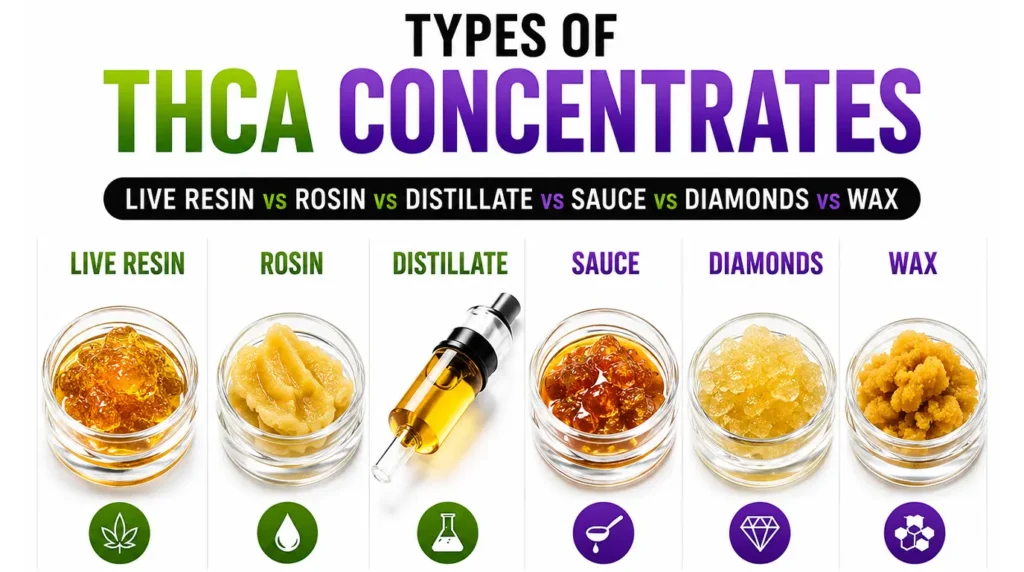
Nine concentrate types matter on a real menu: live resin, live rosin, distillate, sauce, diamonds, wax, shatter, crumble, badder. They split along three lines. Solvent-based extracts (live resin, distillate, sauce, diamonds, wax, shatter, crumble, badder) use hydrocarbons or CO2 to pull cannabinoids out of the flower. Solventless extracts (live rosin, hash rosin) use heat and pressure only. Fresh-frozen flower keeps the native terpene profile; cured flower yields a milder terpene signal. Price ranges $20 to $80 per gram retail depending on the type and the source-flower grade.
Pick by flavor priority first. Solventless live rosin tastes truest to the strain. Live resin runs close to that for less money. Distillate is the most potent on paper but flavor-stripped (terpenes get reintroduced after extraction, often not strain-true). Sauce and diamonds are the dabbing-flavor purist formats. Wax, shatter, crumble, and badder are texture variations of the same hydrocarbon-extract base.
Honest upfront note about Passion Farms and concentrates: we currently run one concentrate SKU, Drip Diamonds, which is live-resin-derived. We don’t yet stock standalone rosin, distillate, sauce, wax, shatter, crumble, or badder. This piece teaches the full type taxonomy regardless of what we sell, because the buyer searching “thca concentrates” is shopping the whole category, not just our shelf. For the chemistry foundation underneath the buyer-decision layer, the broader THCA concentrates explainer is the umbrella piece.
The 60-Second Answer: 9 Concentrate Types, What Separates Them
Nine names, three real splits. Solvent or not. Fresh-frozen or cured. Crystallized or not. Everything else is texture and finish.
Solvent vs solventless is the first fork. Solventless extracts (live rosin and hash rosin) use heat and pressure to squeeze terpenes and cannabinoids out of fresh-frozen flower or hash. No butane, no propane, no CO2. The result is purer in a chemical sense and more expensive because the yield per pound of starting material is lower. Solvent-based extracts (live resin, distillate, sauce, diamonds, wax, shatter, crumble, badder) use hydrocarbons or CO2 to dissolve cannabinoids out of the plant matter, then purge the solvent off with heat or vacuum. Cheaper, faster, higher yield, slight residual-solvent risk if poorly purged.
Fresh-frozen vs cured source flower is the second fork. Fresh-frozen flower is harvested and immediately frozen at sub-zero temperatures, preserving the native terpene profile in full. Cured flower is dried and aged like traditional cannabis, which mellows the terpene signal. Live resin and live rosin both use fresh-frozen source. Distillate, wax, shatter, crumble, and badder typically use cured source.
Crystallized vs amorphous is the third fork. Diamonds are THCA crystals grown from a sauce base. Sauce itself is the high-terpene liquid surrounding the diamonds. Everything else (wax, shatter, crumble, badder, distillate, live resin in non-diamond form) is amorphous, meaning no crystalline structure.
Price quick map. Distillate, wax, shatter, crumble run $20 to $40 per gram. Live resin and badder land $30 to $50. Sauce and diamonds $40 to $70. Live rosin is the premium at $50 to $80 per gram. Strong indoor flower hits 25 to 30% THCA. Most concentrates hit 70 to 99%, which means a rice-grain-sized dab equals roughly half a bowl of strong flower.
For consumption methods (dab rig, e-rig, bowl topper, vape), how to smoke THCA diamonds covers all five methods in detail.
The Side-by-Side Comparison Table (Every Type, Every Variable)
| Type | Process | Source Flower | Terpenes | THCA % | Price/g Retail | Texture | Best Use |
| Live Resin | Hydrocarbon, cold-extraction | Fresh-frozen | Native, full-spectrum | 75 to 85% | $30 to $50 | Sauce-like, wax | Flavor-focused dabbing |
| Live Rosin | Heat + pressure, solventless | Fresh-frozen hash | Native, full-spectrum | 70 to 85% | $50 to $80 | Badder, jam | Cleanest flavor, premium |
| Distillate | Heat + vacuum, terpene-stripped | Cured | Stripped, reintroduced | 85 to 99% | $20 to $35 | Honey-clear | Vape carts, potency focus |
| Sauce / HTE | Hydrocarbon + diamond crystallization | Fresh-frozen | Concentrated | Liquid 50-70%, crystal 95-99% | $40 to $60 | Crystalline + liquid | Terpene-loud dabs |
| Diamonds | Crystallization from sauce | Fresh-frozen | Strain-derived | 95 to 99% | $50 to $70 | Crystalline | Top-shelf dabs, vape diamonds |
| Wax | Hydrocarbon + agitation | Cured or fresh-frozen | Variable | 70 to 85% | $25 to $40 | Soft, opaque | Daily-driver dabs |
| Shatter | Hydrocarbon + no agitation | Cured | Variable | 70 to 90% | $25 to $40 | Brittle glass | Classic dab format |
| Crumble | Hydrocarbon + low-heat purge | Cured | Variable | 70 to 85% | $25 to $40 | Dry, breakable | Sprinkle on flower |
| Badder | Hydrocarbon + whip | Cured or fresh-frozen | Variable | 70 to 85% | $30 to $45 | Cake-batter | Easy-handling dabs |
The price-per-effect math. Distillate at 95% THCA on $25/g delivers roughly 950mg of THC per gram for 26 cents per mg. Live rosin at 80% THCA on $70/g delivers 800mg for 8.75 cents per mg. Distillate is three times cheaper per mg of active cannabinoid. The premium on solventless and live-resin extracts is the terpene profile, not the THC content. Decide based on what you’re paying for.
Live Resin (the Flavor-Truest Solvent Extract)
Live resin is hydrocarbon-extracted from fresh-frozen cannabis flower. The cold extraction temperature preserves the native terpenes from the live plant, so the final product tastes like the actual strain instead of a generic cannabis flavor.
How it’s made, plain language. Fresh-frozen flower goes into a closed-loop extraction system at temperatures around -40°F. Butane or propane runs through the chilled flower and dissolves the cannabinoids and terpenes. The solvent gets evaporated off under vacuum, leaving behind a sauce-like extract that smells like the strain it came from. Properly made live resin tests at 75 to 85% THCA with a robust terpene panel showing 8 to 12 named terpenes.
What it tastes like. The strain. That’s the whole pitch. A Jealousy live-resin dab smells and tastes like a Jealousy bud. A gas-forward strain dabs gas-forward. A fruity strain dabs fruity. Compare to distillate, which tastes mostly neutral with whatever terpenes were sprayed back in after extraction.
Price range. $30 to $50 per gram retail for the standard market. Premium small-batch live resin runs $50 to $70. Bulk wholesale for retailers drops to $15 to $25 per gram at MOQ.
Passion Farms anchor: our Drip Diamonds are live-resin-derived. The sauce that the diamonds crystallized out of is live resin. If you want the experience without the crystalline structure, ask your retailer for the sauce-only version. We ship the diamonds as the dominant SKU because the crystalline format stores longer and ships more cleanly than pure liquid sauce.
For consumption walkthrough, how to smoke THCA diamonds covers dab rig, e-rig, bowl topper, joint topper, and the no-rig methods.
Live Rosin (the Solventless Premium)
Live rosin is the solventless equivalent of live resin. Same fresh-frozen source flower, completely different extraction. Instead of hydrocarbons dissolving the cannabinoids out, heat and pressure squeeze them out mechanically.
How it’s made. Fresh-frozen flower gets washed in ice water to separate the trichomes from the plant matter (this produces “ice water hash” or “bubble hash”). The hash gets pressed between heated plates at controlled temperature and pressure. The cannabinoids and terpenes ooze out as a sticky resin. No butane, no propane, no CO2, no residue. The result is the cleanest concentrate on the market, chemically speaking.
Why solventless costs more. Yield is lower per pound of starting material. The hash-making step requires significantly more labor and quality control. The press equipment is expensive. Stable production at scale is harder than hydrocarbon extraction. All of that gets passed to the buyer. Retail $50 to $80 per gram is the standard band; premium small-batch live rosin from named cultivators pushes $80 to $120.
When the price premium is worth it. You’re a terpene purist and can taste the difference between solventless and hydrocarbon extraction. You have residual-solvent sensitivity (some users do). You want the cleanest possible product chemically. You’re rewarding the cultivator’s labor with the price premium.
When it isn’t worth it. You’re price-sensitive and dabbing for potency, not flavor. You can’t taste the difference (most casual users can’t). You’re going through volume and the cost compounds.
Live rosin is the format most named-cultivator releases land in. If a small-batch grower drops a “premium release,” it’s usually live rosin. Doesn’t mean every live rosin is premium. Read the COA, smell the jar.
We don’t currently run a live rosin SKU. When we do, it’ll be flagged on the bulk flower category and the broader concentrates pillar.
Distillate (the Potent Flavor-Stripped Workhorse)
Distillate is the most-abundant concentrate by volume on the open market and the one that gets the most flak from rosin purists. Both reactions are correct for different reasons.
How it’s made. Cured flower or trim goes through hydrocarbon or ethanol extraction first, producing a crude oil. That crude gets heated and vacuum-distilled, which strips out the lipids, waxes, chlorophyll, and most of the terpenes. The result is a near-pure THCA distillate that tests 85 to 99% pure on the COA. Terpenes get reintroduced after distillation, either cannabis-derived (from a different extraction) or food-grade botanical (cheaper, less strain-true).
The potent-but-flavor-stripped trade-off. Distillate at 95% THCA is roughly three times more potent per milligram than live resin at 75 to 80%. You’re getting more THC per dollar. The flavor signal is whatever the brand decided to reintroduce. A “blue dream distillate” cart tastes like the brand’s blue-dream terpene blend, which may or may not resemble actual Blue Dream.
When distillate is the right choice. Vape carts and disposables (most pens on the market are distillate-based, see our 2g disposable picks for 2026 for the hardware breakdown). High-tolerance smokers chasing dose-per-dollar. Edibles manufacturing (consistent potency, easy to dose). Daily-driver vaping where flavor authenticity matters less than convenience and price.
When it’s not. Flavor-focused dabbing. Strain-specific experiences. Buyers who can taste the difference and care about it.
Most of the cheap concentrate market is distillate with reintroduced terps wearing whatever strain name on the label. Most of the premium market is solventless or live-resin extracts. Distillate is the workhorse of the entire vape category, including the Passion Farms disposable lineup when we run distillate-based SKUs alongside live-resin ones.
Sauce, HTE, and Diamonds (the Crystallized Trio)
Sauce, HTE (high-terpene extract), and diamonds are three names for related extracts that share a single production path. Live resin sauce is the parent. Diamonds are crystals that grow inside sauce during a controlled crystallization process. HTE is a marketing-leaning name for terpene-heavy sauce sold by itself.
Sauce in plain terms. After live resin extraction, the resulting extract is rich in cannabinoids and terpenes. If the extractor lets the sauce sit at a specific temperature and pressure for days or weeks, THCA molecules crystallize out of the terpene liquid into solid diamond shards. The leftover terpene-rich liquid is the sauce. The crystals are the diamonds. Sometimes brands sell the combo as “sauce” (both components in the jar). Sometimes they separate them and sell diamonds standalone, sauce standalone.
Crystalline diamonds vs sauce-only. Diamonds standalone test 95 to 99% pure THCA on the COA. Sauce standalone tests 50 to 70% with the rest as terpenes. A combined sauce jar runs roughly 75 to 85% THCA averaged across both components.
When to pick the diamond-and-sauce combo: flavor purist on a dab rig. When to pick diamonds-only: top-shelf dabs, vape diamonds, or sprinkle-on-flower applications where you want the crystalline form. When to pick sauce-only: terpene-loud experience without the visual showmanship of crystals.
Passion Farms sells Drip Diamonds as the dominant concentrate SKU. They’re the crystalline form crystallized out of our in-house live resin sauce. For consumption walkthrough across all five methods (dab rig, e-rig, bowl topper, joint topper, no-rig), how to smoke THCA diamonds is the guide.
Wax, Shatter, Crumble, Badder (Same Base, Different Texture)
These four are texture variations of the same hydrocarbon-extracted base. The chemistry is similar across all four. The finishing process changes the physical texture, which changes how the concentrate handles and how it stores.
Wax is the agitated version. Hydrocarbon-extracted oil gets whipped or agitated during the purge, which introduces air pockets and creates a soft, opaque, butter-like texture. Easy to handle with a dabber. Cheap to produce. The daily-driver format for dab-rig users on a budget.
Shatter is the non-agitated version. Same hydrocarbon extraction, but the purge happens without agitation. The result is a brittle, glass-like sheet that snaps when broken. Higher visual aesthetic. Slightly harder to handle (warm dabber works best). Classic dab format from the early 2010s, still popular.
Crumble is the low-heat purge version. Same hydrocarbon extraction, purged at a lower temperature for longer. The result is a dry, breakable, sandy-looking concentrate. Easy to crumble onto flower (hence the name) for joint or bowl topping. Common sprinkle-on-flower format.
Badder (also spelled “batter” or “budder”) is the whipped-into-cake-batter version. Heavier on the whip than wax, softer and more spreadable. Easy to scoop with a dabber. Often the format premium small-batch hash-rosin releases land in.
Functionally they’re interchangeable on a dab rig if the THCA % and terpene profile match. The texture choice is about handling preference and storage. Wax stays soft for months. Shatter can get brittle in cold or stretchy in heat. Crumble dries out further if not stored airtight. Badder spreads but can run if it gets warm.
For sprinkle-on-flower applications, browse the bulk flower category for the base flower and the pre-rolls page for rolled-and-ready formats. Crumble specifically pairs well with the topper method since the dry texture sprinkles cleanly.
We don’t currently run wax, shatter, crumble, or badder SKUs. The reason is supply-chain: making one extract well at scale is harder than making four texture variations of mid-quality. We focus on Drip Diamonds (live-resin diamonds) and may expand into one of the textures when we have the cultivation and extraction throughput to do it right.
The Decision Framework: 5 Questions to Pick (Plus the Real Math)
Five questions ranked from most-decisive to least.
- Flavor priority? Cleanest = live rosin. Strain-true with hydrocarbons = live resin. Flavor-neutral and potent = distillate. Terpene-loud = sauce. Texture-flexible = wax / shatter / crumble / badder (variable on extraction quality).
- Budget per gram? Under $30 = distillate, wax, shatter, crumble. $30 to $50 = live resin, badder, sauce. $50+ = live rosin, diamonds.
- Consumption method? Dab rig works for any. Vape pen and disposable = distillate or live-resin sauce. Bowl topper = crumble or diamond chunks. E-rig = any.
- Tolerance level? New user = lower-potency live resin at 75 to 85%. Experienced = diamonds (95 to 99%) or distillate.
- Storage and shelf life? Long shelf (12+ months) = distillate. Medium (6 to 9 months sealed) = wax, shatter, crumble, badder. Short (3 to 6 months at peak terpene profile) = live rosin and high-terpene sauce.
Per-dollar value math. At $25/g distillate (95% THCA) you’re paying 26 cents per mg of cannabinoid. At $40/g live resin (80% THCA) you’re paying 50 cents per mg. At $70/g live rosin (80% THCA) you’re paying 88 cents per mg. Three-and-a-half times the price-per-mg for the solventless premium. Worth it for some buyers, not for others. Flavor is the variable that justifies the math, not potency.
Most buyers end up owning two or three concentrate types. Distillate for the daily vape (potency, convenience). Live resin or sauce for the flavor dabs at home. Diamonds for the heaviest sessions. Each one solves a different use case in the same daily rotation.
For the COA verification step that should happen before you buy any concentrate type, how to read a THCA COA walks through the document line by line. For broader dosing context across formats, the safe consumption guide covers the limits.
THCA Concentrates FAQ
What’s the strongest THCA concentrate?
THCA diamonds and high-grade distillate are tied for strongest by THCA percentage, both testing 95 to 99% pure on the COA. Subjectively, live rosin can feel stronger at lower percentages because the full terpene profile amplifies perceived intensity (the entourage effect). Sauce and live resin sit at 70 to 85% THCA.
What’s the best THCA concentrate for beginners?
Live resin at 75 to 80% THCA. Lower potency than diamonds or distillate, real terpenes for flavor authenticity, easier to handle on a dab rig or e-rig than crystalline diamonds. Start with a rice-grain-sized dab at 545°F to 600°F on a banger. The how to smoke THCA diamonds walkthrough covers the technique across five methods.
Live resin vs live rosin: which is better?
Live rosin if you want the cleanest possible flavor and don’t mind paying 40 to 60% more per gram. Live resin if you want flavor authenticity at standard pricing. Both use fresh-frozen source flower. The split is solvent (live resin uses hydrocarbons) vs solventless (live rosin uses heat and pressure). Most casual users can’t taste the difference. Terpene purists swear by rosin.
Is THCA distillate worth buying?
Yes if you’re optimizing for potency and price-per-mg of cannabinoid, or if you’re vaping daily and care more about consistent dosing than flavor. No if you’re a strain-flavor purist or you want the entourage effect from a full terpene profile. Distillate is the workhorse of the vape-cart market for a reason: it’s potent, shelf-stable, and three times cheaper per mg than live rosin.
How do you dab THCA concentrate?
Heat a quartz banger with a torch until it glows red, wait 30 to 50 seconds to cool to the 545°F to 600°F sweet spot, drop a rice-grain-sized chunk in with a dabber, cap with a carb cap, inhale slow and steady. E-rigs handle the temperature automatically. How to smoke THCA diamonds covers all five methods including no-rig alternatives.
Are THCA concentrates legal?
Federally yes, when hemp-derived and the source plant tests at or under 0.3% Delta-9 by dry weight under the 2018 Farm Bill. State-by-state varies, with North Carolina’s S328 banning smokable THCA products as of November 12, 2026. Always check current state status before ordering across state lines. See our THCA legality coverage for state-specific detail.
Does THCA concentrate show up on a drug test?
Yes. THCA converts to Delta-9 THC the moment heat hits it, and Delta-9 metabolites trigger every standard urine, blood, and hair drug test the same way as dispensary cannabis. Hemp-derived legal status doesn’t change drug-test outcomes. If you’re subject to drug testing, don’t use any THCA, Delta-8, HHC, or THCP product regardless of legality.
What’s the difference between wax and shatter?
Same hydrocarbon extraction, different finishing process. Wax is whipped or agitated during the purge, producing a soft opaque butter-like texture. Shatter is purged without agitation, producing a brittle glass-like sheet. Chemistry is similar; texture and handling differ. Wax is easier to scoop, shatter looks cleaner. Functionally interchangeable on a dab rig if the cannabinoid and terpene profiles match.
Why are THCA diamonds so expensive?
Diamonds require a slow, controlled crystallization process taking days to weeks after the initial live-resin extraction. Yield per pound of starting material is lower than amorphous extracts because some THCA stays in the sauce instead of crystallizing. The crystalline form is also visually distinctive, which carries a market premium. Live-resin diamonds at $50 to $70 per gram reflect both the process complexity and the premium positioning.
How long do THCA concentrates last?
Distillate has the longest shelf life at 12 months or more sealed and refrigerated. Wax, shatter, crumble, and badder run 6 to 9 months sealed. Live resin and high-terpene sauce degrade fastest (terpene oxidation), peaking at 3 to 6 months. Live rosin tracks live resin. Diamonds are stable longer than sauce because the crystalline structure resists terpene loss.
Can you smoke THCA concentrate without a dab rig?
Yes. Four no-rig methods: sprinkle on a bowl of flower, twax onto a joint or pre-roll, drop on top of bong-bowl flower, or use an e-rig, vape pen with concentrate chamber, honey straw, or hot knife. The bowl-topper method is the easiest entry. How to smoke THCA diamonds walks all five paths.
Does Passion Farms sell every type of THCA concentrate?
No. We currently sell Drip Diamonds, which is live-resin-derived crystalline THCA. We don’t yet stock standalone rosin, distillate, sauce, wax, shatter, crumble, or badder. The reason is supply-chain: making one extract well at scale beats making four texture variations of mid quality. Expansion into more concentrate formats is on the roadmap.
What We Actually Sell (Drip Diamonds) and What’s Honestly Elsewhere
Real talk on the catalog. Nine concentrate types exist; we sell one. Drip Diamonds is the in-house live-resin diamonds run we make from California-grown flower, extracted in Oklahoma, finished in Houston. That’s our concentrate lane.
For everything else covered in this guide, the honest call is to buy elsewhere if a non-diamond format matches your use case better. A buyer chasing distillate-vape value should hit a brand that runs distillate vapes at volume. A buyer chasing live rosin’s flavor purity should buy from a solventless specialist. Pretending our one SKU covers nine use cases would be the same Backwoods-marketing dishonesty most of the SERP runs on, and the audience this brand serves can tell the difference.
What we can honestly cross-sell from the existing catalog. Distillate-curious vapers can browse our 2g disposable picks for 2026, which run distillate alongside live-resin SKUs. Crumble-curious bowl-toppers can pair our bulk flower with a crumble jar from a specialist (or wait until we run our own). Live-resin dab enthusiasts get the closest analog through Drip Diamonds, which are the crystalline form of our in-house live resin sauce.
Wholesale interest in stocking concentrates from Passion Farms once we expand the catalog, talk to us. Pre-rolled blunt SKU and additional concentrate textures are both on the roadmap; we’d rather launch them right than rush. The umbrella explainer for the chemistry underneath all of this is the broader THCA concentrates guide.
Pick the concentrate that matches the use case. One type rarely covers every situation. Most experienced buyers run two or three formats in rotation. Start with live resin if you’re new, expand from there.

