
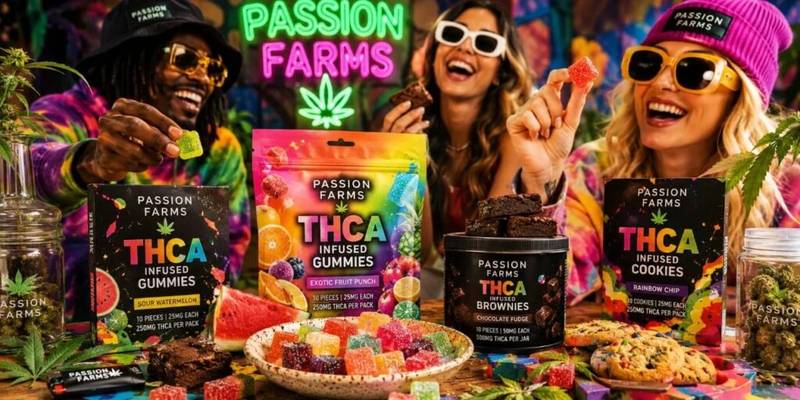
THCA and THC are the same compound caught at two different stages of its life. THCA is the raw, non-intoxicating form that sits in the plant. THC is the active form that gets you high. The thing that turns one into the other is heat, a process called decarboxylation, and with edibles that one fact explains almost everything people get confused about.
So here’s the answer to the question everybody actually has. A raw THCA edible, with the THCA never activated, barely gets you high. A THC edible gets you high. And most “THCA gummies” you see on shelves are built to be psychoactive, because the THCA in them got activated during the making, or because they’re using THC and calling it THCA for reasons we’ll get into. The label is doing more work than the chemistry sometimes.
We sell lab-tested edibles at Passion Farms, so we field this question all the time. This is the straight version. What THCA and THC actually are, how the edible kind works, whether the gummies get you high, and how to read what you’re really buying. None of this is medical advice, and the laws around it are still moving, so we’ll keep it honest on both.
THCA vs THC: The 10-Second Answer
THCA stands for tetrahydrocannabinolic acid. It’s the raw cannabinoid that exists in living and freshly harvested cannabis, and on its own it does not get you high. THC, specifically delta-9 THC, is the activated version, and it’s the one responsible for the high everybody knows.
The bridge between them is heat. Apply enough of it and THCA loses a piece of its molecule and becomes THC. That’s why you smoke or vape flower instead of eating it raw, the flame does the conversion instantly. Raw, they’re different. Heated, the THCA becomes the THC.
For edibles, that conversion is the entire story, because whether your gummy gets you high depends on whether the THCA in it ever got activated. Hold that thought. It’s the part most guides skip right over.
What Is THCA?
THCA is the acid precursor to THC. In the raw cannabis plant, almost none of the cannabinoid exists as THC yet. It’s nearly all THCA, sitting in the trichomes waiting on heat. Because of its shape, THCA doesn’t fit the brain’s receptors the way THC does, so raw THCA on its own won’t get you lifted.
This is why a THCA flower can test high and still be sold as hemp. On paper it’s THCA, not delta-9 THC, so it can fall under the federal hemp definition even though it turns into THC the second you light it. We broke down how that works in our piece on how THCA works.
So THCA is real, it’s everywhere in fresh cannabis, and by itself it isn’t what gets you high. It’s the before. THC is the after.
What Is THC?
THC, delta-9 tetrahydrocannabinol, is the active compound, the one that binds to your receptors and produces the high. When people say weed gets them lifted, THC is what they’re talking about. It’s the after-heat version of THCA.
Every bit of THC in cannabis started life as THCA. There’s no separate THC plant. The grower harvests THCA-rich flower, and heat, from a lighter, a vape, an oven, turns that THCA into THC. The strength of your high comes down to how much THC ends up active by the time it reaches you.
In edibles, the THC can get there two ways. Either the maker activated the THCA on purpose during cooking, or they used an already-active THC distillate. Both get you high. The difference is just the starting material and the label on the bag.
Decarboxylation: How THCA Becomes THC
Decarboxylation is the chemical reason for all of this, and it’s simpler than the word makes it sound. THCA has an extra carboxyl group, a little piece of the molecule. Add heat and that piece breaks off as carbon dioxide, and what’s left is THC. That’s the whole conversion, start to finish.
Two things drive it, temperature and time. When you smoke or vape, the heat is so high that decarboxylation happens instantly, which is why flower hits right away. When you bake, it’s lower and slower, usually somewhere around 220 to 250 degrees for a stretch, which is how edible makers turn raw THCA into active THC before it ever goes in the gummy or the butter.
Here’s the part that matters for eating it. Your stomach does not decarboxylate THCA well. So if you swallow raw, un-activated THCA, your body converts very little of it to THC, and you feel very little. The heat has to happen before you eat it, not after. We get deeper into the chemistry in our science of cannabis edibles guide, but that’s the core of it.
No heat, no high. That’s the rule edibles live by.
THCA vs THC in Edibles: The Part That Confuses Everyone
This is where people get lost, so let’s slow down. With smoking, the conversion is automatic, the flame handles it for you. With edibles, somebody has to do the decarbing on purpose, and whether they did is what decides if your edible works.
Picture two gummies. One is made with raw THCA that was never heated. The other is made with THCA that the maker decarbed during production, or with active THC distillate. They can both say “THCA” on the label and look identical. But the first one is close to a placebo, and the second one will put you on the couch. Same word on the bag, completely different night.
So “THCA edible” is not one thing. It’s a label that could mean an activated, psychoactive product or a raw, barely-active one, depending on how it was made. The only way to know which you’ve got is the COA and the dosing, not the brand name. Real edibles tell you the active THC content. The sketchy ones hide behind the THCA label and let you assume.
The takeaway is simple. In edibles, ask whether the THCA is activated, because that’s the difference between feeling it and wasting your money.
Do THCA Edibles Actually Get You High?
Yes and no, and the answer depends entirely on activation. A genuinely raw THCA edible, where the THCA was never heated, gets you barely anything, because your gut can’t convert it well. If somebody sold you “raw THCA gummies” and you felt nothing, that wasn’t a fluke. That was the chemistry doing exactly what it does.
But here’s the real-world truth. Almost every THCA edible actually on the market is made to get you high. The makers either decarb the THCA during production so it becomes THC, or they use active THC and label it THCA for compliance reasons. So in practice, when you buy “THCA gummies” from a real brand, you’re usually buying a psychoactive edible. It works because the THCA got activated somewhere along the line.
So if you’re asking whether THCA edibles get you high, the honest answer is this. A truly raw one won’t. A properly made one absolutely will, because by the time it reaches you the THCA has become THC. Check the COA for the active THC number, and you’ll know exactly what you’re getting before you ever take a bite. When in doubt, our edibles come with lab sheets, so the guessing’s gone.
One more thing people get twisted. The high from an edible isn’t weaker just because it started as THCA. Once it’s activated, it’s THC, full stop, and it hits like any other THC edible of the same dose. The raw-versus-activated thing only matters at the manufacturing stage. By the time a real, tested THCA edible reaches your hand, it’s a THC product in everything but the name printed on the label.
THCA Gummies Explained (And Why They Exist)
If raw THCA barely works in an edible, why is the whole market full of “THCA gummies”? The answer is part chemistry, part law. The THCA label exists because of how hemp is defined, not because the gummy is actually raw.
Under the federal rules, hemp is measured by delta-9 THC content. THCA is a different molecule on paper, so a product can be built around THCA, stay under the delta-9 line on the label, and still deliver a real high once that THCA is activated. That’s the loophole, plainly stated. The “THCA” name keeps it compliant on the certificate while the product still does what THC does.
This isn’t us knocking it, it’s just how the market works right now, and you deserve to understand it before you buy. A well-made THCA gummy from a licensed brand is a real, tested, psychoactive edible. A badly made one is either underdosed or mislabeled. The label alone won’t tell you which, so the COA does the talking. Our THCA gummies and 500mg edibles ship with their lab numbers for exactly that reason.
The laws here are moving fast, especially in Texas, so treat the legal side as a snapshot, not a promise. More on that below.
Edibles vs Smoking: Onset, Duration, and the Liver
Edibles and smoking deliver the same THC differently, and the difference is your liver. When you smoke, THC hits your bloodstream through your lungs almost instantly, peaks fast, and fades in a couple hours. When you eat it, it goes through your digestive system and your liver first, and that changes the whole experience.
Your liver converts some of that THC into a compound called 11-hydroxy-THC, which is often stronger and longer-lasting than the THC you inhale. That’s why edibles feel heavier than smoking the same amount, and why they sneak up on people. The trade-off is timing. Edibles take longer to start.
Onset is usually 30 to 90 minutes, sometimes longer on a full stomach, and the effects can run 4 to 8 hours. That slow start is exactly where people mess up, taking a second dose at the 45-minute mark because nothing’s happening, then getting hit by both at once. Patience is the whole skill with edibles. If you smoke and want the flower side too, our guide on whether THCA is safe to smoke covers that lane.
How to Dose THCA and THC Edibles
Dosing is about the active THC, not the THCA number on the front. This is general information, not medical advice, and everybody’s tolerance is different, so the only smart rule is start low and go slow.
A common starting point for newer users is a low dose, then waiting a full two hours before deciding whether to take more. The mistake that ruins people’s nights is impatience, eating more before the first dose has had time to land. Two hours. Set a timer if you have to.
Food, tolerance, and body chemistry all change how an edible hits, so the same gummy can feel different on different days. Read the COA, know the active THC per piece, and respect the slow onset. The goal is to enjoy it, not to white-knuckle through a dose you didn’t mean to take. If you want edibles worked into a routine the smart way, our piece on how to incorporate THCA into your routine is a sane place to start.
THCA Edible vs THC Edible: Side by Side
Here’s the quick compare, with the honest version in each row.
| Factor | Raw THCA Edible | THC / Activated Edible |
| Gets you high? | Barely, if truly raw | Yes |
| Why | Gut won’t convert THCA well | THC is already active |
| What’s on the label | “THCA” | “THC” or “THCA” (activated) |
| What actually matters | The active THC on the COA | The active THC on the COA |
| Most market gummies | Rare | This is what you usually get |
The row that matters is the last real one. Whatever the front of the bag says, the active THC number on the COA is the truth. A “THCA” gummy with real activated content gets you high. A “THCA” gummy that’s actually raw doesn’t. Same label, and only the lab sheet tells them apart.
The Legality Angle: Why “THCA” Is on the Label
The THCA label is a legal strategy as much as a chemical description, and you should understand it plainly. The 2018 Farm Bill legalized hemp by defining it as cannabis with no more than 0.3 percent delta-9 THC by dry weight. THCA is not delta-9 THC, so a high-THCA product can technically meet that definition on the certificate, even though it becomes THC when you heat it.
That’s why the market filled up with THCA flower and THCA edibles. They’re sold as compliant hemp on paper while delivering a real cannabis experience once activated. Some states and some testing methods now measure “total THC,” which accounts for the THCA after conversion, and that’s where the rules start to bite. The picture is different state to state, and it’s changing.
Texas is a live example, where THCA products are widely sold but the law keeps getting challenged. We track the state-by-state picture in our guide on THCA legality by state. None of this is legal advice, and the rules are evolving, so treat any legal claim, including this one, as current-best, not permanent. Buy from licensed, tested sources and you stay on the right side of it.
THCA vs THC vs CBD vs Delta-9: Quick Context
It helps to place THCA and THC next to the other names you see, because the shelf is crowded. THC and delta-9 are basically the same thing in casual use, delta-9 is just the specific, most common form of THC. So “THCA vs delta-9” is really the same raw-versus-active question we’ve been answering.
CBD is the non-intoxicating cannabinoid people reach for when they want calm without the high, and it stays non-intoxicating whether you heat it or not, which makes it a different animal from THCA. We compare them in our THCA vs CBD guide. THCP is a newer, much stronger cousin of THC, broken down in our THCP vs THCA piece, and the basic THC vs THCA breakdown covers the fundamentals if you want them.
The short version. THCA becomes THC with heat, delta-9 is the main THC, CBD is the non-high one, and THCP is the heavyweight. Edibles can be built from several of these, which is exactly why the COA matters more than the buzzword on the front.
How to Choose a Good THCA Edible
Picking a good edible comes down to three things, and none of them is the brand name. First, the COA. A real edible has a batch-matched lab sheet showing the active THC per piece, plus a clean pass on pesticides and metals. No COA, no buy.
Second, dose clarity. A good product tells you exactly how much active THC is in each gummy, so you can dose with intention. Vague “THCA” labeling with no per-piece active number is a red flag, because it means you can’t actually predict the effect.
Third, the source. A licensed operation with a real name behind it beats a mystery bag from a random link every time, same as it goes with flower and disposables. We keep lab sheets on our edibles and the rest of the menu so you’re never guessing what you’re about to feel.
Safety and Responsible Use
Quick and straight, because it matters. Edibles are stronger and longer than people expect, so the responsible move is to start low, wait the full two hours, and keep them away from kids and pets, who can’t tell a gummy from candy. This is harm-reduction common sense, not medical advice.
Don’t drive on edibles, don’t mix recklessly, and if you took too much, the move is to find a calm space and ride it out, because it passes. Overdoing an edible is uncomfortable, not the end of the world, but it’s a bad time you can easily avoid by respecting the dose and the clock.
Know your source, know your number, and go slow. That’s the whole safety conversation in one line.
The Houston Way: Straight Answers, Tested Product
Passion Farms started in Houston, and we’d rather tell you the real chemistry than hype you a buzzword. The THCA versus THC thing gets used to confuse buyers, and we’d rather you understand it and buy with your eyes open. That’s how H-Town raised us. Keep it real, even when the easy money is in keeping it vague.
We grow in California and Oklahoma, we lab-test everything we sell, and our edibles come with the active numbers on the sheet. No mystery dose, no label games. When you want to know what’s actually in the gummy, the COA is right there, and a real person picks up when you call.
How to Order
Simple. Check the menu, look at our edibles and the active THC on each one, and order to your door, lab-tested and tracked. Start low, wait it out, and you’ll know exactly where you stand. Try the Stiiizy gummies or our house gummies if you want a tested place to start.
Now, if you run a shop and want to stock edibles, that’s a different lane with volume pricing and COAs, and our Texas retailers guide covers that side of the house. For everybody else, the answer to “do THCA edibles get you high” is now in your hands, along with how to buy one that actually does.
Frequently Asked Questions
What’s the difference between THCA and THC?
THCA is the raw, non-intoxicating form found in fresh cannabis. THC is the active form that gets you high. Heat turns THCA into THC through a process called decarboxylation. Same compound, two stages.
Do THCA edibles get you high?
It depends on activation. A truly raw THCA edible barely does anything, because your gut won’t convert it well. But most THCA edibles on the market are made to be psychoactive, because the THCA gets activated during production. Check the COA for active THC.
Are THCA gummies psychoactive?
Usually yes, in practice. Most THCA gummies from real brands are built to get you high, with the THCA activated or THC used. A genuinely raw one wouldn’t. The lab sheet, not the label, tells you which you have.
Is a THCA edible the same as a THC edible?
Once the THCA is activated, effectively yes, since activated THCA is THC. The difference is the starting material and the label. An un-activated THCA edible is the odd one out, because it won’t get you high.
What is decarboxylation?
It’s the heat-driven reaction that turns THCA into THC by knocking off part of the molecule. Smoking does it instantly. Edible makers do it in the oven before the THCA goes in the product. No decarb, no high.
Why are they called THCA gummies if they get you high?
Mostly because of how hemp is defined legally. Hemp is measured by delta-9 THC, and THCA is a different molecule on paper, so the THCA label can keep a product compliant on the certificate while it still gets you high once activated.
How long do THCA edibles take to kick in?
Usually 30 to 90 minutes, sometimes longer on a full stomach. That slow onset is why people mistakenly double-dose. Wait a full two hours before deciding whether to take more.
How long do edibles last?
Typically 4 to 8 hours, longer than smoking, because your liver converts THC into a stronger, longer-lasting compound. Plan your day around that before you take one.
How much THCA edible should I take?
Start low and wait two full hours before more. This is general information, not medical advice, and tolerance varies a lot. Dose off the active THC number on the COA, not the THCA on the front.
Are THCA edibles legal?
They’re sold widely as hemp products under the federal definition, which measures delta-9 THC. But “total THC” rules and state laws complicate it, and the picture is evolving. Buy from licensed, tested sources, and treat legality as current, not permanent.
Are THCA edibles legal in Texas?
THCA products are widely sold in Texas right now, but the law keeps getting challenged and is changing. This isn’t legal advice. Check current state rules and buy from a licensed, lab-tested source.
THCA vs delta-9, what’s the difference?
Delta-9 is the main active form of THC. THCA is the raw form that becomes delta-9 THC when heated. So THCA versus delta-9 is the same raw-versus-active question, just with the specific name for THC.
Do you have to heat THCA edibles?T
he THCA has to be activated by heat at some point to get you high, but that’s done during production, not by you. If a THCA edible was never decarbed, eating it won’t do much. The COA’s active THC number tells you if it was.
Are THCA edibles stronger than smoking?
They often feel stronger and last longer, because your liver turns THC into a more potent compound. They also take longer to start. Same cannabinoid, different ride entirely.
Can you fail a drug test from THCA edibles?
Yes. Once THCA becomes THC, your body processes it like any THC, and it can show on a drug test. If you’re tested, assume any THCA or THC product is a risk.
What does “total THC” mean on a COA?
Total THC accounts for the THC you’ll actually get after the THCA converts, so it adds the delta-9 THC and the THC that the THCA becomes. It’s the honest number for how strong a product really is, and it’s the figure stricter states use.
Can you make THCA edibles at home?
You can, but you have to decarb the flower first, heating it in the oven around 240 degrees so the THCA becomes THC, then infusing it into butter or oil. Skip the decarb and your edible won’t do much. It’s the same chemistry the pros use, just in your kitchen.
Are THCA gummies safe?
A lab-tested THCA gummy from a licensed brand is treated like any cannabis edible, so start low and keep it away from kids and pets. The real risk is an untested one with no COA, where you don’t know the dose or what’s in it. None of this is medical advice.
How do I know how much THC is really in a THCA edible?
The COA. A real edible’s lab sheet shows the active THC per serving. If a product only lists THCA with no active THC number and no COA, you can’t know what you’re getting, and that’s a reason to skip it.
THCA vs THC edibles comes down to one idea. THCA is the before, THC is the after, and heat is the switch. A raw THCA edible barely works, while a properly made THCA or THC edible gets you high because the compound got activated. Read the COA for the active number, start low, and you’ll always know what you’re getting. Check the menu, pick a tested edible, and take it slow.
