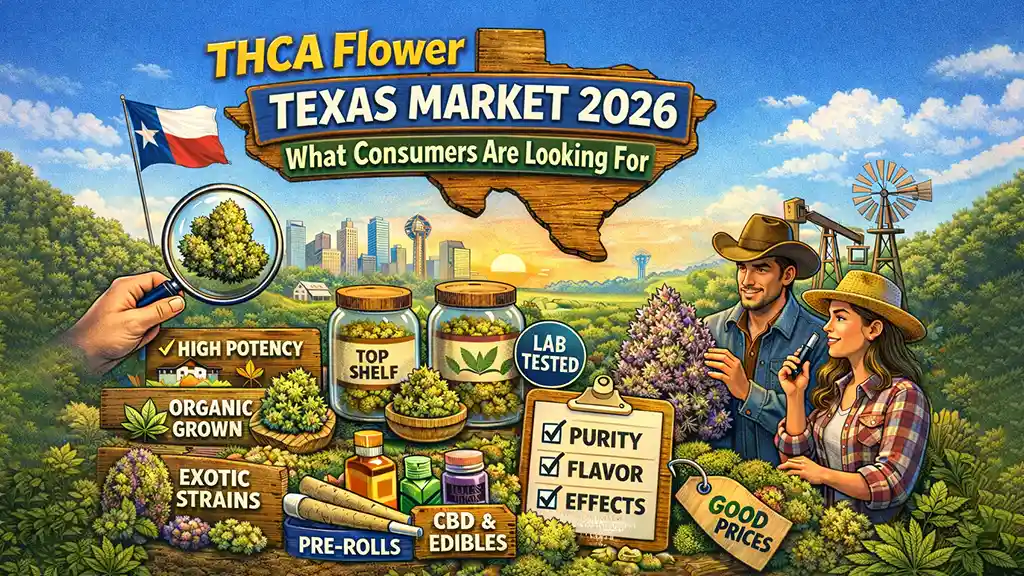
What’s blooming in Texas, pushing boundaries and rewriting rules, while shoppers lean in closer asking, “Is this the future or just another phase?” If you live or work anywhere near the hemp space, you already know the answer is not simple. Texas has never done simple. And that is exactly why this conversation matters right now.
Despite legislative pressure, louder headlines, and a maze of compliance updates, THCA Flower Texas Market has not slowed down. It has grown up. What started as a curiosity on smoke shop shelves has moved into a clear maturity and scaling phase, with defined buyers, sharper expectations, and real retail infrastructure behind it.
In the sections ahead, we will break down exactly what Texas buyers are looking for in 2026, how the legal landscape is shaping decisions, and why quality and clarity now matter more than noise.
What Texas Consumers Are Looking For in 2026
Less noise. More nuance. Zero shortcuts. If 2024 was about discovery and 2025 was about experimentation, then 2026 is about discernment. Texas consumers have grown sharp. They scroll slower, read labels longer, and ask better questions. Here is what that looks like on the ground.
- The Return of Real Flower
There is a clear and growing preference for raw, intact flowers. Not dusted. Not enhanced. Not misted with mystery solutions to boost numbers. Texas buyers want buds that look like they came straight off the plant and were handled with respect from harvest to jar.
The whole THCA flower trends, signals honesty. You can see the structure, feel the density, and judge the trim with your own eyes. Consumers now associate overly shiny or artificially loud buds with shortcuts. In 2026, subtle visual integrity wins trust faster than exaggerated potency claims.
- Strains People Actually Recognize
Another major shift is strain literacy. Shoppers are no longer impressed by madeup names designed only for shock value. They gravitate toward genetics that they recognize and can research on their own.
Classic strains like Blue Dreamand Sour Diesel continue to hold attention not because they are trendy, but because they are familiar reference points. Consumers use these names to compare aroma, structure, and overall experience.
- Terpenes Take the Lead
Potency used to dominate the conversation. In 2026, aroma and flavor will take center stage. Texas consumers now treat terpene profiles as the primary quality marker, not an afterthought.
Citrusheavy notes driven by limonene, earthy depth associated with myrcene, and complex blends that linger after the jar is opened are what shoppers remember. Many buyers will choose a lowernumbered flower with a richer terpene profile over something that only performs on paper. This shift reflects a more mature consumer mindset. It is not about chasing extremes. It is about selecting something that feels intentional.
- A Buyer Who Values Process, Not Promises
Underneath all these preferences is one unifying theme. Texas consumers want to understand the process. They care about how something was grown, how it was handled, and how honestly it is presented. Big claims without context no longer land. Clear explanations do.
The 2026 Legal Landscape: Staying Compliant in Texas
If consumers in 2026 are more discerning, regulators are just as alert. Because in Texas, the rules matter as much as the product. The Texas legal environment around THCA flower has become layered, technical, and fastmoving. Staying informed is no longer just a business requirement. It is a survival skill. Here is what defines the compliance reality right now.
- Executive Order GA56 and the 21+ Standard
One of the clearest guardrails in place is age restriction. Executive Order GA56 reinforced a strict 21 and over mandate for all intoxicating hempderived THCA product sales. This is not a suggestion. It is a hard line.
Every transaction requires governmentissued ID verification, whether the sale happens online or in person. Digital age verification tools have become standard for ecommerce, while brick and mortar stores have tightened in store protocols. In 2026, failure to verify age is viewed less as an oversight and more as negligence. For consumers, this has quietly increased confidence. For retailers, it has raised the bar on operational discipline.
- DSHS Rule Changes and the “Total THC” Question
January 2026 brought renewed attention to proposed rule changes from the Texas Department of State Health Services. The most consequential proposal centers on redefining “Total THC” to include THCA content, not just delta9 THC.
If implemented fully, this interpretation could effectively ban smokable THCA flower in Texas by late January 2026. The industry response has been swift and divided. Some argue it conflicts with legislative intent. Others see it as an administrative tightening of definitions.
- Federal Pressure and the November 12, 2026 Deadline
Beyond statelevel changes, federal law is looming large. By November 12, 2026, new federal definitions of “hemp” are expected to take effect. These definitions may place stricter limits on products that can produce intoxicating effects, regardless of how they are labeled.
This has introduced a longterm planning challenge for brands and retailers. Decisions made today about sourcing, product mix, and infrastructure need to account for what the market could look like postdeadline. The days of building shortterm inventory strategies without a regulatory horizon are over.
- The $20,000 Retail Fee and Market Consolidation
Perhaps the most tangible shift has been financial. Texas retail licensing fees have jumped dramatically, from roughly $150 to as much as $20,000. This single change has reshaped the landscape.
Smaller, undercapitalized operators are being squeezed out, while larger, wellstructured retailers are absorbing market share. The result is consolidation. Fewer stores, but more stable ones. Less chaos, more compliance.
How to Read a COA (Certificate of Analysis) in 2026
Because clarity beats confidence every time, and informed choices always age better than blind trust. Here are the key areas of reading a COA.
- Transparency is Key
In 2026, Texas consumers expect a third party COA for every batch, not hidden behind emails or QR codes that do not work. Easy access signals honesty and tells buyers the brand has nothing to mask or rush past.
- Compliance Check
A quick scan starts with delta9 THC staying below the 0.3 percent legal limit, followed by a clear listing of THCA content. Consumers now know the difference and check both numbers before trusting the label.
- Safety Testing
Top tier Texas brands treat clean results as non negotiable, with heavy metals, pesticides, and microbial contamination all coming back clear. If it is not tested and readable, it is simply not considered premium anymore.
Shopping Habits: Online vs. InStore in Texas
| Shopping Channel | What Consumers Prefer in 2026 | Why It Matters in Texas |
| Online Stores | Wider strain variety, competitive pricing, and seamless digital age verification | Online shopping allows Texans to compare genetics, terpene profiles, and COAs at their own pace while meeting strict 21+ compliance requirements |
| InStore Retail | Boutique style hemp shops in Austin, Dallas, and Houston with knowledgeable staff | These locations focus on education, strain guidance, and trust building, creating a curated experience rather than a quick transaction |
| DirecttoConsumer (DTC) | Repeat purchases, loyalty programs, and predictable seasonal buying patterns | DTC models help brands understand customer behavior, forecast demand, and build long term relationships beyond one time sales |
Potential Challenges and Future Outlook
The Texas THCA landscape in 2026 is not just about growth, it is about navigation. Opportunity exists, but only for those paying attention to the signals shaping the next phase of the market.
- The “Total THC” Threat: Administrative rule making continues to clash with legislative intent, creating uncertainty around how hempderived THCA is classified and sold. This ongoing tension keeps retailers and consumers alert, knowing that definitions alone can shift an entire category overnight.
- Farm Bill 2025/2026 Impact: The upcoming federal Farm Bill has the potential to redraw the boundaries of what qualifies as legal hemp by late 2026. Any changes at this level will ripple through state markets, forcing quick adaptation across sourcing, formulation, and retail strategy.
- Quality Over Hype: The market has outgrown exaggerated promises and vague wellness claims. In 2026, accountability, clear labeling, and verifiable data matter far more than loud marketing or trend driven language.
Looking ahead, the brands that survive will be the ones that plan for change instead of reacting to it. Flexibility, compliance, and transparency are no longer optional, they are the foundation.
Summing up: The Smart Texan’s Way to Shop
By 2026, shopping smart in Texas is about intention, not impulse. The savviest buyers are not chasing hype but THCA flower trends. They are checking age verification, reading COAs, understanding strains, and knowing exactly what is going into their stash before they ever roll. Indoor grown, strain specific, lab tested sustainable THCA flowers have become the baseline, not the bonus.
That is where Passion Farms fits naturally into the conversation. Built on clean cultivation, clear testing, and respect for the plant, Passion Farms helps Texans stock a stash they can trust and roll without second guessing. No shortcuts. No smoke and mirrors. Want to stay ahead of Texas regulations, market shifts, and what is actually worth rolling next?
Sign up, stay informed, and keep your circle sharp. In Texas, smart rolls last longer.
Frequently Asked Questions (FAQs)
1. Is THCA flower legal in Texas in 2026?
THCA flower remains legal in Texas as long as it complies with state and federal hemp laws, including delta9 THC staying below 0.3 percent. However, evolving DSHS rules and the broader THCA Flower Texas Market regulations mean consumers should stay updated before purchasing.
2. What is the difference between THCA flower and traditional THC products?
THCA flower contains tetrahydrocannabinolic acid in its raw form and falls under hemp-derived THCA when sourced legally. It differs from traditional THC products because legality is determined by delta9 THC levels, not total cannabinoids.
3. Why is lab-tested THCA flower important for consumers?
Lab-tested THCA flower ensures compliance, safety, and transparency. A valid COA confirms THC limits, verifies potency, and proves the product is free from contaminants like pesticides or heavy metals.
4. What trends are shaping consumer demand in 2026?
Key THCA flower trends include preference for indoor grown buds, terpene rich profiles, recognizable strains, and sustainable THCA flower cultivation practices.
5. Where can consumers find reliable wholesale and retail options in Texas?
Reputable retailers and distributors operating in the THCA Market in Texas prioritize compliance, education, and sourcing from trusted growers, including options for Wholesale THCA flower Texas buyers seeking consistency and scale.
Call: 346-449-5408 | Email Us: info@passionfarms.org | California, Oklahoma and Texas