
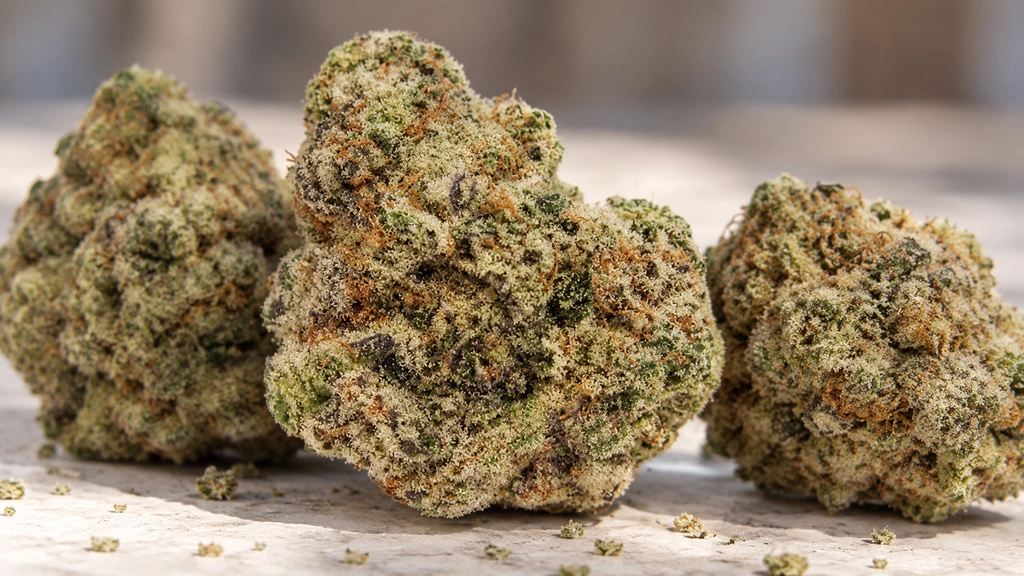
Miracle Alien Cookies is arguably one of the most well-known hybrid strains in today’s cannabis market. It is also among the most misunderstood. Half the flower sold under that name isn’t really Miracle Alien Cookies at all. The actual history involves a washing machine, a single surviving seedling, a fifteen-thousand-dollar Instagram auction, and an honor code that was bound to fail sooner or later.
-
Bulk Flowers
Illemonati THCa Flower
Price range: $300.00 through $9,000.00 Select options This product has multiple variants. The options may be chosen on the product page -
Bulk Flowers
Tangie Candy THCa Flower
Price range: $275.00 through $8,500.00 Select options This product has multiple variants. The options may be chosen on the product page -
Bulk Flowers
Schmega LCG THCa Flower
Price range: $300.00 through $9,250.00 Select options This product has multiple variants. The options may be chosen on the product page -
Bulk Flowers
Blue Runtz THCA Flower
Price range: $400.00 through $12,000.00 Select options This product has multiple variants. The options may be chosen on the product page -
Bulk Flowers
Blueberry Belts THCa Flower
Price range: $400.00 through $12,500.00 Select options This product has multiple variants. The options may be chosen on the product page -
Bulk Flowers
MOB 342 THCa Flower
Price range: $375.00 through $11,500.00 Select options This product has multiple variants. The options may be chosen on the product page
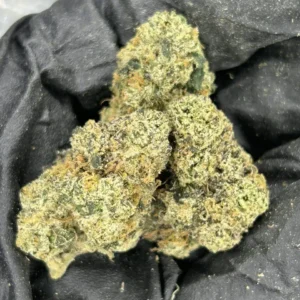
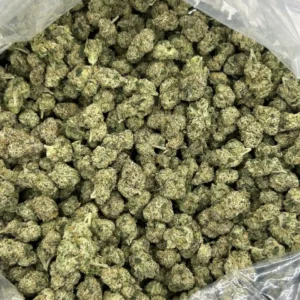
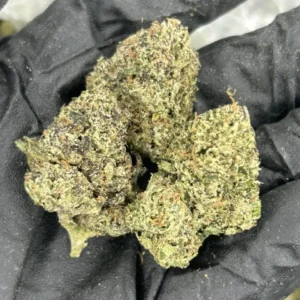
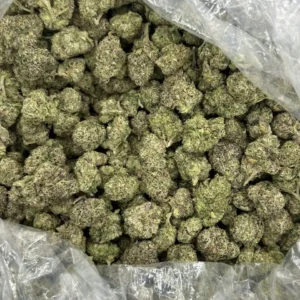
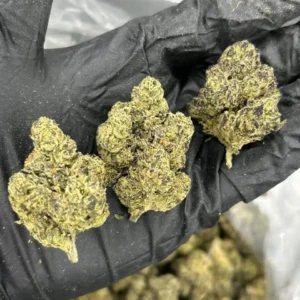
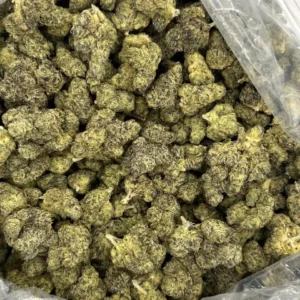
This guide covers the genuine genetics, the honest lab numbers, and the real signs of superior MAC.
What Is the Miracle Alien Cookies Strain?
Miracle Alien Cookies, usually abbreviated to MAC, is a balanced hybrid developed by the California breeder Capulator from Alien Cookies F2 #7 and a male called Miracle 15.
It built its reputation on two things. The first is appearance: MAC is one of the most heavily trichome-covered cultivars in commercial cannabis, with buds so frosted they read closer to white than green. The second is the nose – a blend of creamy citrus over diesel with a cookie-dough base underneath.
The name has since expanded well beyond the original plant. Today, MAC describes a seed line, an elite clone-only cut, a family of hybrids, and – on hemp menus – a general flavor category. You will also see it listed as the miracle cookies strain, which refers to the same genetics. That drift is precisely why buyers get fooled, and it is worth understanding before you spend money on anything wearing the label. If you are shopping the premium tier generally, our guide to exotic THCA flower covers what that term should actually mean.
The Real Origin Story Behind the Name
The “Miracle” in Miracle Alien Cookies is literal, and the story is documented rather than invented.
Capulator described the process directly in a 2019 interview with Cannabis Now. He had crossed Starfighter with a Colombian landrace he collected himself while traveling in South America, then left the seeds lying around and ran them through the wash. His partner rescued them, germinated them on a wet paper towel, and every seed sprouted. Then, at two weeks old and two inches tall, all of them died except seed number fifteen.
He named it “Miracle 15.” The plant was male, so it never produced smokable flower – it existed purely for breeding, and crossing it onto an Alien Cookies female produced MAC. Capulator has also joked that the letters stand for Mother of All Cookies. Strains with origin stories, this specific tends to hold its reputation, much like Lemon Cherry Gelato has in the exotic tier.
Miracle Alien Cookies Strain Genetics and Lineage
MAC’s family tree is frequently garbled online, so here is the accurate version.
The mother is Alien Cookies F2 #7, bred by JAWS Genetics from Alien Dawg and Girl Scout Cookies genetics, then selected by Capulator as essentially the best flower most people would ever smoke. The father is Miracle 15, the Starfighter × Colombian landrace survivor.
Two mistakes show up constantly. The Colombian parent was not Colombian Gold, bought from a seed bank – Capulator has said the genetics were acquired personally. And “Alien Cookies crossed with Starfighter and Colombian” does not tell the whole story, because that description collapses two generations of breeding into one.
In terms of what the pairing produces: Alien Cookies supplies the resin production and dessert structure, while the Colombian side contributes brightness and citrus-driven energy. That same dessert lineage runs through cultivars like Black Cherry Gelato.
MAC vs MAC 1 vs MAC Runtz: What’s Actually Different
These three names get used interchangeably. They shouldn’t be – they describe three genuinely different things.
MAC: the seed line
MAC represents the entire population created through that initial cross. Individual plants grown from MAC seed differ considerably, which is why two growers working from the same pack can produce noticeably different flowers.
MAC 1: the clone-only cut
MAC 1, also called “The MAC” or “Cap’s Cut,” is one particular phenotype Capulator selected out of that population and preserved as a clone. It has never been sold as seed by him. Every genuine MAC 1 plant descends from a cutting of that single mother.
MAC Runtz: a separate strain
The Mac Runtz strain is a different hybrid altogether – a cross between MAC and Runtz. It has its own flavor, much sweeter and more candy-forward than MAC’s citrus-and-gas profile. If you are searching for MAC Runtz, you are looking at a hybrid descended from MAC rather than MAC itself.
| MAC | MAC 1 | MAC Runtz | |
| What it is | Seed line | Single clone-only cut | Separate cross |
| Genetics | Alien Cookies F2 × Miracle 15 | Selected MAC phenotype | MAC × Runtz |
| Available as seed? | Yes | No, never from Capulator | Yes, various breeders |
| Consistency | Varies plant to plant | Identical by cloning | Varies by breeder |
| Flavor lean | Citrus, cream, gas | Citrus, cream, gas | Sweeter, candy-forward |
Naming confusion like this is common across the market, which is why our bulk flower lineup lists genetics rather than relying on the strain name alone.
Is the MAC Strain Indica or Sativa?
MAC is an even 50/50 hybrid, with effects that tend to favor energized, clear-headed states over sedation.
The confusion is real, and it has a cause. Virtually all seed banks and retailers list MAC as a balanced hybrid. Leafly’s aggregated review data describes the effect profile as energizing, happy, and uplifting. Yet plenty of consumer reviews describe a heavy, relaxed finish that sounds distinctly indica.
All of that can be true at once. MAC is phenotype-dependent – individual plants from the same seed line express differently. Harvest timing amplifies it: a flower pulled at peak trichome clarity reads brighter and more cerebral, while a later harvest with more amber reads heavier. Cure quality and dose shift it further.
So the honest answer to whether the MAC strain is indica or sativa: structurally balanced, energizing at moderate doses, more relaxing at higher ones, or from later-harvested batches. Our strain families breakdown explains how these categories actually work in practice.
Appearance, Aroma, and Flavor
MAC’s appearance is what made it famous, and it is genuinely distinctive rather than marketing language.
Appearance
Grown properly, MAC yields dense, compact buds with little foliage, covered in trichome frosting thick enough that barely any green shows through. Growers report resin heavy enough to curl the fan leaves. Pistils run orange to brass, and a colder finish can pull purple through the flower.
Aroma
The first impression is sour and citrusy – closer to zesting an orange than lemon candy – followed by diesel and a sour funk, with cream and floral notes underneath. Some cuts carry a soft incense character attributed to bisabolol, a relatively uncommon terpene.
Flavor
The taste follows the nose: citrus first, cookie dough and cream through the middle, then gas on the exhale. That layering is part of why MAC stayed relevant while flashier strains cycled out. It is the same quality you find across well-grown indoor exotic flower.
THC Content and Terpene Profile
Typical MAC THC content sits in the low-to-mid twenties, not the 30%+ figures found on some menus.
This matters because inflated potency numbers are the single most common marketing lie in cannabis retail. Credible lab-referencing sources cluster tightly. Secret Nature reports 20-23%. Diesel Hemp reports 20-26%. Strainpedia lists MAC 1 at 20-24%. One user-submitted lab result from a Michigan batch came back at 23.18% THC with 1.82% total terpenes. AllBud’s 14-20% sits at the low end, and anything claiming 30%+ is suspect – it likely belongs to a different cultivar.
That 1.82% terpene figure is arguably the more telling number. MAC’s value is aromatic intensity, not raw potency.
| Compound | Typical range | Notes |
| THC | 20-26% | Elite indoor occasionally 27%+ |
| CBD | Under 1% | Negligible |
| CBG | 0.3-1.0% | Minor presence |
| Total terpenes | 1.5-2.0% | High drives the profile |
| Limonene | Dominant | Citrus lift |
| Caryophyllene | Secondary | Pepper, gas |
| Pinene | Secondary | Sharp, pine |
| Bisabolol | Trace | Soft incense note |
If those numbers don’t mean much to you yet, learning to read a COA is the fastest way to stop guessing.
Why Is MAC Difficult to Grow?
MAC is challenging because it grows slowly, feeds sensitively, and demands precision at every stage – which is exactly why quality varies so much on shelves.
The cultivator himself pointed out that the true cut takes longer in vegetative growth, and experienced growers use that slowness as an authenticity check. Rapid early growth in something sold as MAC 1 is a red flag rather than an advantage.
Beyond pace, the plant is nutrient-sensitive, burns easily, and locks out if overfed. The core specs:
- Flowering period: 8-10 weeks
- Yield: 400-500 g/m² indoors, below high-output commercial strains
- Temperature: roughly 20-26°C, with humidity controlled through flowering
- Environment: prefers drier air and strict climate control
- Difficulty: experienced growers only, mainly due to feeding sensitivity
A grower chasing volume will lose money on MAC. A grower chasing bag appeal gets paid back for the effort, which is the logic behind how we run our own grows in California and Oklahoma.
What Separates Good MAC From Bad
The gap between good MAC and bad MAC is wider than almost any strain on the market, and it comes down to the grower rather than the genetics.
Check the frost first
True MAC frost should read genuinely pale – an even, dense layer of trichomes, not spotty sparkle sitting on a few sugar leaves. Under magnification, you want whole trichome heads, not stalks sheared off by rough handling.
Trust your nose
Real MAC brings citrus and gas together. A jar that smells generically sweet with no sour or fuel edge means the terpenes either never developed or were lost in the dry.
Read the cure in the structure
Buds should be dense but give slightly under pressure. Bone-dry and crumbling means over-dried; spongy means rushed.
Ask for the COA
Then read the terpene total, not just the THC line. MAC at 22% with 2% terpenes will smoke better than MAC at 27% with 1%. Most disappointing purchases trace back to mislabeled mids rather than bad genetics.
How to Spot an Authentic MAC 1
There is no trademark on MAC 1, no registry, and no enforcement – which is precisely why verification falls to the buyer.
Capulator released the cut in a controlled way, sending it only to growers he felt took the plant seriously, specifically so it wouldn’t be diluted the way Gorilla Glue #4 and GSC had been. He has publicly admitted the system failed: the rule was misunderstood, miscommunicated, or ignored by people he trusted. Federal prohibition makes cannabis genetics effectively untrademarkable, so reputation was the only protection available to him.
In practical terms, that leaves four things to check:
- Provenance. Buy from operations that disclose where their cut came from and can explain it.
- Unsupported claims. Treat any “authentic Cap’s Cut” label with no backing as marketing.
- Growth pace. Early vigor and rapid growth suggest a fake MAC 1.
- Context. On a hemp-derived menu, “MAC” is more often a flavor description than a genetic claim.
Any supplier worth buying from will answer questions about COAs and sourcing without hesitation.
Miracle Alien Cookies in the THCA Market
MAC sold as THCA flower is genetically the same plant – the difference is regulatory rather than botanical.
THCA is the acidic compound that converts to THC when heated. Hemp-compliant flower is cultivated and harvested to stay under the federal delta-9 limit of 0.3% by dry weight while still carrying substantial THCA. Sourced properly, MAC THCA should be the same cultivar a licensed dispensary would sell.
There is one drawback: because the name is unprotected, it cannot be relied on by itself. Some of what’s sold as MAC is genuine. Some is a different cookies-family cross renamed for shelf appeal.
So judge the flower, not the label. A current COA with cannabinoid and terpene content, visible frost, a citrus-and-gas nose, and a supplier who will discuss where the plant was grown will tell you far more than the name ever can. For buyers moving weight, our bulk buying guide covers pricing, margins, and storage.
The Bottom Line
MAC earned its status the hard way: proven lineage, resin production that still sets the benchmark, and a flavor profile nobody has convincingly reproduced. What it never earned was protection. The name gets used without restriction, and the flower wearing it ranges from award-winning to forgettable.
That makes MAC a useful test of how you buy cannabis generally. Numbers on a label are easy to inflate. Frost coverage, terpene content, an accurate COA, and a supplier willing to talk about sourcing are much harder to fake.
That last part is the whole reason Passion Farms exists. We cultivate in California and Oklahoma and distribute out of Houston, which means we see the same cultivar grown by different hands, in different rooms, under different conditions – and we know exactly how much that changes what ends up in the jar. Every batch ships with its own lab report. Judge the bud in front of you rather than the story attached to it, and MAC will keep living up to the legend.
FAQs
1. Is Miracle Alien Cookies the same as MAC?
Yes. MAC is simply the abbreviation for Miracle Alien Cookies, and both refer to the same Capulator-bred hybrid. It is sometimes listed as Miracle Cookies or, in certain markets, “The MAC” – though that last name more specifically describes the MAC 1 clone-only cut.
2. Is the MAC strain indica or sativa?
MAC is a well-balanced hybrid, usually considered 50/50. User feedback indicates it delivers energy and clarity more than sedation. Experience varies by phenotype, harvest timing, and dose, which explains why sources disagree so often on this question.
3. Who bred Miracle Alien Cookies?
MAC was created by Capulator, a California breeder, by crossing Alien Cookies F2 #7 with a male called Miracle 15. He has discussed the breeding process publicly, including in a widely cited 2019 interview published by Cannabis Now.
4. What does MAC stand for?
MAC means Miracle Alien Cookies. The “Miracle” refers to Miracle 15, the single seedling that survived after Capulator accidentally put a batch of seeds through the wash, and every other sprout died. He has also jokingly interpreted the acronym as Mother of All Cookies.
5. How strong are Miracle Alien Cookies?
MAC typically comes in between 20% and 26% THC, which is genuinely strong without being an outlier. Anything claiming more than 30% should be validated against a certificate of analysis. Total terpenes, usually 1.5% to 2.0%, play a large part in the experience.
6. What is MAC 1, and why is it special?
MAC 1 is a single phenotype Capulator selected from the MAC seed line and preserved only as a clone. He never released it as a seed. Its reputation rests on exceptional trichome coverage and consistency, since every legitimate plant shares the genetics of that original mother.
7. Is MAC Runtz the same strain as MAC?
No. The Mac Runtz strain is a separate hybrid produced by crossing MAC with Runtz. It shares traits with both parents but has its own flavor, tending sweeter and more candy-like than MAC’s citrus-and-diesel character. Treat it as a related strain, not an alternative name.
8. What terpenes does MAC contain?
Limonene dominates, producing the citrus aroma MAC is known for, followed by caryophyllene and pinene. Some batches also show bisabolol, an uncommon terpene responsible for the incense-like note experienced growers describe. Total terpene content generally ranges from 1.5% to 2.0%.
9. Is MAC difficult to grow?
Yes, MAC is best suited to experienced growers. It grows slowly, reacts badly to overfeeding, and needs careful environmental control with relatively low humidity. Flowering runs 8-10 weeks with moderate yields, making it a quality cultivar rather than a commercial volume play.

