

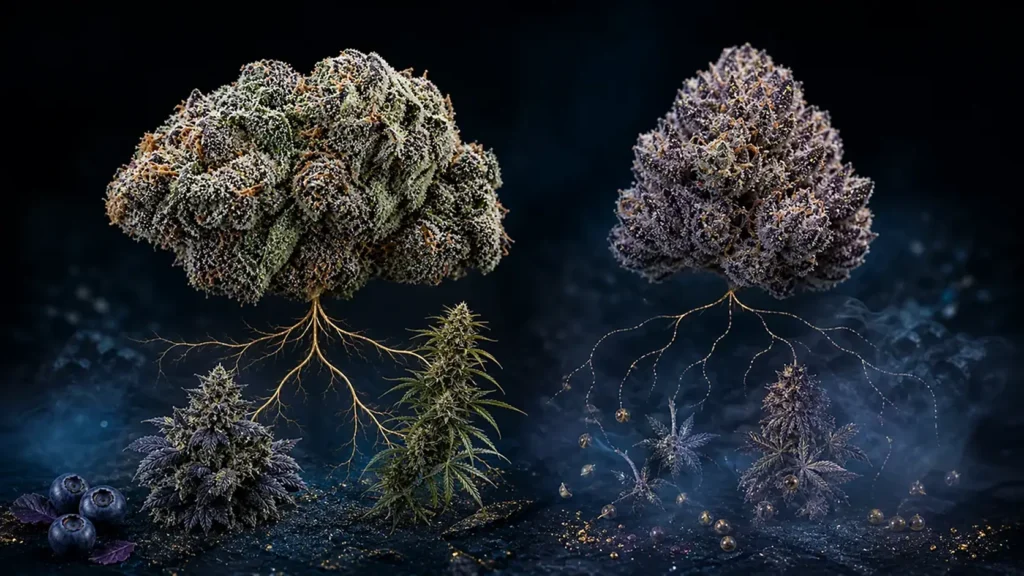
Two jars on a counter. One says Blue Dream, one says Blueberry Dream. The customer holding them swears it’s the same strain in two outfits, the budtender swears it isn’t, and both are half right. Which is the most annoying kind of argument to walk past, so let’s settle it.
The blueberry dream strain and Blue Dream are not the same strain, but the difference isn’t what most people think it is. Blue Dream is a documented legend: DJ Short’s Blueberry crossed with Haze, born in Santa Cruz, roughly 60 percent sativa, with a paper trail any grower can recite from memory. Blueberry Dream is a menu name without a fixed pedigree. Depending on who grew it, that jar might hold an honest Blueberry cross, a relative of Blue Dream itself, or a marketing decision.
One strain has a birth certificate. The other has a vibe.
That asymmetry is the whole story, and it changes how you should buy both. Here’s the family tree, the mix-up economics, the grow-room angle, and the questions that reveal what’s actually in the jar.
The Short Answer
Blue Dream is a specific, famous cultivar. Blueberry crossed with Haze, sativa-leaning, originally a California clone passed hand to hand for years before seed makers reverse-engineered their own versions. Blueberry Dream is a strain name that different growers attach to different genetics. The big strain databases list a sativa-dominant hybrid under the name, but no single agreed parentage sits behind it the way one sits behind Blue Dream.
So, same strain? No. And also: it depends which Blueberry Dream you were handed. If that sounds like a cop-out, it isn’t. It’s the most useful thing you can know before spending money on either name.
The reliable move in the blue family never changes. Ask what it was crossed from. A grower who knows answers in one sentence. A grower who shrugs also answered, just not the question you asked.
Blue Dream: The One With the Birth Certificate
Some strains get famous off one viral season. Blue Dream ran the entire 2010s. For most of a decade it was the best-selling flower in legal America, the default recommendation for nervous first-timers, the name your cousin who “doesn’t really smoke” still recognizes. The reasons start with the parents.
The mother is Blueberry, DJ Short’s indica masterpiece from the 90s, a Cannabis Cup winner famous for actually tasting like the fruit on the label. The father is Haze, the towering sativa line that gave half of modern cannabis its engine. Cross them and you get the balance that made this strain untouchable: a 60/40 sativa lean, berry on the nose with a sharp sweet exhale, and a lift that rises without launching you. Works at 10 a.m., works at 10 p.m., hard to overdo. The people’s champ.
The origin story feeds the legend too. Blue Dream came up as a clone-only cut out of Santa Cruz. For years the real thing physically traveled as cuttings, garden to garden, no seeds sold anywhere. Seed companies eventually rebuilt it from the parent genetics, which is why Blue Dream from one state can smoke a touch different from another. Same recipe. Different kitchens.
We keep the full breakdown, numbers, and what our own cut runs like in the Blue Dream strain guide, so this piece can stay locked on the comparison. For the vs question, carry one sentence forward: Blue Dream is the strain with the documented story, and everything in the next section is defined by not having one.
Blueberry Dream Strain: The Name Without Papers
Now the other jar. Look up the blueberry dream strain on the big databases and you’ll find a sativa-dominant hybrid, berry flavor, mellow creative lean. Close enough to Blue Dream’s profile to explain every counter argument ever had about them. Here’s what you will not find: an agreed set of parents. Some listings trace it to Blueberry crossed with a Haze relative. Some growers sell a Blueberry x Blue Dream cross under the name. And some jars labeled Blueberry Dream are, frankly, Blue Dream wearing a promotional jacket.
None of that makes the flower bad. Some Blueberry Dream cuts smoke beautifully, better than tired Blue Dream in the same case sometimes. It makes the NAME unreliable, which is a different problem than quality. Sneakier, too.
The label’s biggest moment came from exactly the world you’d guess. In 2015, Snoop’s Leafs by Snoop line carried a Blueberry Dream, and the Denver Post’s cannabis desk reviewed it the way a wine column handles a new vintage. Celebrity menu, major newspaper, real numbers. The high-water mark of the name. And even then it didn’t come with a pedigree the industry agreed on.
That’s the honest read in 2026. Blueberry Dream is a name with genuine market presence, genuine search demand, and often genuine flower behind it, attached to genetics that change depending on whose garden it left. Treat the label as the start of a conversation with your supplier. Never the end of one.
Side by Side: What Each Name Actually Guarantees
The comparison laid flat, including the row nobody else prints: what the name on the jar actually promises.
| Blue Dream | Blueberry Dream | |
| Documented lineage | Yes: Blueberry x Haze | No fixed pedigree; varies by grower |
| Typical lean | ~60/40 sativa | Usually sold sativa-dominant |
| Flavor lane | Blueberry over sweet haze | Berry-forward, varies with the cut |
| Origin story | Santa Cruz clone-only legend | Market name, no single origin |
| Fame | Best-seller of the legal era | Leafs by Snoop menu, 2015 |
| What the name guarantees | A known recipe | A flavor direction, not genetics |
| How to verify | Any grower can recite the cross | Ask the specific grower, every time |
When to pick which? Want the known quantity, the strain equivalent of ordering the classic? Blue Dream, by a mile, with decades of consistency behind the name. Strain-curious, and your supplier can actually say what their Blueberry Dream is crossed from? It can be a great buy, occasionally the better one, because unfamous names don’t carry famous markups.
And if the seller can’t answer the lineage question, understand what changed. You’re no longer choosing between two strains. You’re choosing between a strain and a story, and stories don’t have terpene profiles.
The Third Name in the Mix: Blueberry Haze, and the Parent of It All
The blue family confusion doesn’t stop at two names. Meet the third: Blueberry Haze, which is what happens when a different breeder runs nearly the same recipe. Where Blue Dream emerged as a Santa Cruz clone, Blueberry Haze was built by a seed company from the same style of pairing, Blueberry genetics put to Haze. Sibling recipes, different kitchens. Most people find it leans harder into the racy Haze side, quicker heartbeat, less of Blue Dream’s soft landing.
Behind all three names stands the actual patriarch. Blueberry itself. DJ Short spent the 90s refining it, it took Cannabis Cup gold in 2000, and a generation later it’s still one of the most-searched strains on earth. Every dreamy, hazy, berry-named jar on a modern menu is drafting off that one plant’s reputation. Respect where it’s due.
So here’s the family tree, cleaned up. Blueberry is the parent. Blue Dream is the famous child with the documented birth. Blueberry Haze is the cousin with the same grandparents and a different temperament. And Blueberry Dream is the name that showed up to the reunion wearing the family colors, and depending on the grower, it might genuinely belong there.
Our strain library overview maps how we organize families like this across the whole menu. Once you see strains as families instead of one-off names, every wall makes more sense.
Why Menus Mix Them Up
Real talk about how this happens, because it isn’t always shady. It’s just always unexamined.
Strain names sell. Blue Dream spent ten years as the most recognizable name in flower, so anything blue and dreamy borrows its glow. A grower holding a berry-leaning cross with no famous name faces a real choice: market an unknown honestly, or pick a name adjacent to a legend. Blueberry Dream splits that difference. Sometimes it’s an honest christening for an honest cross. Sometimes it’s a Blue Dream cut somebody renamed to stand out on a crowded menu, which is backwards, but menus are written by humans with sales targets.
The timeline explains the temptation. Blue Dream’s fame peaked through the 2010s, the Snoop-menu moment put the Blueberry Dream name on national shelves in 2015, and then the exotic era arrived and made classic names feel like your uncle’s strains. The workaround the market found: keep the trusted family flavor, freshen the label. Same reason Wedding Cake spawned a bakery’s worth of layered variants competing for one strain’s shine. Names are the least regulated thing in this industry. That’s not cynicism. That’s a shopping instruction.
Now, what paperwork can and can’t fix. A COA proves potency and cleanliness: cannabinoid numbers, pass or fail on the lab panel. It does not genetically fingerprint a strain. So verification for a name like Blueberry Dream runs two layers. The COA covers what’s measurable. The grower’s lineage answer covers what isn’t. You want both, and only one can be printed.
How Each One Smokes
Blue Dream first, the known quantity. The classic experience is the whole reason it conquered a decade: a bright, clear lift that arrives without anxiety riding shotgun, berry sweetness in, soft relaxation underneath, a high that never demands the rest of your day. Modern cuts typically test high-teens to mid-20s THCA. Strong but civilized. If you’re hunting the ceiling instead, our strongest flower rankings cover different territory entirely.
Blueberry Dream is where honesty makes this section harder to write, and we’re writing it anyway. The experience depends on which cut your grower runs. The database consensus says mellow creative sativa with heavy berry flavor, and the good cuts we’ve handled match it: sweeter than Blue Dream, softer takeoff, a touch more couch-adjacent on the landing. A Blueberry Dream built from different parents will read different, and pretending otherwise is exactly the kind of review this article exists to call out.
First-timer picking between the jars? Take Blue Dream and thank yourself later. Its whole legend is built on being forgiving. Save the mystery cut for the day you know your tolerance and your taste well enough to grade it.
One practical note for both: the berry terps in this family are volatile, first thing that bad storage murders. Whichever dream you buy, the flower care basics matter more here than with gassier strains. A blue-family jar that summered in a hot case smells like nothing, and a blueberry strain that smells like nothing is a paperweight with a nice label.
Growing the Blue Family
Quick grow-room detour, because the search data says plenty of you are asking about blue dream strain flower time, and the answer explains half of why this strain took over the world.
Blue Dream flowers in roughly nine to ten weeks, which is standard for a sativa lean, but here’s the part growers love: it yields like a plant twice its trouble. Vigorous growth, forgiving of beginner mistakes, big stretch after the flip, and heavy colas that made it the commercial grower’s best friend for a decade. Easy to grow plus easy to sell is how a strain ends up on every menu in America. The economics grew the legend as much as the flavor did.
The Blueberry side of the family brings the pretty. DJ Short’s line is famous for throwing purple and blue hues when night temperatures drop late in flower, which is where every jar photo with a violet tint comes from. Color is genetics plus weather, not potency, so admire the purple and read the COA anyway.
And the family trait that matters for buyers: because the real Blue Dream started clone-only, cut quality varies more than the name suggests. Two grows can run the same label and finish weeks apart in quality. Genetics load the gun. The grow pulls the trigger.
One more grow-side fact that quietly explains your shopping options. Heavy yielders like Blue Dream throw off plenty of smaller nugs alongside the show colas every harvest, and that is the entire small buds economy: same plant, same lab results, friendlier price. The blue family makes that trade especially kind, because the berry terps live in the trichomes, not in the nug size. A half-sized Blue Dream nug smokes exactly like the big one next to it. It just photographs worse, and photographs were never the point of any of this.
Buying the Blue Family Without Getting Played
The checklist, built from every mislabeled blue jar that’s ever crossed our counter.
Lineage question first: what’s this crossed from? For Blue Dream the answer should be instant. Blueberry and Haze, no hesitation, maybe a bored tone because they’ve said it a thousand times. For Blueberry Dream, any confident specific answer beats a famous vague one. The grower who says “our Blueberry mother to a Dream cut, leans sweet, finishes soft” just earned the sale. The one who says “it’s like Blue Dream but better” is doing improv.
Then the nose, because the blue family is generous to buyers here. Real Blueberry lineage announces itself: sweet berry that reads as fruit, not as candy flavoring. A jar labeled anything-blueberry that smells generic and green has a name working harder than the flower.
Three red flags from the wild, free of charge. A berry smell that reads like syrup, that’s flavoring talk, not terpenes. A Blueberry Dream priced above Blue Dream with no lineage answer attached, that’s a story tax. And a menu where every strain somehow tests 30-plus percent, that’s a menu that thinks you can’t read.
On our side of the counter, the blue family is stocked and papered. Beyond Blueberry is the deep-berry indoor cut for people who want the fruit turned all the way up. Blue Zuchi runs the modern-exotic end of the blue line. Both ship with COAs, and both come from grows we can answer lineage questions about, because we grow them. Quantity buyers run the same cuts by the pound through the bulk flower shelf, and whatever’s live right now is on the menu with the paperwork one click deep.
Last tell: price behavior. Blue Dream’s fame keeps its price honest, too many sellers for gouging to hold. Blueberry Dream floats, because unfamous names have no reference price. If a Blueberry Dream costs Blue Dream money, the lineage answer had better be excellent.
Menu Integrity: A Note for Shops
Retail buyers, this section is yours and only yours. Mislabeling the blue family costs shops money in one specific, repeatable way: a customer loves “Blueberry Dream,” comes back for it, gets this month’s different cut wearing the same name, hates it, and quietly stops trusting your entire wall. The name did that damage. Not the flower.
The fix is boring and it works. Menu names tied to actual lineage, batch labels that match COAs, and a supplier who can answer the crossed-from question for every SKU in the case. Our wholesale bulk buyer’s guide covers how lineage documentation rides along on case orders, and if you want blue-family cuts your budtenders can describe accurately twice in a row, reach us through the contact page. Real grows, real answers, boring paperwork. That’s the whole pitch.
Blue Family Questions, Answered Straight
The versions of the counter argument that land in our inbox, settled. Longer list on the FAQ page.
Are Blueberry Dream and Blue Dream the same strain?
No. Blue Dream is a documented Blueberry x Haze cross out of Santa Cruz. Blueberry Dream is a menu name without one fixed pedigree, and the jar’s contents vary by grower. Same family colors, not the same plant.
What strain is Blueberry Dream?
Databases list a sativa-dominant hybrid with berry flavor, but the parentage isn’t standardized. Some cuts trace to Blueberry crossed with Haze relatives, some to Blue Dream itself, some are anyone’s guess. The grower’s answer outranks the label.
Is Blueberry Dream indica or sativa?
Usually sold sativa-dominant, and the well-known cuts smoke that way: mellow lift, soft finish. Since the genetics vary by source, so does the lean. Ask about the specific cut in front of you.
Is Blue Dream indica or sativa?
Sativa-dominant, roughly 60/40. Haze supplies the lift, Blueberry supplies the flavor and the soft landing. That balance is the fame.
What is Blue Dream crossed with?
Blueberry and Haze. The mother is DJ Short’s Cannabis Cup-winning Blueberry, the father is classic Haze. Public record, which is exactly what separates it from its imitators.
Is Blueberry Haze the same as Blue Dream?
No, but they’re cousins built from the same style of cross, Blueberry to Haze, by different breeders. Blueberry Haze typically leans harder into the racy Haze side. Blue Dream keeps the smoother balance that made it the bigger name.
Did Snoop really have a Blueberry Dream strain?
Yes. The Leafs by Snoop line carried a Blueberry Dream in 2015 and the Denver Post reviewed it. Biggest moment the name ever had, and the pedigree question still walked away unanswered.
Which one is stronger?
Neither name guarantees strength. Blue Dream cuts typically test high-teens to mid-20s THCA, and a given Blueberry Dream can land under or over that. The COA settles it, not the label.
How long does Blue Dream take to flower?
Nine to ten weeks, typically, with a big stretch and famously heavy yields. That grower-friendly math is a quiet reason the strain ended up everywhere. Easy to grow travels as fast as easy to smoke.
Is Blue Dream still worth it in 2026?
Yes, and don’t let strain-of-the-week culture argue otherwise. It stopped being the flashiest jar years ago and became something better: the one that smokes the same excellent way every time. There’s a reason it never left the menus.
How do I know which one is actually in my jar?
Two layers. The COA proves potency and cleanliness. The grower’s lineage answer proves the name. Get one without the other and the flower is real weed either way, but the label is unverified, so pay mystery prices, not legend prices.
Does Passion Farms carry blue-family strains?
Yes. Beyond Blueberry and Blue Zuchi hold down the blue line, grown in-house with COAs attached, singles through bulk on the same checkout. Ask what they’re crossed from. We like customers who ask that.
Two Jars, One Rule
The counter argument has an ending now. Blue Dream and the blueberry dream strain are not the same plant. They’re a legend and a label, and the label sometimes points at excellent flower and sometimes points at marketing with a berry candle lit behind it. The rule that survives every version of the mix-up fits in one line: buy genetics you can verify, or pay prices that admit you can’t.
The blue family earned its fame the honest way, one grower and one jar at a time. The names got complicated along the road. The flower never did.
Ask the crossed-from question wherever you shop. Around here we answer it before you finish asking.
