

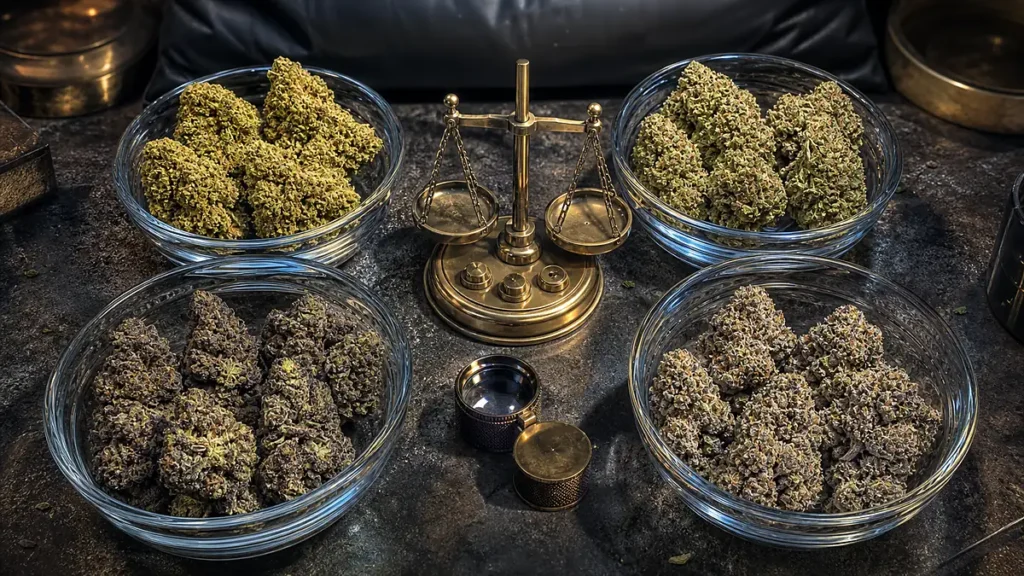
The pound minimum killed more good buyers than bad product ever did.
You know the situation. You want to move up from ounces, the supplier says pound or nothing, and now you’re holding sixteen ounces of one strain you’ve smoked exactly twice. If it’s fire, you look like a genius for eight weeks. If it’s mid, you’re eating that mistake until Croptober. That bet has ended more runs than any price ever did.
So the minimum is gone. Quarter pounds and half pounds are live on our bulk flower shelf now, sitting in the same dropdown as the 1 through 10 pound options, same flower, same labs, smaller commitment. A QP starts at $125 on the value tier and runs $250 to $400 for the premium lanes.
Straight talk before we go further, because this part gets oversold everywhere else: there is no mix-and-match bundle here. No four-for-one discount, no variety pack pricing. Each quarter pound is priced on its own, and buying four different ones costs more per gram than buying one pound of a single strain. What the QP tier actually buys you is the right to be wrong cheaply, and that turns out to be worth more than the discount you’re not getting. Here’s the real math.
The Short Answer on QPs
A quarter pound is four ounces, roughly 113 grams, and it’s now the entry point to bulk pricing instead of the pound. On our shelf that’s $125 on value strains and $250 to $400 across the premium tiers, with half pounds and pounds stacked above it.
The reason to care isn’t a bundle deal, it’s risk. Four QPs of four different strains costs somewhere around $1,000 to $1,300 depending on tier. One pound of one strain runs $850 to $1,350. Similar money, completely different exposure. One buy teaches you one thing. The other teaches you four things and leaves you three winners when one misses.
If you already know exactly what moves and you’re reordering it, buy the pound. It’s cheaper per gram and it always will be. The QP is for everyone who isn’t there yet.
What Changed: No More Pound Minimum
For most of our run, bulk meant pounds. That’s how the supply side prefers it, and plenty of buyers who wanted in couldn’t get in.
Quarter pound and half pound are now unit options on every bulk listing, next to the 1 through 10 pound tiers. Not a clearance lane, not leftovers. Same jars, cut smaller.
One thing to know before you shop: the catalog is deep and stock rotates hard. Hundreds of strains cycle through the system and only a few dozen are live at any moment, because bulk flower sells through and drops get replaced. That’s not scarcity marketing, that’s what a real menu looks like when it isn’t warehousing the same product for a year. Check what’s in stock the day you buy, because last month’s list is not today’s list.
Which is the strongest argument for variety there is. When the menu moves that fast, four QPs teach you the current shelf. One pound teaches you one thing about a shelf that already changed.
What a Quarter Pound Actually Costs
Real numbers off live listings. These shift as drops rotate, so treat them as the shape of the pricing, not a permanent quote.
| Strain | QP | 1 lb (singles) | 1 lb (wholesale) |
| Seeded Deps | $125 | value tier | value tier |
| Pink Runtz | $250 | $850 | $750 |
| Grease Monkey | $250 | $850 | $750 |
| Gumbo | $400 | $1,350 | $1,250 |
Note the three-price ladder on every listing: singles, multiples, wholesale. Buy one pound and you pay the singles price. Buy several pounds of the same strain and you drop to multiples, then wholesale. The discount ladder rewards buying deep on one strain, which is exactly the behavior the QP tier lets you skip.
Now run the honest comparison. Pink Runtz at the QP is $250, so four different QPs at that tier is $1,000. One pound of Pink Runtz as a single-pound buy is $850. You are paying about 18 percent more for the variety, and anybody telling you variety is free is selling you something.
Here’s why that premium is usually cheap anyway. One pound of a strain that doesn’t move is $850 sitting in a jar. Four QPs where one misses costs you $250 and hands you three that work plus real information about what your people want. The variety premium is insurance, and insurance only looks expensive when nothing goes wrong.
Mix across tiers and it gets more interesting. A $125 value QP plus two $250 mids plus one $400 top shelf is $1,025 covering four price points you can actually sell to. Try covering that spread with one pound of anything.
How to Read a Passion Farms Bulk Listing
This is the part that saves you the most money and almost nobody uses it. Every bulk listing carries two pieces of data most suppliers won’t publish at all.
The nose score. Each strain lists a nose type and a rating out of ten. Pink Runtz reads Gassy (8/10). Grease Monkey reads Gassy (8/10). Gumbo reads Gas/Candy (9/10). That’s our own call on how loud the jar is, published before you buy, and it tells you what the flower actually smells like rather than what the name implies.
Which matters more than it sounds, because strain names lie constantly. Pink Runtz sounds like candy. It scores as gas. If you built a four-strain order off name vibes alone you’d end up with three gas strains wearing different labels and wonder why your rotation feels flat.
The tier tag. The other line is the grow classification. Cali Deps is light-deprivation greenhouse, the workhorse tier. Licensed Cali Candies is the premium licensed line. That tag is why Gumbo costs $1,350 a pound and Pink Runtz costs $850, and once you see it you can predict pricing across the whole shelf without opening every listing.
Put those two together and the pattern shows up fast: nose score tracks price. The 8/10 Cali Deps sit around $750 to $850. The 9/10 Licensed Candies run $1,250 to $1,350. You’re paying roughly $500 a pound for one point of nose, and whether that’s worth it depends entirely on whether your buyers can tell. Some can. Plenty can’t, and that gap is where margin lives.
Building a Variety Order That Isn’t Four of the Same Thing
Now use the data instead of the names. The mistake is picking four strains you like the sound of and ending up with one flavor profile in four jars.
Build across the two axes the listings give you. Spread your nose scores and spread your tier tags.
One or two 8/10 workhorses. This is your volume. Gas-forward Cali Deps like Pink Runtz or Grease Monkey at $250 a QP, the flower that moves every day without eating your budget. Note that Grease Monkey leans toward the nighttime end, so if you take two from this tier, take one for daytime and one for winding down.
One 9/10 flex. Something from the Licensed Candies tier like Gumbo, $400 a QP, gas and candy on the nose. This is what you hand somebody who says price doesn’t matter, and it’s what makes the rest of your shelf look credible.
One value slot. Seeded Deps at $125 covers the customer shopping on price without you losing the sale to somebody cheaper. Every rotation needs a floor.
One rotating experiment. Keep a slot open for whatever’s new on the shelf that week. That’s how you find next season’s anchor without ever risking a pound on it.
Season matters too, and most people ignore it. Summer moves the bright, gassy, daytime end harder, because nobody in a Texas August wants the strain that pins them to a couch in a hot room. Come November the heavy lane doubles its share on its own. Weight the mix toward daytime in July and flip it when it gets dark at six. Reading the calendar is free money.
If you want to go deeper on potency across the shelf before you pick, the strongest-strain rundown covers that end.
Why Variety Beats Volume
The pound-minimum era trained people to think about bulk as one number: lowest cost per gram, everything else noise.
The market got crowded and that changed. Your people have options now. The buyer who wants gas and gets handed dessert goes somewhere that has gas, and they don’t circle back to see if your next drop fixed it. Selection retains customers in a way price alone stopped doing a while ago.
Variety also solves the burnout problem nobody plans for. Smoke one strain for six straight weeks and your nose flattens out on that profile, everything starts tasting like nothing, and you convince yourself the flower got worse when really you got bored. Four strains in rotation keeps the whole run tasting like something.
And the real prize: information. Four QPs is four data points about what your market wants. One pound is one data point and a long time to think about it. On a shelf that rotates this fast, the buyer who learns fastest beats the buyer who saved thirty dollars a unit.
The pound still wins on one thing and it’s worth repeating: once a strain is proven, the pound is the cheaper way to buy it, and the multiples and wholesale tiers get cheaper still. Prove it at the QP. Then scale it.
Reading a QP Before You Commit
Four ounces is small enough to be a low-stakes bet and big enough to hurt if it’s garbage.
Start with the nose, and now you have something to check it against. If the listing said 8/10 gas and the jar opens quiet, something happened between the grow and your hands, usually heat or age. Published scores cut both ways, which is the point of publishing them.
Then structure. Dense nugs with visible trichome frost, a little give when you squeeze, no crunch. Crunchy means overdried and it smokes harsh no matter what the label says. Wet or spongy is the other failure, and that one turns into mold in a sealed bag.
Then the paperwork. Every jar should carry a COA with cannabinoid numbers and a clean panel. Numbers on a label with no lab behind them are decoration.
One more tell that only shows up at volume: consistency through the bag. Pull nugs from the top, middle, and bottom of a QP and they should look like siblings. When the top two ounces are photogenic and the bottom two are stems and popcorn, that jar got packed to impress you and somebody knew exactly what they were doing. Real bulk is boringly uniform all the way down.
The good news at this tier is that being wrong is survivable. You learn a supplier’s real floor for $250 instead of $850.
Storing Four QPs Without Losing Money
Nobody warns new bulk buyers about this and it costs more than any price difference. Four QPs is a lot of surface area, and flower degrades on a schedule whether you’re selling it or not.
Glass beats plastic, always. Airtight, cool, dark, and not in the closet sharing a wall with the water heater. Heat strips the terpenes that earned that 8/10 in the first place, and light finishes the job. A QP that sat warm for three weeks smokes flat and you’ll blame the grower.
Break the bulk down once and leave it alone. Every time you open a jar you swap good air for room air, so portion into a working jar early and keep the reserve sealed. Humidity packs are worth the couple dollars at this volume, because dried-out flower loses weight and smokes harsh at the same time, which is losing twice.
The full breakdown lives in our flower care guide, and it matters double when you’re holding four different jars.
The Smalls QP: Budget Lane That Isn’t a Downgrade
Worth its own section because the search traffic proves people are hunting it. Smalls are the smaller nugs off the same plants as the show colas, priced lower per gram with the same genetics and the same lab numbers.
The trade is cosmetic, not chemical. Smaller nugs, less impressive in a photo, identical once ground. For anybody rolling, packing bowls, or filling prerolls, nug size is irrelevant to the experience, which is why smalls quietly became the smart money’s tier. Full grading conversation is in the small buds guide.
In a variety order, smalls do something specific: they free up budget on the workhorse slot so you can spend up on the 9/10 flex slot. A smalls QP plus a premium QP is a smarter order than two mid QPs at the same total.
Two people splitting an order is the other move worth naming, since plenty of buyers already do it. Two friends going in on four QPs each walk away with two ounces of four strains for the price of a decent personal buy, which beats both of them buying single ounces at retail four separate times. Just settle the split before the box lands, not standing over a scale at midnight arguing about who called the Gumbo.
Ordering, Shipping, and the Boring Realities
Zero friction, same as the rest of the bulk side. Pick the strain, choose the quarter-pound unit, check out. No account manager, no application, no phone call about your business structure. Everything live sits on the menu and anything sold through says so instead of taking an order it can’t fill.
The realities worth knowing. We ship from California, Oklahoma, and Texas, and THCA products can’t go to Arkansas, Idaho, Minnesota, Oregon, or Rhode Island under state guidelines. Everything else in the lower 48 ships tracked and discreet.
On legality, since bulk buyers ask about it more than anybody: THCA flower sells under the federal hemp framework measured by delta 9 content, and Texas has spent the year arguing about it in courtrooms. We keep the Texas situation updated as rulings land. Buy from operators who publish labs, keep your paperwork somewhere you can find it, and understand that holding weight makes the paperwork matter more, not less.
For the deeper economics of buying at volume, margins, and how tiers stack, that’s the bulk buying guide. This post is the QP door. That one is the house.
For Licensed Shops and Wholesale Accounts
Retail accounts, this section is yours and it’s the only one that is. QPs solve a different problem for a licensed shop: they’re how you test a strain on your actual counter before committing case volume. Four QPs across four nose profiles tells you in three weeks what your customers reach for, then you buy that one deep at the multiples or wholesale tier instead of guessing at a pallet.
Our wholesale bulk buyer’s guide covers how licensed accounts get structured, what documentation rides with case orders, and how tier pricing works as volume climbs. To talk supply, consistency, or sequencing a test order into a standing one, reach us through the contact page and a real person picks it up.
Test small, scale what works, keep the paperwork boring.
Quarter Pound Questions, Answered Straight
The ones that actually come in. More on the FAQ page.
How many ounces are in a quarter pound?
Four ounces, about 113 grams. One step below a half pound, and now the entry point to bulk pricing.
How much does a THCA quarter pound cost?
On our shelf, $125 on the value tier and roughly $250 to $400 across the premium tiers, depending on the strain and the drop. The live listing is always the real answer.
Do you offer a mix-and-match discount?
No. Each quarter pound is priced individually and there’s no variety bundle. You can absolutely put four different QPs in one cart, and plenty of buyers do, but you’re paying each one’s listed price. We’d rather say that plainly than let you find out at checkout.
Is a QP cheaper per gram than a pound?
No, and it never will be. A pound is always the better per-gram number, and multiples and wholesale tiers go lower still. The QP wins on risk and variety, not unit price.
Is a quarter pound cheaper than buying ounces?
Meaningfully, yes. That’s why the tier exists. You give up buying one ounce at a time and you get a per-gram price single ounces can’t touch.
What does the nose score on your listings mean?
It’s our own rating of how loud the jar is, listed out of ten with the nose type, like Gassy (8/10) or Gas/Candy (9/10). It tells you what the flower actually smells like instead of what the strain name suggests, and it generally tracks price.
What’s the difference between Cali Deps and Licensed Cali Candies?
Grow classification. Cali Deps is light-deprivation greenhouse, the workhorse tier around $750 to $850 a pound. Licensed Cali Candies is the premium licensed line closer to $1,250 to $1,350. The tag on the listing tells you which lane you’re in before you look at the price.
How long does a quarter pound last?
Depends on you. For a personal smoker it’s often a couple months, for somebody moving product it can be a couple weeks. Storage matters more than the calendar, because four ounces held badly for two months is worse flower than four held right for four.
What is a THCA smalls QP?
A quarter pound of smaller nugs off the same plants as the premium buds. Same genetics, same lab results, lower price, less photogenic. For grinding and rolling it makes no practical difference.
Do quarter pounds come with lab results?
Yes. Every bulk order ships with a COA covering cannabinoid content and the safety panel. A supplier who can’t produce one at this volume just told you something.
How should I store a quarter pound?
Airtight glass, cool, dark, humidity packs if you’re holding more than a few weeks. Portion into a working jar and leave the reserve sealed instead of opening the main jar daily.
Which states can’t you ship to?
Arkansas, Idaho, Minnesota, Oregon, and Rhode Island, per state guidelines on THCA products. Everything else in the lower 48 ships tracked from our California, Oklahoma, and Texas operations.
Why is your stock list different every time I check?
Because bulk flower actually sells and drops actually rotate. Hundreds of strains cycle through and a few dozen are live at once. Buy what’s in front of you when it looks right.
Buy Four, Learn Four
The pound minimum made sense when bulk meant one strain and a handshake. It stopped making sense the day buyers needed selection more than they needed the last thirty dollars off a unit.
So the QP is the door now. Four ounces at a time, $125 to $400 a jar, no bundle discount and no pretending there is one. What you get instead is the ability to test four nose profiles across two grow tiers for roughly the cost of one pound of guessing, and to find out which one your people actually come back for before you buy it deep.
Read the nose score. Check the tier tag. Pick four, and let the shelf teach you the rest.
