
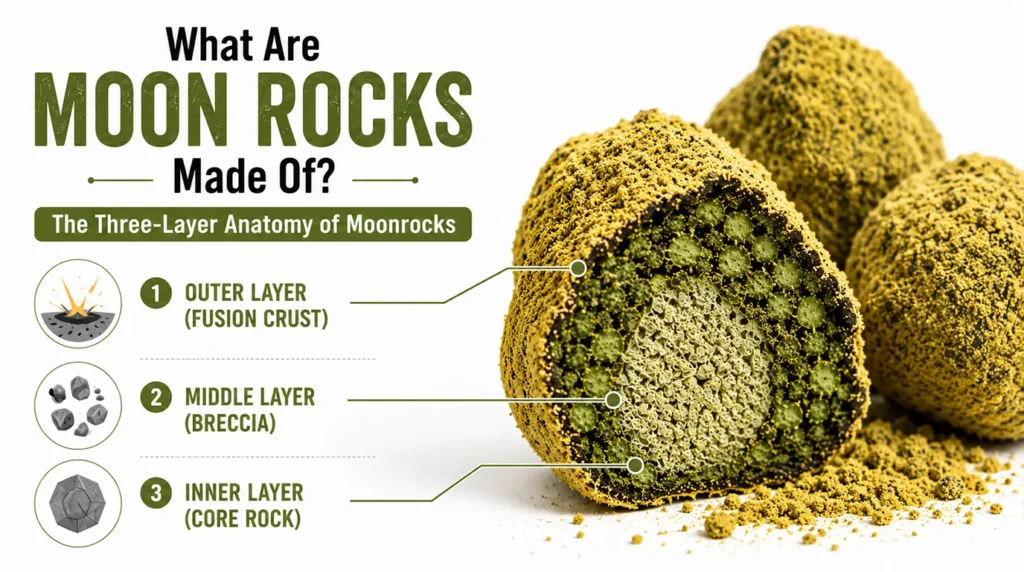
A moon rock is three cannabis products stacked into one form.
Core: a cured cannabis flower nug. Real piece of flower, the kind you’d smoke on its own. Around that nug: a coating of cannabis oil, which could be hash oil, distillate, or live resin depending on who made the moon rock. Around the oil: a layer of kief, fine powder of trichome heads that fall off cannabis flower during processing.
That’s the entire composition. Three layers. Three products. One assembled moonrock.
Component Overview Table
| Layer | What It Is | Weight Share | Typical Potency |
| Core | Cured flower nug | ~60% of total | 18-28% THCA |
| Middle | Hash oil / distillate / live resin | ~20% of total | 60-90% cannabinoid |
| Outer | Kief (trichome heads) | ~20% of total | 30-50% cannabinoid |
| Combined | Stacked moon rock | 100% | 50-70% total |
Rest of this piece breaks each layer down separately. Different layers come in different quality grades, and the quality of the inputs determines whether you looking at a $40 moon rock, an $80 moon rock, or a $20 fake.
Want to know how to smoke moon rocks (technique, dose, troubleshooting)? We got a separate piece on that. This one is about what’s inside.
Layer 1 – The Flower Core (Why the Nug Matters)
Base of every moon rock is a cured cannabis flower nug. Sixty percent of the moon rock’s weight is this center piece. Get the flower wrong, the whole product is compromised, no matter how good the oil and kief are.
Top-Shelf Nug vs Shake (Quality Spectrum)
Three flower-quality tiers show up in commercial moon rocks.
Top-shelf nugs. Whole, intact cannabis flowers. Hand-trimmed. Properly cured. Dense trichome coverage visible to the naked eye. THCA testing at 22% to 28%. Strain-specific terpene profiles. What a real cultivator uses. Strains commonly used as moon rock cores: GSC, Wedding Cake, Gelato, Zkittlez. The look: chunky, glossy with trichomes, deep green with purple or orange highlights depending on phenotype.
Mid-shelf nugs. Smaller flowers, possibly machine-trimmed or rough-trimmed, less dense trichome coverage. THCA at 18% to 22%. Still recognizable as quality flower. Many decent commercial moon rocks fall here because the oil and kief carry the potency.
Shake or popcorn buds. Loose flower from the bottom of a jar, or small immature buds. Compressed and reshaped to look like nugs. THCA often under 18%. What cheap moon rock operators use because shake costs a fraction of whole nugs. Spotting it: break the moon rock open, the inside looks like shredded leaf material rather than a coherent flower structure.
Strain Selection (Indica, Sativa, Hybrid)
Moon rocks inherit their effect profile from the flower core. Indica-dominant nugs produce body-heavy moon rocks (couch lock probable). Sativa-dominant nugs produce more head-active highs. Hybrids give you both. Reputable brands label the strain. Cheap operators don’t because they bought bulk mid-shelf or shake without strain segregation.
When buying, look for the strain name on the package. No strain name usually means no strain integrity.
Layer 2 – The Oil Coating (Hash Oil, Distillate, or Live Resin)
Middle layer is a cannabis concentrate. About 20% of the moon rock’s weight, but it carries the majority of the cannabinoid load because oils run 60% to 90% pure cannabinoid by weight. Three main types of oil show up in moon rocks. They ain’t equal.
Hash Oil (The Default)
Term “hash oil” is broad. Usually refers to hydrocarbon-extracted concentrates like BHO (butane hash oil) or PHO (propane hash oil). Flower washed with a solvent, solvent purged off, what remains is a sticky amber-to-gold concentrate with cannabinoid content in the 70-85% range.
Hash oil is the default coating for mass-market moon rocks because it’s widely produced, easy to work with, and gives a good cannabinoid load. Done right, with proper solvent purging, safe and effective. Done wrong (insufficient purge), it carries residual solvent and is harmful.
Distillate (The Cheap Choice)
Distillate is the cheapest cannabis concentrate on the market. Flower washed with hydrocarbons, then distilled to remove everything except the cannabinoid molecules. Result is a clear, odorless, near-tasteless oil running 85% to 95% cannabinoid by weight.
Distillate has high potency. No terpenes. Most distillate-coated moon rocks have terpenes added back artificially, which often come from non-cannabis sources (botanical terpenes from citrus or pine). Smoke tastes synthetic. High is one-dimensional.
Cheap-operator default. Moon rock costs $25 and another costs $60 and both claim 60% cannabinoid? $25 one is almost certainly distillate-coated. The difference is the experience, not the number.
Live Resin and Rosin (The Premium Choice)
The high end. Live resin extracted from fresh-frozen cannabis flower (frozen immediately after harvest before drying), which preserves the full terpene profile. Rosin is solventless, made by pressing fresh-frozen flower with heat and pressure to express the oil mechanically without any chemical solvent.
Both run 65% to 85% cannabinoid by weight, lower than distillate but with full terpene retention. Smoke has the actual strain flavor. High feels complex.
Premium moon rocks use live resin or rosin coatings. These cost more to produce and the moon rock prices reflect it ($60 to $100+ per gram). Difference between a moon rock that smokes like cannabis and one that smokes like sweetened pine sap.
Oil-Coating Comparison Table
| Oil Type | Extraction Method | Terpene Preservation | Price Tier |
| Distillate | Hydrocarbon + post-distillation | Stripped (often re-added) | Low |
| Hash Oil (BHO/PHO) | Hydrocarbon | Partial | Mid |
| Live Resin | Hydrocarbon, fresh-frozen | High | High |
| Rosin / Live Rosin | Solventless (heat + pressure) | Highest | Premium |
Want to know what’s in the oil before buying? Ask for or look up the COA (Certificate of Analysis). Real brands publish em. COA tells you the cannabinoid content, the extraction solvent (or “solventless”), residual solvent levels.
Layer 3 – The Kief Coating (Sift, Dry-Sift, Bubble Hash)
Outer layer is kief. Kief is the trichome heads that fall off cannabis flower during processing. Trichomes are the resin glands that hold most of the plant’s cannabinoid and terpene content. Concentrated kief runs 30% to 50% cannabinoid by weight, more potent than flower but less than oil.
About 20% of a moon rock’s weight is kief. Quality varies more here than people realize. Three production methods produce three quality grades.
Dry-Sift Kief (Standard Grade)
Dry cured flower is rubbed against a fine mesh screen. Trichome heads (firmer than the surrounding plant material) fall through the screen as a fine powder. Plant material stays above. Collected powder is kief.
Dry-sift is the most common production method. Quality depends on the screen size (finer screens = purer kief), operator’s technique, starting flower quality. Good dry-sift is light tan to gold. Mediocre dry-sift is brown-tan and contains some plant material along with the trichomes.
Bubble Hash Kief (Premium Grade)
Cannabis flower mixed with ice water. Trichome heads, slightly heavier than water, sink. Plant material floats. Water filtered through progressively finer mesh bags to separate the trichome heads by size. Result is dried into a powder.
Bubble hash kief is purer than dry-sift kief because the water-extraction method strips out plant contamination. Quality grades go from one-star (lowest, contains plant matter) to six-star (highest, pure trichome heads). Six-star bubble hash is the gold standard for moon rock outer coating. Color: pale cream to white-gold.
Full-melt bubble hash means the kief literally melts when heated (because it’s pure trichome content with no plant material to char). Light a moon rock coated in full-melt, the outer kief layer vaporizes cleanly rather than burning.
How to Read Kief Color and Quality
| Grade | Source | Color | Quality Signal |
| Trim kief | Run-off from trimming | Brown-yellow | Lower grade |
| Dry-sift | Mechanical screen separation | Light tan to gold | Standard |
| Full-melt bubble hash | Ice-water extraction | Golden to cream | Premium |
| Six-star bubble hash | Multi-screen ice-water | Pale cream | Highest grade |
Color is the fastest visual quality check. Brown-yellow kief means the trichomes were aged, oxidized, or contaminated with plant material. Golden or cream-colored kief is fresh and pure. Moon rock’s outer dust is brown? Kief is likely trim run-off or low-grade dry-sift, and the rest of the product probably matching quality.
How Moon Rocks Are Made (The Assembly Process)
Producing a moon rock takes three ingredients (cured nug, warmed oil, prepared kief) and about ten minutes per gram. Here’s the working sequence.
The Dip-and-Roll Sequence
Step 1: Cured nug ready. Trimmed, dense, ideally whole. Set aside.
Step 2: Hash oil or chosen concentrate warmed to working viscosity. About 100°F to 120°F for hash oil, slightly warmer for thicker rosin. Not so hot that the terpenes start vaporizing. Just warm enough that the oil is liquid and workable.
Step 3: Dip the nug. Some operators use tweezers, others wear nitrile gloves. Nug rolled through the warm oil until it has an even coating. No pooling. No drips. Coating should be visible but not dripping off the surface.
Step 4: Roll the coated nug in a tray of prepared kief. Oil is sticky, kief adheres immediately. Roll thoroughly so the entire surface gets coated.
Step 5: Set aside on parchment to cure. Two to four hours at room temperature lets the oil firm up around the nug and lets the kief layer adhere properly. After cure, the moon rock should be firm but slightly pliable when squeezed.
Step 6: Package. Reputable brands package in air-tight containers (glass jar or sealed plastic) with a humidity pack to prevent the oil from drying out and the kief from oxidizing.
Why Bad Moon Rocks Skip the Cure Step
The 2 to 4 hour cure matters. Skipping it produces moon rocks where the kief flakes off in the package, the oil pools at the bottom of the jar, the structure falls apart when you handle the rock. Cheap operators skip the cure to ship faster. Result is a product that looks fine in the package and falls apart the moment you try to break a piece off.
The Kurupt Origin (Where the Commercial Moon Rock Came From)
The term “moon rock” predates the commercial product. West Coast cannabis slang going back to the 80s used “moon rock” to describe top-shelf flower so dense with trichomes that the nugs looked extraterrestrial. The phrase was a compliment for any particularly resin-coated bud.
Packaged commercial moon rock came from Kurupt and a cultivator partner named Dr. Zodiak. Around 2014 in California, they launched “Kurupt’s Moon Rock” as a defined SKU: a cured nug dipped in hash oil and rolled in kief, sealed in a jar with branding. Form factor was new. Pricing was premium. Product caught on fast.
By 2016, moon rocks were a standard SKU at California dispensaries. By 2018, every state with a legacy cannabis market had moon rocks circulating. By the early 2020s, the product had crossed into the federally-legal hemp space, with cultivators producing THCA moon rocks that used hemp-compliant flower and concentrates.
Houston picked up moon rocks through a slightly different cultural channel. Chopped-and-screwed scene out of Third Ward and the surrounding neighborhoods had been about slowing down for years. DJ Screw. Pimp C. The UGK era. Slow tempo. Long sessions. Heavy product. Moon rocks fit the cultural preference perfectly. By the late 2010s, moon rocks were a recognizable form factor across Houston’s cannabis culture, both in legacy markets and in the federally-legal hemp-derived corner of the market that grew after 2018.
Lineage matters because moon rocks are a culturally-coded product, not just a chemically-defined one. Form factor came from somewhere. You crack one open, you looking at the assembly of a specific scene’s preferences crystallized into a SKU.
Moonrocks vs Sunrocks vs Caviar (The Stacked-Concentrate Family)
Moon rocks part of a broader product family that uses the same general approach (flower + concentrate + outer dust) with different ingredients. Knowing the distinctions helps you read a product menu honestly.
Moonrocks. Flower core + hash oil/distillate/live resin coating + kief outer layer. The original. Total cannabinoid usually 50% to 70%.
Sunrocks. Flower core + shatter or wax coating (hydrocarbon-extracted concentrates with a glassy or buttery texture) + sift hash outer layer. Generally stronger overall than moon rocks because shatter and sift hash both run high cannabinoid percentages. Sunrocks usually 65% to 80% total. Harder to make because shatter is brittle and doesn’t melt-coat as evenly as hash oil.
Caviar. Flower coated only in oil, no kief outer layer. Sometimes called “jet fuel” or “caviar buds”. Visual is glossy nug rather than dusty nug. Total cannabinoid 30% to 50%. Cheaper to produce than moon rocks because the kief step is skipped.
Cherry rocks, ice rocks, ghost rocks. Various commercial variants using different concentrate types or color profiles. Most are marketing variations on the basic moon rock concept.
Product calls itself a moon rock? Expect the kief outer coating. Calls itself caviar? No kief. Calls itself a sun rock? Expect the shatter/wax middle layer.
Hemp-Derived (THCA) Moon Rocks vs Marijuana-Derived (Delta-9) Moon Rocks
Two production paths. Same physical form factor. Different legal status.
Hemp-derived moon rocks (THCA). Made from flower that tested under 0.3% Delta-9 THC at harvest, paired with hemp-derived oil and hemp-derived kief. Federally legal under the 2018 Farm Bill. Shippable to all 50 states except where state laws have specifically restricted them (North Carolina, Tennessee, California, and a handful of others as of 2026). The flower’s THCA percentage is not capped at the federal level. Smoke it, the THCA decarboxylates to Delta-9 THC and the effect is functionally identical to marijuana-derived moon rocks. We got a separate piece on whether THCA is real weed that covers the chemistry.
Marijuana-derived moon rocks (Delta-9). Made from licensed-cannabis flower in state-legal markets, with concentrates and kief from licensed extractors. Available only at state-regulated dispensaries. Cannot be shipped across state lines. Pricing often comparable, with some markets running cheaper than hemp moon rocks due to local supply chains.
Chemistry is similar. Legal status is different. Fundamental composition (three layers) is identical.
How to Spot a Quality Moon Rock (Buyer’s Frame)
Five checks before paying.
The Five-Check Quality Frame
- The core check. Look at the cross-section if the rock is broken, or ask the operator to slice one. Real moon rock shows a whole nug at the center, with visible flower structure. Shake or trim shows up as a homogenous shredded interior. Walk away from shake-core moon rocks.
- The kief color check. Outer dust should be golden, cream, or pale tan. Brown or yellow kief means the trichomes are aged or contaminated. Cream-colored kief is fresh.
- The oil pooling check. Hold the moon rock under a light. Oil should be evenly distributed and firm. Visible pooling at the bottom of the package or oil running off the rock means the rock wasn’t cured properly.
- The smell check. Real moon rock has a complex terpene profile (gas, citrus, pine, earthy, depending on the strain). Distillate-coated moon rock often smells artificial or sweetly sweet. Chemical or solvent smell means the concentrate wasn’t purged properly. Walk away from any moon rock that smells like petroleum.
- The physical check. Squeeze a corner gently. Moon rock should be firm but slightly pliable. Rock-hard means too much oil or improper cure. Crumbly means insufficient oil or aged-out product.
Why Passion Farms Doesn’t Currently Sell Moon Rocks (Component Honesty)
Honest disclosure: we don’t package moon rocks at Passion Farms right now.
We sell two of the three components. Our top-shelf THCA flower qualifies as the core layer. Our Drip Diamonds run at 90%+ cannabinoid, stronger than the oil coating on most moon rocks. We don’t currently produce or package kief.
When we eventually build a moon rock SKU, here’s what to expect: whole-nug core (no shake), Drip Diamonds-derived oil coating (90%+ purity, terpene-preserved), golden dry-sift or full-melt kief outer layer, proper cure, sealed packaging with the strain name and the harvest date on the label. We’ll tell you on the product page when it ships.
Until then, you can build moon-rock-tier sessions yourself with our flower and Drip Diamonds. The smoking moon rocks piece covers the technique. Cheaper than buying a packaged moon rock. Better dose control. Same triple-product experience minus the kief layer.
FAQ
What are moon rocks made of?
Moon rocks are made of three cannabis products stacked: a cured flower nug at the center, a cannabis oil coating (hash oil, distillate, or live resin) around the nug, and a layer of kief (trichome heads) coating the outside. Combined, they typically test at 50% to 70% total cannabinoid by weight.
What’s the difference between moonrocks and sunrocks?
Moonrocks use hash oil or distillate or live resin as the middle coating and kief as the outer layer. Sunrocks use shatter or wax (BHO concentrate) as the middle coating and sift hash as the outer layer. Sunrocks generally stronger but harder to produce. Same general concept, different ingredients.
How strong are moon rocks?
Moon rocks typically range from 50% to 70% total cannabinoid by weight, depending on the quality of the three components. Premium moon rocks with live resin coatings and full-melt kief can push past 65%. Compared to top-shelf flower at 20% to 30%, moon rocks are roughly two to three times stronger gram-for-gram.
What kind of oil is used in moon rocks?
Three main types: hash oil (broad term, usually hydrocarbon-extracted BHO or PHO), distillate (highly refined, terpene-stripped, cheapest), or live resin and rosin (terpene-preserved, premium). Quality and price tier of the moon rock depends heavily on the oil choice.
What is the kief on a moon rock?
Kief is the trichome heads that fall off cannabis flower. Trichomes are the resin glands that contain most of the plant’s cannabinoid and terpene content. Kief can be produced by dry-sift (mechanical screen) or bubble hash (ice-water extraction). Quality varies by color (golden = good, brown = aged or lower-grade) and particle size.
Are moon rocks dipped in wax?
No. Wax is a different concentrate type and is used in sunrocks, not moon rocks. Moon rocks use hash oil, distillate, or live resin as the middle coating. Wax has a butter-like texture that doesn’t melt-coat as evenly.
Can you make moon rocks at home?
Yes, if you have the three components. Warm cannabis oil to working temperature, dip a cured nug, roll in kief, let cure 2 to 4 hours. Quality of your home-made moon rock depends entirely on the quality of the inputs. Most home builds use mid-shelf flower and distillate, which gives a functional but not premium result.
Are moon rocks legal?
Depends on the cannabinoid source. Hemp-derived THCA moon rocks made from Farm Bill-compliant components (Delta-9 under 0.3% at harvest) are federally legal. Marijuana-derived moon rocks made from licensed cannabis are state-legal where cannabis is legalized. Synthetic-cannabinoid moon rocks (rare but exist) are usually illegal regardless of state.
What does a moon rock look like?
A moon rock looks like a small, sticky nug with a fine dust coating that gives it an extraterrestrial appearance (the namesake). Color varies: underlying flower might be green, purple, or orange. Oil coating creates a glossy amber sheen. Kief outer layer adds a golden or cream-colored dust. Size is usually a half-gram to a gram per piece.
Are moon rocks the same as caviar weed?
No. Caviar weed is flower coated in oil only, no kief outer layer. Moon rocks add the kief layer. Caviar is also called “jet fuel” or “oiled nug” in some markets. The two products are sometimes conflated but the kief layer is the defining moon rock feature.
