
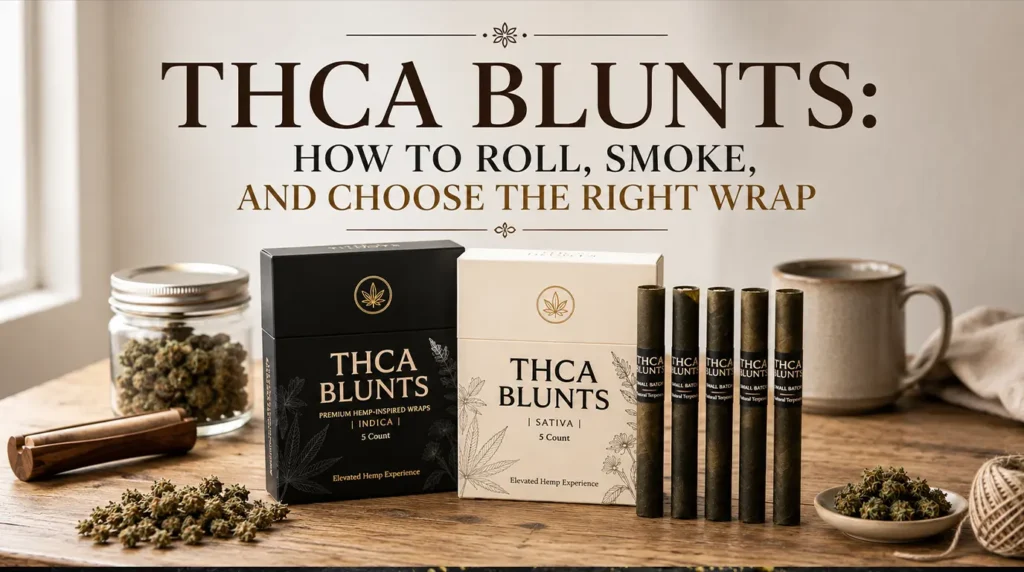
A THCA blunt is a blunt rolled with hemp-derived THCA flower instead of regular dispensary cannabis. Heat converts the THCA into Delta-9 THC the second the cherry lights, so the high is identical to a traditional blunt with one difference: federally legal under the 2018 Farm Bill, as long as the source flower tests at or under 0.3% Delta-9 by dry weight. Hits the same. Wraps the same. Smells the same. Different supply chain.
A blunt is not a joint. The wrap is bigger, slower-burning, denser. The smoke is heavier. The session lasts longer. The dose-per-pull is higher because there’s more flower packed in. If you’ve smoked a joint and shrugged, a blunt of the same strain will tell you the strain wasn’t the problem. The format was.
This piece covers wrap types (Backwoods-style tobacco, hemp wraps, palm leaf), how to roll a THCA blunt from scratch, what to look for in a pre-rolled, the Houston-and-hip-hop register the format actually lives in, legal status, and where to source from us if rolling isn’t your move. Adjacent sibling reading: joints vs blunts: which hits harder.
THCA Blunts in 60 Seconds: What, How, and Why
THCA is the cannabinoid in raw cannabis flower that converts to Delta-9 THC the moment heat hits it. Indoor flower runs 25% to 30% THCA. When you light a blunt, the cherry crosses the decarboxylation temperature (around 220°F) instantly and you’re inhaling active Delta-9 THC vapor along with the smoke. Same molecule as dispensary weed. Same high. Different legal pathway.
The hemp-legal path runs through the 2018 Farm Bill. Hemp flower can be packed with THCA and still test under 0.3% Delta-9 in its raw, uncombusted state, so it qualifies as federal hemp. The high happens in your hand when you light it.
What makes the THCA blunt specifically different from any other THCA format: it’s the only format where the wrap matters as much as the flower. A bad wrap kills a good strain. A good wrap stretches a mid strain. The wrap is half the experience, which is why this piece spends as much time on wraps as it does on the flower itself.
Three paths through the rest of this piece. Want to roll one from scratch? Jump to section 4. Buying pre-rolled? Section 5. Trying to figure out which wrap to grab at the store? Section 3. For the broader THCA context, our THCA flower guide is the umbrella.
Why a Blunt Hits Different From a Joint or Pre-Roll
Three things separate a blunt from a joint or paper-cone pre-roll: wrap size, burn rate, and the dose math.
Wrap size. A standard joint or pre-roll holds 0.5g to 1g of flower in a thin rolling paper. A blunt wrap holds 1.5g to 2g, sometimes more. You’re not smoking the same amount of cannabis. You’re smoking twice to three times as much.
Burn rate. Rolling papers are thin and burn fast. A joint or pre-roll cherry travels at about 5 to 12 minutes for a 1g paper cone. A blunt wrap is thicker, denser, often slightly damp from the manufacturing oils. A 2g blunt burns 25 to 45 minutes depending on how it was rolled and how it’s being passed. Longer burn means more sustained smoke, more sustained dose, longer session.
Smoke density. Tobacco wraps and hemp wraps both produce denser smoke than rolling papers. The wrap material is contributing combustion mass that the paper cone doesn’t. You’re inhaling more particulate per pull. That’s the heaviness people describe when they say a blunt “hits harder.” It’s not always cannabis hitting harder; the smoke profile is heavier overall.
| Variable | Joint (paper cone) | Pre-Roll (paper cone) | Blunt (wrap) |
| Typical flower | 0.5g to 1g | 1g standard | 1.5g to 2g |
| Burn time | 5 to 12 min | 8 to 15 min | 25 to 45 min |
| Smoke density | Lighter | Medium | Heaviest |
| Smell during use | Strong cannabis | Strong cannabis | Cannabis + wrap |
| Smell after | Lingering | Lingering | Stays on clothes longer |
| Dose-per-pull | Lower | Mid | Higher |
| Best for | Solo, quick session | Solo or shared, mid-session | Group session, longer hangout |
| Discretion | Mid | Mid | Low (smell + size) |
For the deeper joint-versus-blunt comparison, joints vs blunts: which hits harder walks through every variable. This piece focuses specifically on the blunt-as-THCA-format question.
The cultural register is part of it too. A blunt is a group format. The pass, the rotation, the timing of when you ash it and when you pass it. A joint can be solo. A blunt is built for the room. That shifts the use case, not just the dose.
Wrap Types: Tobacco, Hemp, Palm Leaf (the Real Comparison)
This is where most articles bail. They say “use a hemp wrap” and move on. Real blunt-rolling has a wrap economy, with named brands, real differences, and trade-offs worth knowing.
Tobacco wraps (cigar leaf). Backwoods is the most-rolled brand in the United States for blunt culture. The “honey” or “sweet aromatic” flavors are the standards. Swisher Sweets is the second standard, especially in the South and East Coast. Phillies and Dutch Masters round out the legacy tier. All four contain real tobacco leaf, which means real nicotine. A Backwoods wrap carries roughly the nicotine equivalent of half a cigarette, give or take by brand and size. The nicotine adds a slight head rush on the first few pulls that some smokers like and others avoid.
Why people roll Backwoods specifically: the leaf is fragrant, hand-rolled-looking, holds together when stretched, and seals well with a moist finger. The wrap itself becomes part of the flavor profile. A honey-Backwoods THCA blunt with a gas-forward strain tastes like sweet-meets-funk, completely different from the same flower in a paper cone.
Hemp blunt wraps. Hempire, King Palm hemp, Zig-Zag hemp, RAW hemp. These are the legal-state, nicotine-free alternative. Hemp wraps are slightly thinner than tobacco cigar leaf, burn at a similar rate, and don’t carry the tobacco aromatic backbone. Flavor is neutral with a slight grassy hemp note. For smokers who want the blunt format without nicotine, hemp wraps are the standard answer. For smokers who specifically came to blunts for the Backwoods-honey flavor, hemp wraps feel naked. Personal preference territory.
Palm leaf wraps. King Palm is the dominant brand. The wrap is a real cordia tree leaf, naturally hollow inside, sold as a pre-formed cone. No tobacco, no hemp, no additives, no glue. Burns slowest of the three options. Flavor is the most neutral. Smokers who want the cleanest blunt experience often run palm leaves. Downside: the leaf is more delicate to handle than tobacco or hemp wraps, and once you’ve packed it, you can’t easily reshape.
Pre-rolled hemp paper cones. RAW, Elements, Vibes. Technically not blunts (the wrap is hemp paper, not leaf), but worth mentioning because they cover the format some smokers prefer when they want the rolled-up convenience without the wrap-material smoke contribution. Burns faster than any real wrap. Holds less flower.
| Wrap Type | Brand Examples | Nicotine | Burn Rate | Flavor | Legal-State Friendly |
| Tobacco wrap (cigar leaf) | Backwoods, Swisher, Phillies, Dutch | Yes (~half a cigarette) | Slow | Strong tobacco/aromatic | 21+ tobacco age in restricted states |
| Hemp blunt wrap | Hempire, King Palm hemp, Zig-Zag hemp, RAW hemp | No | Slow to medium | Neutral, slight hemp grass | Federally hemp-legal |
| Palm leaf wrap | King Palm cordia leaf | No | Slowest | Most neutral | Federally legal |
| Hemp paper cone | RAW, Elements, Vibes | No | Faster than wrap | Most neutral | Federally legal |
For smokers in tobacco-restricted states, the legal-friendliness column is the deciding factor. For everyone else, it’s a flavor and nicotine-tolerance call.
How to Roll a THCA Blunt (Step by Step, the Way It’s Actually Done)
Five steps. Most people get steps two and four wrong, which is why most home-rolled blunts burn unevenly or come apart.
Step 1: Tools. One wrap (Backwoods, hemp wrap, or palm leaf). A grinder. A lighter. Optional but recommended: a roach filter (a small piece of cardstock rolled into a tight cylinder) to put at the mouthpiece end. Optional: a moist paper towel to revive a slightly dried-out wrap.
Step 2: Break it down. This is where the wrap matters. For a Backwoods or similar tobacco cigar, you have two options. Option A: split the wrap lengthwise with a fingernail or razor along the natural seam, remove the inner tobacco, leaving just the outer leaf. Option B: do a “cigar-roll”, moisten the wrap, unspool it carefully without removing the inner tobacco (some smokers like the tobacco mix; many remove it because of nicotine). For a hemp wrap or palm leaf, the wrap comes pre-formed and just needs to be opened along its existing fold.
Most rolling mistakes happen here. Rushed wrap-splitting tears the leaf. Over-moistened wraps fall apart. Get the wrap fully flat and intact before moving on.
Step 3: Grind and load. Grind 1.5g to 2g of THCA flower to a medium-fine consistency (not powder, not chunks). Pack a gas-forward strain like Jealousy or a fruity-candy strain like Runtz depending on the flavor you want. Browse the bulk flower category, the exotic THCA flowers, or the strongest THCA flower strains for current rotation. Lay the ground flower evenly down the length of the opened wrap.
Step 4: Roll, tuck, seal. Place the wrap with the flower line in your fingers, thumbs underneath. Roll the wrap forward and back gently to compact the flower into a cylinder. Tuck the leading edge of the wrap UNDER the flower, then continue rolling forward, tightening as you go. Once fully rolled, moisten the trailing edge with your tongue or a damp finger and press to seal. The seal is what makes or breaks an evenly burning blunt.
Step 5: Dry and light. A freshly rolled blunt is slightly damp from the moisture used to seal it. Either let it air-dry for 2 to 5 minutes or run a lighter flame along the seal seam to dry it faster. Light the foot of the blunt evenly, rotating while you draw, until the entire cherry is glowing across the full circumference. Uneven lighting is the second-most-common rolling mistake; it causes canoeing (one side burns faster than the other).
Common mistakes to avoid: packing the flower too tight (kills airflow, blunt won’t pull), packing too loose (canoes immediately), over-licking the seal (wrap tears as it dries), under-licking (wrap won’t seal, blunt unravels mid-session).
For the COA verification side of sourcing the flower, how to read a THCA COA covers what to check on the lab sheet.
Pre-Rolled THCA Blunts: What to Look For, What to Avoid
Not everyone rolls. Pre-rolled blunts are a legitimate format, but the market is uneven. Here’s the field guide.
What to look for, in order of importance:
- Wrap type listed on the package. “Hemp wrap” or “palm leaf” should be explicit. If the package just says “blunt” without specifying the wrap, you’re probably getting an unnamed tobacco-leaf substitute that may or may not contain nicotine.
- Flower weight stated. Standard sizes are 1g, 1.5g, and 2g. Below 1g, you’re paying premium for what’s effectively a joint with extra wrap material.
- Third-party COA on the brand’s site or via QR code on the package. The COA should match the batch number on the wrap or packaging. Lab name should be a real lab, not the brand’s own internal “lab.”
- THCA percentage stated. Real flower runs 20% to 30% THCA. If the COA shows under 18%, the flower inside is mid at best.
- Terpene panel on the COA. Live-resin and premium strains carry named terpenes (myrcene, beta-caryophyllene, limonene, etc.). If the panel is empty or shows generic flavors, the flower is likely distillate-sprayed mid, not real top-shelf bud.
Red flags:
- No batch ID on the package.
- “Lab tested” with no link to the actual lab document.
- Wrap brand not listed.
- Price under $8 per gram pre-roll (real flower in a real wrap can’t profitably sell below that).
- Wrap looks shiny / over-processed (real cigar leaf and hemp leaf have natural texture, not plastic sheen).
For the broader pre-roll buyer’s view, how to choose a quality THCA pre-roll covers the format-agnostic version, and why THCA pre-rolls are taking over smoke shops covers the market context.
The Cultural Context: Why the Blunt Matters in Houston and Beyond
The blunt isn’t a neutral format. The format has history, and the history matters for understanding why “smoke a blunt” hits differently than “smoke a joint” in the audience this article is written for.
Southern hip-hop runs on blunts. DJ Screw didn’t roll joints. Pimp C didn’t roll joints. The chopped-and-screwed lineage out of Houston moves on a blunt: slow as the music, dense as the smoke, long as the session. The format isn’t decoration. It’s how the South listens. A screw tape and a Backwoods is one experience. A screw tape and a joint is a different experience, and anyone who’s lived in it knows which one belongs together.
That cultural register matters because most articles writing about “THCA blunts” frame the format as a wellness or convenience product. It’s not. It’s a cultural choice. The reader who searched “thca blunts” online didn’t search to learn about cannabinoids. They searched to find their format, hemp-legal, ready to roll or buy. Treat the format like the cultural artifact it is, not a generic product category.
That’s also why this piece spends time on wraps. Backwoods, Swisher, Hempire, King Palm, these aren’t interchangeable. The wrap matters as much as the flower in blunt culture. A real roller knows which wrap they prefer and why. That knowledge is part of what separates a real blunt session from a marketing-coded “premium experience” some hemp brand wants to sell.
We’re a Houston-based cultivator. We’re Houston’s THCA flower distribution hub. The blunt is on our home court.
THCA Blunts: Legal Status
Federally legal, state-variable, with an extra wrinkle for the wrap.
The 2018 Farm Bill legalizes hemp-derived cannabinoids if the source plant tests at or under 0.3% Delta-9 THC by dry weight. THCA flower meets that test in its raw form. So a THCA blunt rolled with federally-compliant hemp is federally legal. Detail in our state-by-state THCA legality overview.
State law varies.Texas keeps THCA legal after the 2026 hemp ban was blocked in court. California allows it under a separate hemp regulatory framework. North Carolina’s S328 bans THCA flower as of November 12, 2026, which would also capture pre-rolled THCA blunts under the same definition. State law moves; check current status before ordering across state lines.
The wrap adds a second layer. Tobacco-leaf wraps (Backwoods, Swisher, etc.) are subject to tobacco-product age restrictions, which are 21+ in most US states (the federal Tobacco 21 law). Hemp wraps and palm leaf wraps don’t carry tobacco restrictions and follow general hemp-product age rules (typically 21+ but for cannabinoid reasons, not tobacco reasons).
Drug-test outcome: THCA blunts trigger the same positive results as any other THCA or THC consumption. The drug test doesn’t distinguish between hemp-derived and dispensary-derived THC metabolites. If you’re subject to testing, don’t smoke a THCA blunt or anything else cannabinoid.
THCA Blunts FAQ
What is a THCA blunt?
A THCA blunt is a blunt rolled with hemp-derived THCA flower instead of dispensary cannabis. Heat converts the THCA to Delta-9 THC on combustion, so the high is identical to a traditional blunt. The federal Farm Bill keeps it hemp-legal as long as the flower tests under 0.3% Delta-9 in its raw form.
Are THCA blunts legal?
Yes federally, under the 2018 Farm Bill, when made from hemp-derived flower testing under 0.3% Delta-9 by dry weight. State law varies. Texas, California, and Florida keep them legal. North Carolina’s S328 bans them as of November 12, 2026. Always check current state status before ordering across state lines.
Do THCA blunts get you high?
Yes. THCA converts to Delta-9 THC the moment the cherry lights. The high is identical to dispensary-grade cannabis at the same dose. A 1.5g to 2g blunt of strong indoor flower (25% to 30% THCA) delivers roughly 350 to 600 mg of active THC across the full session, more than most users smoke in a single joint.
Are THCA blunts stronger than joints?
Subjectively yes, structurally no. THCA is the same molecule as dispensary THCA. What makes a blunt feel stronger than a joint is the format math: 1.5g to 2g of flower in a slow-burning wrap vs 0.5g to 1g in a thin paper cone. More flower, longer burn, denser smoke. The dose per session is higher even if the flower potency is the same.
Do THCA blunts have nicotine?
Depends on the wrap. Tobacco-leaf wraps (Backwoods, Swisher Sweets, Phillies, Dutch Masters) contain real tobacco, which means real nicotine. Hemp wraps (Hempire, King Palm hemp, Zig-Zag hemp) have no nicotine. Palm leaf wraps (King Palm cordia leaf) have no nicotine. Read the wrap-type listing on a pre-rolled package to know which one you’re getting.
What’s the best wrap for a THCA blunt?
Depends on what you’re optimizing for. Backwoods if you want the traditional sweet-aromatic flavor and don’t mind the nicotine. Hempire or King Palm hemp if you want the blunt format with no nicotine. King Palm cordia leaf if you want the cleanest, slowest-burning, most neutral wrap. RAW hemp paper cones if you want speed and minimal wrap-material smoke.
How much flower goes in a THCA blunt?
Standard is 1.5g to 2g. A “fat” or “double” blunt runs 2g to 3g. A “skinny” or “blunt-lite” runs 1g to 1.5g. Most home-rolled blunts land at 2g in a Backwoods-size wrap. Pre-rolled commercial blunts typically come in 1g, 1.5g, and 2g sizes.
How long does a THCA blunt last?
25 to 45 minutes for a typical 1.5g to 2g blunt, depending on wrap type, pull frequency, and whether it’s solo or in rotation. A solo blunt smoked at a casual pace lasts about 35 minutes. A blunt in rotation with three or four people lasts 20 to 30 minutes because the cherry stays hot.
Do THCA blunts show up on a drug test?
Yes. THCA converts to Delta-9 THC on combustion, and Delta-9 metabolites trigger standard urine, blood, and hair tests the same way as dispensary cannabis. Hemp-derived legal status doesn’t affect drug-test outcomes. If you’re subject to testing, don’t smoke any THCA, THC, Delta-8, HHC, or THCP product.
Are pre-rolled THCA blunts worth it?
Worth it if rolling isn’t your skill or your time. The convenience premium is roughly 30 to 50% over rolling your own at the flower price. A pre-rolled THCA blunt typically runs $10 to $25 retail for 1g to 2g formats. A home-rolled equivalent costs $4 to $12 in flower plus the wrap. Verify the COA, the wrap type, and the flower weight before paying premium.
What’s the difference between a THCA blunt and a regular pre-roll?
The wrap. A standard pre-roll uses thin hemp rolling paper formed into a cone, holds 1g, burns 8 to 15 minutes. A blunt uses a thicker wrap (tobacco, hemp, or palm leaf), holds 1.5g to 2g, burns 25 to 45 minutes, and produces denser smoke. The flower can be identical; the format changes the experience.
Where can I buy THCA blunts online?
We don’t currently maintain a dedicated pre-rolled blunt SKU in our catalog (the closest is our standard pre-rolls in paper cones). For DIY blunt rolling, our bulk flower category and exotic THCA flowers cover the flower side; pair with a wrap from any reputable smoke shop. Pre-rolled blunt SKU is on the roadmap.
Roll It or Buy It (And What We Actually Sell)
The honest call on Passion Farms and blunts: we sell the flower, you roll the blunt. A dedicated pre-rolled blunt SKU isn’t in the catalog yet. The closest format we run is the standard pre-rolls in hemp paper cones, which is not a blunt and we won’t pretend it is.
If you want the blunt experience, grab flower from the bulk flower category (gas-forward strains for the heavy blunt session, fruit-forward for the smoother burn). Pick up a wrap at any smoke shop, Backwoods if you want the classic, Hempire or King Palm hemp if you want nicotine-free. Roll the way section 4 walks through. The session is on you.
Buying pre-rolled in the meantime, the standard pre-rolls page has paper-cone pre-rolls if that format works for the use case. Texas-based smoke shop owners interested in stocking once we add the blunt SKU, talk to us. The pre-rolled blunt is coming. We’d rather build the right SKU than rush a half-version into the catalog.
Pick the format that matches the session. Joint for the quick solo. Pre-roll for the medium hang. Blunt for the long one. Different tools, different jobs.

