

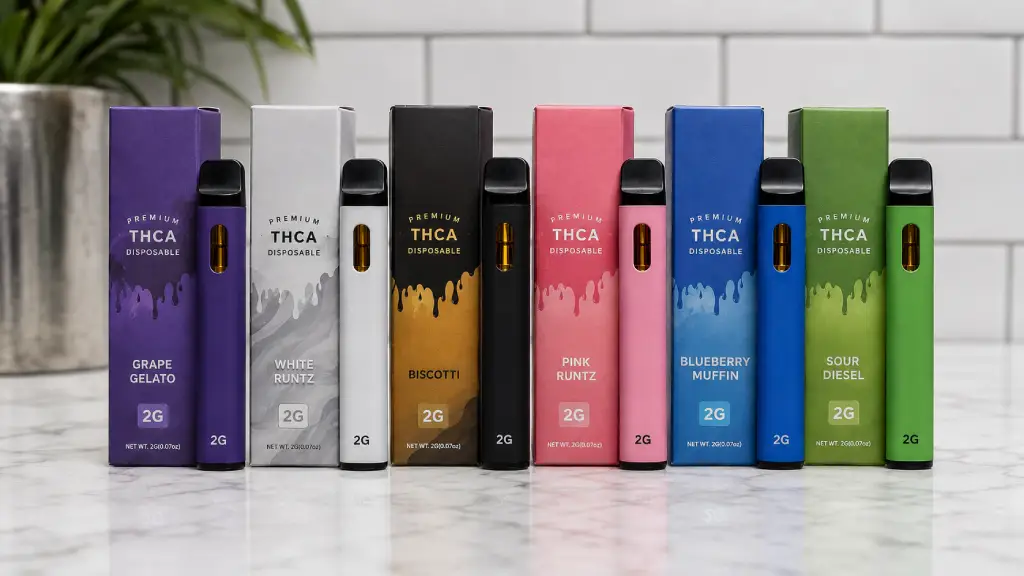
Most people shopping bulk disposables are working off two numbers: what a case costs and what they can sell it for. Everything else is noise until those two line up.
So here’s the number that starts the conversation. Case pricing on our branded 2 gram wall runs from $10.50 a unit at the volume end up past $20 on the premium lines, with most of the shelf landing between $11 and $18. A 200-piece case of the value mover is $2,100. A 50-piece case of a mid-tier brand is around $800. Those are real prices off live listings, not a range somebody invented to get you on the phone.
What this page covers: what each brand actually costs per unit, how the 50/100/200 tier ladder works, the margin math on a case, and the authentication problem that decides whether any of it matters. If you’re buying singles, this isn’t your page. If you’re buying cases, this is the whole map.
The Short Answer on Bulk 2g
Bulk 2 gram disposables sell in case quantities, typically 50, 100, or 200 pieces, with per-unit pricing that drops as the count climbs. Every branded line on our disposables shelf follows that structure.
The spread across the wall is wide and it’s mostly about brand pull, not hardware. A value line and a premium line contain roughly the same amount of oil in roughly the same hardware. What separates $10.50 from $18 is whether customers walk in asking for it by name.
Two grams is the standard now because the older 1 gram units died before the oil ran out. At two grams the battery outlasts the tank, so you stop throwing away product you paid for, and the per-gram cost drops without the hardware getting more expensive. That single change is why this category looks the way it does.
What a Case Actually Costs, Brand by Brand
Real numbers. The first three lines publish their full tier ladder on the listing, so those per-unit figures are exact. The rest publish a case-price range, so I’ve listed the range as-is rather than guessing at the tiers behind it.
Verified tier pricing:
| Brand | 50 pieces | 100 pieces | 200 pieces | Case range |
| Gold Coast Clear | $13.00 | $11.50 | $10.50 | $650 to $2,100 |
| Gold Aces | $16.00 | $15.00 | $14.50 | $800 to $2,900 |
| Dranks | $18.00 | $17.00 | $16.00 | $900 to $3,200 |
Case ranges across the rest of the wall:
| Brand | Case range |
| Limited Series 2G Hitz | $700 to $2,200 |
| Hitz Gladiator | $700 to $2,200 |
| Cali Clear Duos | $700 to $2,500 |
| Sweets Half and Halfs | $700 to $2,200 |
| Mad Labs Gold Edition | $750 to $2,600 |
| 2G OG Cake | $800 to $2,800 |
| 2G Cakes | $825 to $2,800 |
| Stealthy with Carbon Filter | $800 to $2,900 |
| Boutiq Switch Orb V5 | $900 to $4,800 |
Notice the shape of it. The low end of each range is the smallest case and the high end is the largest, so a brand at $700 to $2,200 is roughly $14 a unit at 50 and $11 at 200. Boutiq is the outlier on the top end, which tracks with it pulling the heaviest search demand of anything we stock.
Prices move as drops rotate. Treat this table as the shape of the market rather than a quote, and check the live listing on the day you buy.
How the Tier Ladder Actually Works
Three prices, one decision, and most buyers pick wrong.
The ladder is quantity-based and strain-agnostic: 50 pieces gets you the entry rate, 100 drops it, 200 drops it again. On Gold Coast Clear that’s $13, $11.50, $10.50. On Dranks it’s $18, $17, $16.
The spread from bottom to top tier is where the interesting part hides. Gold Coast Clear moves $2.50 a unit across the ladder, which is a 19 percent cut. Gold Aces moves $1.50, about 9 percent. Dranks moves $2.00, roughly 11 percent. So the ladder is not equally steep everywhere, and the cheaper line rewards volume hardest.
That’s the same pattern that shows up on the flower side. Value product carries thinner absolute margins, so the discount for committing has to be proportionally bigger to be worth anybody’s while. Premium product doesn’t need to discount as hard because the brand does the selling.
Practical read: if you’re stocking a value line, get to the 200 tier or the math barely beats retail arbitrage. If you’re stocking premium, the 50-piece case is a perfectly respectable place to live while you find out whether it moves.
Margin Math on a Case
The part that decides whether any of this is a business.
Two gram disposables commonly retail between $25 and $40 depending on the market, the brand, and how much competition is within driving distance. Run the volume line: Gold Coast Clear at $10.50 in, sold at $30, is $19.50 a unit. A 200-piece case at that spread is $3,900 gross on a $2,100 buy.
Now the premium line: Dranks at $16 in, sold at $35, is $19 a unit. Nearly identical dollar margin, on a case that cost $1,100 more. Same profit per unit, more capital tied up, but the brand pull means it likely moves faster, which is the actual argument for carrying it.
That comparison is the one most people never run, and it reframes the whole shelf. Cheap lines protect your cash. Premium lines protect your velocity. A shelf that’s all one or all the other has a problem it hasn’t noticed yet.
Then subtract reality. Some units fail, some get discounted to clear, some walk out the door as samples. Build 5 to 10 percent shrink into the model and the numbers still work, but the guy who modeled zero shrink is going to be confused in ninety days.
Deeper pricing and tier economics live in our 2g cart wholesale breakdown if you want to go further into it.
The Authentication Problem
Everything above is arithmetic. This is the part that decides whether the arithmetic means anything.
Branded 2 gram disposables are among the most counterfeited products in this industry. Cloned boxes, copied authentication stickers, hardware that photographs correctly and weighs wrong, oil that tastes like scorched plastic by the third pull. The economics guarantee it: when a brand gets popular enough to be asked for by name, faking it becomes profitable.
Our own site runs a permanent scam banner because people impersonate us in DMs, which is the same problem viewed from the supplier side. The play is always identical. A message wearing a brand’s name, pricing well under the real tiers, payment requested somewhere unusual, and then either silence or product that costs you a customer.
The AUTHENTIC marking on our branded listings exists for that reason. It means those cases came through verified channels rather than from a middleman with a suspiciously friendly number.
Your own verification stack, in order of how fast it catches a fake:
Price sanity first, because it’s free and it catches most of them. A premium line offered 40 percent under the real tiers is not a deal, it’s a confession. Then packaging: real lines don’t ship blurry print, crooked stickers, or off-color boxes. Then hardware weight, since counterfeits cheap out on the pen body and your hand notices before your eyes do. Then the oil itself, which should run thick, slow, and amber rather than thin and dark. Then whatever authentication code the box carries, scanned before product hits your shelf rather than after a customer complains.
Our disposable buyer’s guide goes deeper on the hardware side of that check.
Why the Cheapest Case Online Is Usually a Trap
Somebody will always beat our price. Worth understanding what they’re actually selling when they do.
There are only a handful of levers to pull if you want a 2 gram disposable case dramatically cheaper than the real market. The first is oil quality: cheap distillate with synthetic terpenes costs a fraction of live resin or liquid diamonds, tastes like it, and your customer notices on the first pull even if they can’t name what’s wrong. The second is hardware: a cheaper coil and a smaller battery cut the unit cost meaningfully and raise your dead-on-arrival rate to match. The third is short-filling, where a unit labeled two grams holds noticeably less, which nobody catches until they compare how long it lasted against a real one.
The fourth lever is the one that actually hurts, which is that the product is counterfeit and none of the branding on the box means anything at all.
None of those show up in a price comparison. All of them show up in your return rate, and a return rate is just a customer-loss rate wearing a friendlier name. A shop that saves three dollars a unit and loses one customer in twenty is upside down on the trade, because the case profit was maybe four hundred dollars and a regular customer is worth multiples of that over a year.
The honest framing: there’s a floor under real product, and it’s set by what the oil and the hardware genuinely cost. Prices meaningfully below that floor aren’t better sourcing, they’re a different product wearing the same box. That’s not a slogan, it’s arithmetic that anybody in this supply chain can walk you through.
Where legitimate savings actually come from: buying the larger tier, picking lines with less brand premium baked in, and building a relationship that gets you consistent allocation instead of scrambling every time something sells out. Those are real. A mystery 40 percent discount is not.
Reading the Wall: What to Actually Stock
A case of one thing is a bet. A shelf is a strategy.
Cover three price points minimum. Something at the value end that lets you win the customer who shops on price, something in the middle that carries most of your volume, and something premium that makes the rest of the shelf look credible and gives you an answer when somebody says price doesn’t matter.
Cover the ask-by-name brands. Some lines sell because of what’s inside and some sell because customers walked in saying the word. Both are real demand. The best 2g disposables roundup tracks which lines are pulling attention as drops rotate.
Cover a format outlier. A concentrate-forward option like Drip Diamonds or a 3 gram unit like the Dope Dept line gives you something to show the customer who’s bored of the standard wall. It doesn’t need to be your volume item to earn its slot.
What not to do: stock four brands in the same lane at the same price. That’s not selection, that’s four versions of one decision, and it ties up capital that could be covering an actual gap.
Hardware Quality and What Customers Actually Notice
Buyers judge a case on things that have nothing to do with the oil, so it’s worth knowing what they are.
Draw resistance is the first thing anybody notices. Too tight and it feels broken, too loose and it floods. Good hardware sits in the middle and stays there as the tank empties.
Charge port matters more than it used to. Most modern 2 gram units carry USB-C, and a line that still ships micro-USB reads as old stock even when it isn’t.
Then the failure rate, which is the one that actually costs you. A line where two units per case arrive dead is a line you’ll stop carrying, regardless of the price. That’s why supply chain consistency matters more than shaving fifty cents off the unit cost, and it’s why the cheapest case on the internet is usually the most expensive one you’ll ever buy.
If you want the session math to hand your customers, the hits-per-cart breakdown covers what two grams actually delivers.
Turnover, Storage, and Stock Rotation
Cases sit. Plan for it.
Disposables are more forgiving than flower because the oil is sealed, but they aren’t immortal. Heat is the enemy: a case stored in a hot back room or a delivery van in August gets thin oil that leaks past coil seals and gives you units that spit and taste burnt out of the box. Store cases at room temperature, upright, out of direct sun, and the shelf life stretches comfortably.
Rotate first in first out, even though the units look identical. A case that’s been in the back six months while newer stock got sold in front of it is how you end up with a batch of complaints that has nothing to do with the brand.
And match case size to turnover honestly. Two hundred pieces at the best per-unit price is the wrong buy if it takes you eight months to clear, because the last fifty units will underperform and you’ll blame the supplier. Count what you actually sold last quarter, not what you hope to sell next one.
Ordering and Logistics
Direct checkout, no gatekeeping. Pick the line, pick the case size, check out. Everything currently live sits on the menu, and anything sold through says so rather than taking an order it can’t fill.
Case minimums are typically 50 pieces on the branded lines. Below that you’re buying retail, and retail pricing is a different conversation.
Logistics facts worth knowing before you order: we operate out of California, Oklahoma, and Texas, and THCA products can’t ship to Arkansas, Idaho, Minnesota, Oregon, or Rhode Island under those states’ guidelines. The rest of the lower 48 arrives tracked and discreet.
On the legal side, THCA products sell under the federal hemp framework measured by delta 9 content, and Texas has spent the year litigating the category. The current position is tracked in our Texas breakdown. Holding case volume makes documentation matter more, not less.
For Licensed Shops and Wholesale Accounts
Everything above applies to anybody buying cases. This part only applies if you hold a license, and it works differently on purpose.
What changes: consistent supply on the lines you commit to, documentation that rides along with every case, tier pricing that improves as volume climbs, and a supply chain short enough that authentication actually means something rather than being a sticker somebody bought separately.
What doesn’t change: you still have to pick the right lines for your room. No supply program fixes a shelf full of four brands in the same lane.
Our wholesale disposables program lays out how licensed accounts get structured across the branded wall. To talk about which lines fit your counter, how to sequence a test case into a standing order, or where the tier breaks land for your volume, reach us through the contact page and a real person handles it, usually same day.
Bulk 2g Questions, Answered Straight
The ones that come in. More on the FAQ page.
What’s the minimum order for bulk 2 gram disposables?
Typically 50 pieces on the branded lines. That’s the entry tier, and per-unit pricing improves at 100 and again at 200.
How much does a case of 2g disposables cost?
Across our wall, roughly $650 to $4,800 depending on the brand and case size. Per unit that’s about $10.50 at the volume end up past $20 on the premium end, with most lines landing between $11 and $18.
Which 2g disposable brand has the best margin?
Value lines give you the biggest percentage spread, premium lines usually give you faster turnover at a similar dollar margin. Gold Coast Clear at $10.50 sold at $30 is $19.50 a unit. Dranks at $16 sold at $35 is $19. Nearly the same dollars, very different capital requirements.
Do bulk prices include lab results?
Yes. Branded cases ship with the documentation attached. A supplier who can’t produce paperwork at case volume has told you something important.
How do I verify a case is authentic?
Price sanity first, then packaging print quality, then hardware weight, then oil viscosity, then any authentication code on the box, scanned before you shelve it. A price far under real tier pricing is the fastest tell there is.
Are 2 gram disposables better than 1 gram?
For nearly everyone, yes. The battery outlasts the tank instead of dying with oil still inside, and the per-gram cost drops because hardware and packaging costs don’t double when the tank does.
How long do disposables last in storage?
Stored at room temperature, upright, and out of sun, cases hold up well for months. Heat is what ruins them, causing thin oil that leaks past the coil seal and produces harsh pulls straight out of the box.
Can I mix brands in one order?
You can put multiple lines in one cart, though each is priced at its own listed tier. There’s no cross-brand bundle discount, and anybody promising one is doing something other than selling you disposables.
What’s the difference between a disposable and a cart?
A disposable is all-in-one with the battery sealed inside and gets discarded when empty. A cart is only the oil tank and screws onto a battery you own separately. Nearly everything on the branded 2g wall is a disposable.
Which states can’t receive bulk THCA orders?
Arkansas, Idaho, Minnesota, Oregon, and Rhode Island, under those states’ own guidelines. The rest of the lower 48 ships tracked from our three operations.
How fast do drops rotate?
Fast. Branded lines sell through and get replaced, so what’s live today may not be live next month. Buy what’s in front of you when the numbers work rather than waiting on a restock that may arrive as a different line.
Should I start with one case or several?
One, on a line you have a reason to believe in. A single 50-piece case tells you your actual sell-through rate on real customers, which is the number every other decision depends on. Buyers who open with four cases across four brands usually learn less, because nothing gets a clean read and the capital is gone before the lesson lands.
What happens if a case arrives with dead units?
Document it immediately, photos and count, and raise it with your supplier before the case gets picked over. Every line has an occasional failure, and a supplier worth keeping handles a reasonable defect rate without an argument. A supplier who goes quiet on a documented issue has just shown you what the next problem will look like.
Does the oil type change the case price?
Meaningfully, yes. Distillate fills cost less to produce than live resin or liquid diamonds, and that difference is a real part of why one line sits at $10.50 and another at $18. When two lines are priced far apart, the fill is usually a bigger reason than the branding.
Run the Two Numbers
Buying disposables at case volume comes down to what you pay and what you can move, and almost every mistake in this category is a failure to check one of those against the other.
The pricing is published. The tiers are printed on the listing before you add anything to a cart. The authentication markers are visible if you look, and the failure modes are cheap to avoid once you know what they are. What’s left is honest accounting about how fast your room actually clears a case.
Get that number right and the rest of this page is just a menu.
